women's confinement and autonomy
The Yellow Wall PaperWomen's confinement and autonomy in “The Yellow Wallpaper” take shape through an intimate struggle over space, movement, and control. The narrator is sent to an upstairs nursery for rest, although she wants a downstairs room opening onto the piazza; as her husband directs her routine and the room’s barriers become increasingly charged, the wallpaper’s imagined captive becomes inseparable from her own efforts to act. The story makes confinement both architectural and domestic: it is built into the room, administered as care, and contested through acts that grow more secret and forceful.
The Room as a Regulated Space
The narrator’s first objection is practical and specific: she wants a room downstairs that opens onto the piazza, with roses at the window and old-fashioned chintz hangings. Her husband refuses. He argues that the room has only one window, cannot fit two beds, and offers no nearby room for him if he sleeps elsewhere. The decision fixes the couple in a space chosen around his account of their needs rather than her preference.
The upstairs nursery is presented as airy and sunlit, with windows facing in every direction. Its history, however, is written into its fixtures: it has served as a nursery, playroom, and gymnasium; the windows are barred for children, and rings remain in the walls. What might appear to be generous space is therefore also a space designed to contain and manage bodies. The narrator describes scratched, gouged, and splintered flooring, dug-out plaster, and a heavy bed that seems to have endured a struggle. Such details keep the room from functioning as a neutral setting: its surfaces bear marks of past use and make physical constraint part of everyday life.
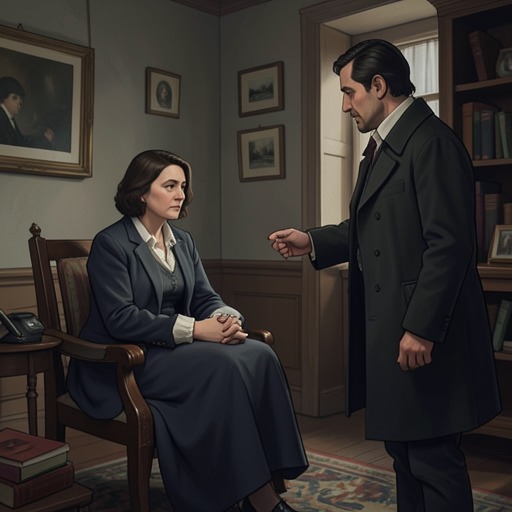
The narrator says that her husband is careful and loving, yet he hardly lets her move without special direction. A schedule assigns her an activity for every hour, and he takes care of decisions for her. She feels guilty for not valuing this care enough, but also tired from having to control her anger in his presence. Care and restriction thus occupy the same relationship: his attentiveness is real as she describes it, while the regimen leaves little room for her own judgment or unplanned movement.
Care, Permission, and the Refusal of Change
Her husband says that the couple came to the house solely for her benefit, so she could have perfect rest and as much air as possible. He makes exercise dependent on her strength and food partly dependent on appetite, but air is available continuously; on this reasoning, they take the nursery on the top floor. The language of treatment transforms a choice about where she will live into a prescription made for her health. Its apparent generosity—air, rest, sunshine—does not give her control over the room or the terms of her recovery.
The wallpaper becomes a test of whose judgment governs the domestic space. Her husband first intends to replace it, but changes his mind, saying that indulging her dislike would make the wallpaper get the better of her. He predicts that once it is changed, she will object next to the heavy bedstead, the barred windows, and the gate at the head of the stairs. Renovating the room is dismissed as unreasonable for a three-month rental, and her request to move downstairs receives no satisfaction. This sequence treats her objections not as evidence that her surroundings may be wrong for her, but as a chain of fancies that must be denied before they multiply.
The structure of the room sharpens that denial. Barred windows, a gate at the top of the stairs, and a bed too heavy to move make freedom a question of physical passage, not merely a matter of feeling. The narrator later locks the nursery door when she creeps in daylight and throws the key into the front path when she intends to keep anyone from entering. Her acts of control do not dissolve the barriers; they temporarily reverse who controls access to the room.
The Wallpaper's Captive and Its Bars
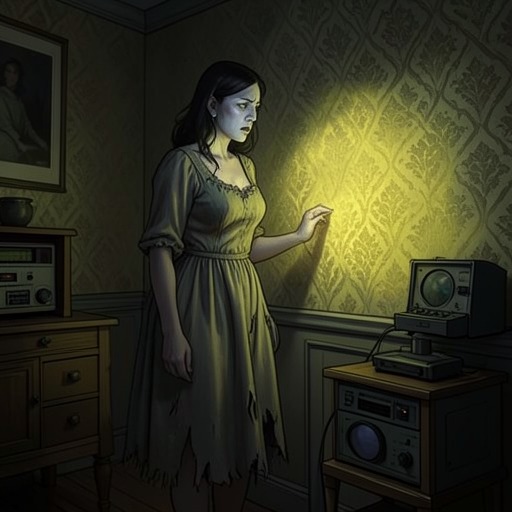
At night, the wallpaper seems different from its daytime appearance. In twilight, candlelight, lamplight, and especially moonlight, the outside pattern becomes bars, with a woman visible behind it. During the day, the woman is subdued and still; the narrator imagines that the pattern keeps her quiet. The vision gives the room’s material restrictions a second form, turning the wallpaper into an image of captivity that can be seen only by watching closely across changing light.
The narrator’s account of the woman’s struggle develops into a repeated scene of attempted escape. In the shady parts of the pattern, the woman grips the bars and shakes them; she is continually trying to climb through. But the pattern seems to strangle anyone who gets through, turning the figures upside down and making their eyes white. The narrator sometimes sees many women behind the pattern, sometimes only one. This uncertainty does not lessen the force of the image: either way, the wallpaper’s order appears to hold women in place and punish the effort to cross its boundary.
A long, low mark around the room gives the pattern a material counterpart. The narrator observes that the even streak runs behind every piece of furniture except the bed, as if something had been rubbed repeatedly around the walls. She wonders who made it and why. The mark is not explained, but its position and repetition make the room seem to record circling movement. Alongside the barred windows and damaged surfaces, it concentrates the story’s concern with bodies moving within limits, leaving traces without finding an exit.
Secrecy, Reversal, and the Limits of Escape
The narrator’s own movements begin to echo those she attributes to the woman. She imagines the figure creeping along a road under the trees and hiding beneath blackberry vines when a carriage passes. The narrator says that she locks the door when she creeps by daylight, because she cannot do so at night without making her husband suspicious. The image of the captive is no longer only something she studies: it becomes a pattern for action, carried out privately within the room.
Secrecy also turns the narrator’s isolation into a struggle over who may approach the wallpaper. She does not want her husband to be irritated and wishes he would take another room, but she also says she does not want anyone except herself to get the woman out at night. Her attention to the figure becomes an objective around which she organizes access and concealment. The narrator even wonders whether she could see the woman from all the windows at once, making the room’s many openings part of her surveillance rather than simply a source of air.
Near the end of the supplied action, she locks the door, throws the key into the front path, and waits for her husband’s arrival while trying to keep everyone out. She has hidden a rope that her husband’s sister has not found, intending to tie the woman if she escapes. The plan is bound to a contradiction: the narrator imagines herself as the woman’s rescuer and possible captor at once. Her control remains compromised by the room’s material resistance. The bed will not move; pushing and lifting it leaves her lame, and biting a corner hurts her teeth. She tears down only the wallpaper within reach while standing on the floor, and the pattern, in her perception, seems to mock her effort.
The barred window makes the outer limit explicit. The narrator considers jumping as exercise, but says the bars are too strong even to try; she immediately rejects the idea as improper and liable to be misconstrued. The moment joins physical prevention to an internalized rule about what a woman may do and how her actions will be judged. Across the story, autonomy appears neither as a simple freedom granted by escape nor as a purely inward state. It is a contested capacity to choose a room, move without permission, interpret one’s experience, and act upon one’s surroundings—capacities that the nursery’s locks, bars, prescribed schedule, and immovable furniture repeatedly put under pressure.