Clay Jensen
Thirteen Reasons WhyClay Jensen is the recipient and listener whose grief gives Hannah Baker’s recorded account its living present. The story begins for him with a package at his front door and the discovery that he is on Hannah’s list; it ends, not with the past repaired, but with Clay turning toward Skye Miller when he recognizes her retreat. His trajectory is shaped by the difference between knowing someone through secondhand praise and meeting her in the intimacy she says she wanted—and by the possibility that attention, offered now, may still matter.
Identity and Introduction
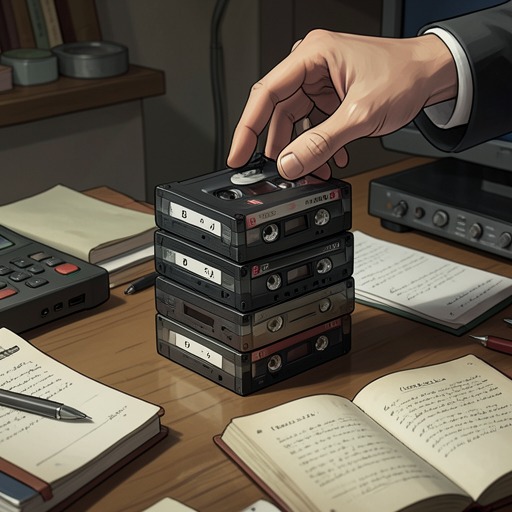
Clay first encounters the tapes as a physical delivery addressed to him. A shoebox-sized package has been left at the front door because it cannot fit through the mail slot. Inside, beneath a tube of bubble wrap, he finds seven loose audiotapes. Their dark-blue side numbers establish a sequence: the first tape contains sides one and two, the numbering continues across the set, and the last tape is marked thirteen on one side only. What looks like a package becomes a tightly ordered account with Clay positioned as one of its intended listeners.
Hannah’s recorded voice makes that position explicit. She says that she will tell the story of her life, more specifically why her life ended, and that anyone listening is one of the reasons. Clay’s response is immediate disbelief at Hannah’s suicide. The tapes therefore introduce him through a collision: he is an ordinary recipient holding a set of recordings, but the voice inside assigns him a place in the story of a death he cannot undo.
Clay also discovers that the package is accompanied by a map. Weeks earlier, shortly before Hannah took the pills, someone had slipped an envelope through the vent of his locker. The red felt-tip warning, SAVE THIS—YOU’LL NEED IT, marked the envelope as something to keep; inside was a city map with about a dozen red stars and small blue numbers corresponding to business names in the margins. The tapes and map together make Hannah’s account both a story to hear and a route through places around town.
Listening and the Shape of Memory
Clay’s experience of the tapes is not only retrospective. He listens from the present, where Hannah’s story is already fixed, and repeatedly feels the wish to intervene in what he hears. At Monet’s, for example, Hannah recalls an earlier conversation with Alex Standall. Clay wants to press Stop on the Walkman and rewind their exchange, to return to the past and warn them or keep them from meeting. The device offers a literal image for his impossible wish: a recording can be stopped and replayed, but the event it preserves cannot be rewritten.
That distinction gives Clay’s listening its painful force. The tapes make the past audible in detail while withholding any power to change it. He can learn how one encounter led toward consequences that neither person could yet see, but he cannot step into the scene and redirect it. His attention arrives after the fact, and every new piece of Hannah’s account enlarges both his understanding and his sense of helplessness.
The story’s recorded form also makes Clay a participant in Hannah’s planned sequence rather than a detached audience. He is listening because he has received the package, and Hannah tells listeners that their names will appear as the account proceeds. The numbering, the recorded voice, and the map frame his understanding as a chain of revelations whose order he cannot simply choose. Clay’s central task is to stay with the account even when what it reveals makes him want to stop, rewind, or deny what he has heard.
Hannah and Clay
Clay’s connection to Hannah is marked by a distinction between the person he hoped to know and the person he actually knew. Hannah says there was never a moment when she decided that Clay was the one. She explains that she was not sure how much of the real Clay she had come to know; much of what she knew came from secondhand information. Yet that same information was consistently good, and it made her want to know him better. Her account gives Clay a place in her story without pretending that their relationship was fully formed or fully understood.
One remembered moment makes that unrealized closeness more concrete. Hannah describes Clay letting her connect with him, then lightening the conversation when she could no longer continue in the same vein. He made her laugh; she calls him hilarious and says he was exactly what she needed. She says that she kissed him. The exchange is followed by a correction—Clay says that he kissed Hannah—and the memory settles on a long, beautiful kiss. The small disagreement over who initiated it does not cancel the shared intimacy; instead, it preserves the moment as something both of them claim from different sides.
For Clay, hearing Hannah describe what she needed turns the kiss into more than a memory of attraction. It reveals a version of their encounter in which his humor and willingness to stay with her mattered to her. But that knowledge reaches him only through the tapes, after Hannah is gone. The tenderness of the memory therefore carries an absence within it: he can hear that he had offered something she valued, while being unable to return to the conversation or discover what might have followed.
Grief, Recognition, and Change
Clay’s response to Hannah’s account is physical as well as emotional. When Tony calls to him over the engine, hearing his own name intensifies the pain in Clay’s head and sends an agonizing twist through his heart. That reaction sits beside Hannah’s account of wanting to know him better. The distance between those two experiences—her knowledge of him as a person worth knowing, and his later knowledge of her through her recorded testimony—makes the tapes a source of grief as much as information.
Near the end, the school corridor links Hannah’s disappearance to Clay’s next choice. He remembers watching Hannah slip away into a crowd of students two weeks earlier, leaving the tapes to say goodbye in her place. Now Skye Miller walks down the same stretch of hall, and her footsteps seem to grow weaker as she moves farther away. Clay starts walking toward her. The action is small and does not erase what happened to Hannah, but it breaks the pattern of simply watching someone recede.
As he passes Mr. Porter’s open classroom door, Clay sees the empty desk that has remained empty for two weeks and will remain so for the rest of the year. His own desk is also empty, but only for one day. The contrast makes Hannah’s absence permanent and his own withdrawal temporary. Dozens of faces recognize him without seeing everything he carries; Mr. Porter is turned away but beginning to turn. In that charged instant Clay feels pain and anger, sadness and pity, and, most unexpectedly, hope. His movement toward Skye gives that hope a concrete direction without claiming that either of them is already safe or healed.
Narrative Role and Significance
Clay’s role binds the recorded past to the unresolved present. The tapes reach him as a numbered physical object, direct their account toward him, and make him confront how little he understood while Hannah was alive. His wish to rewind the conversation at Monet’s expresses the listener’s desire to intervene in a story already complete; the unalterable sequence of the recordings keeps that wish from becoming a fantasy of repair.
The final movement toward Skye offers a quieter alternative to rewriting history. Clay cannot retrieve Hannah from the crowd or revise what led to her death, but he can choose not to repeat the posture of watching someone disappear without responding. The novel leaves that choice at its beginning rather than its conclusion: Clay walks toward Skye and feels hope, while the empty desk remains. His significance lies in that unresolved tension between irreversible loss and the still-open possibility of noticing someone in the present.