Courtney Crimsen
Thirteen Reasons WhyCourtney Crimsen is introduced through the tension between her immaculate public image and the harm she causes Hannah Baker. She is described as pretty and widely regarded as nice, and Hannah initially thinks they may be becoming friends. But that apparent warmth gives way to betrayal: Courtney invents a sexualized story about Hannah, helping turn an admired reputation into a source of isolation. At a later party, Courtney briefly reappears in the chain of events surrounding Hannah’s assault, then leaves; the narrative does not establish what she knows or why she goes. Her role is therefore not simply that of a conspicuous antagonist, but of someone whose carefully managed likability coexists with a consequential act of cruelty and a striking absence at a moment when Hannah needs support.
Identity and Public Image
Hannah’s first description of Courtney is organized around repeated signs of polish: a pretty name, hair, smile, and skin. She is also called very nice, with everyone apparently sharing that judgment. The portrait conveys not only physical attractiveness but social ease: Courtney is recognized as someone who wins approval wherever she goes.
Hannah grants that Courtney could have taken a harsher approach and still had friends and boyfriends, but instead chose sweetness so that people would like her and no one would hate her. This is Hannah’s reading of Courtney’s social manner, not an independently confirmed account of Courtney’s motives. Its importance lies in the contrast it draws between niceness as a public reputation and kindness as conduct. Courtney’s approachable image makes Hannah’s later discovery of the rumor feel less like an ordinary disagreement than a betrayal of the friendliness she believed she was receiving.
A Friendship That Does Not Take Hold
A photograph in Hannah’s scribble book captures Hannah with an arm around Courtney’s waist at a party. Hannah looks happy; Courtney appears nervous. The image leaves the reason for Courtney’s expression unexplained, and Clay Jensen, looking at it, cannot say that he remembers seeing the two girls spend time together. The photograph thus preserves the appearance of closeness without establishing how deep or lasting their relationship was.
Hannah nevertheless recalls thinking that she and Courtney were becoming friends. She says she does not hate Courtney and does not even dislike her, a qualification that keeps the account from reducing their history to simple enmity. In retrospect, however, Hannah believes Courtney was cultivating her as another person who would think Courtney was a very nice girl: another assured vote for Most Liked in the senior yearbook. Friendship, in Hannah’s interpretation, becomes part of Courtney’s strategy for maintaining approval. The difference between Hannah’s hopeful reading and her later suspicion gives their brief connection its particular sting.
The Rumor and Its Consequences
Courtney’s clearest harmful action is the false story she tells about Hannah. Hannah recalls that Courtney told a boy, and others within earshot, that Hannah had sexual surprises hidden in her dresser drawers. Hannah identifies the claim as entirely invented. Its sexualized content turns private space into an imagined spectacle and gives listeners a degrading story to repeat, while Courtney’s standing as the sweet, well-liked girl lends the accusation social force.
The episode marks a sharp reversal in how Hannah understands Courtney. The girl she had regarded as a potential friend becomes someone who uses the authority of a respectable public image to spread a lie. Hannah’s account connects Courtney’s betrayal to the wider damage done by rumor and reputation: a fabricated claim does not remain a private insult but contributes to the hostile social identity imposed on Hannah. The evidence establishes Courtney’s statement and Hannah’s distress; it does not establish how widely the rumor traveled or what Courtney privately intended beyond the interpretation Hannah later gives it.
Recurrence at Courtney’s Party
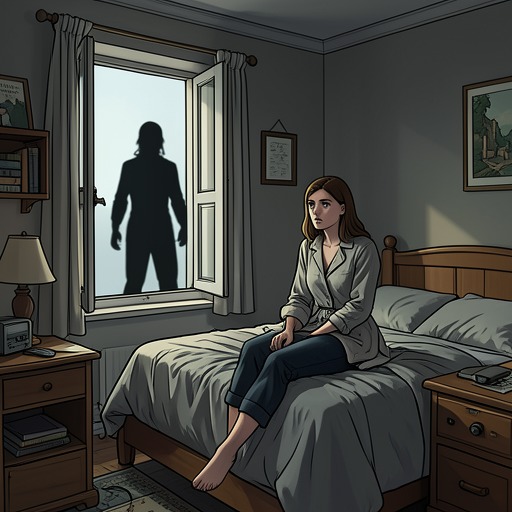
Courtney’s house returns as a setting when Hannah reaches the party after initially being left without anyone to talk to. Hannah describes Courtney appearing beside a boy who invites her to join the group as they sober up. The coincidence is pointed: Courtney had used Hannah as a chauffeur to get to a party and then left her stranded, and now Hannah finds herself at Courtney’s house, where Courtney cannot avoid her.
Yet Courtney is not the focus of the party episode. Hannah explicitly says the tape is not about Courtney, even though Courtney plays a part, and notes that Courtney leaves just as events begin to unfold. Hannah then turns away from the house. This limitation matters: the account places Courtney at the threshold of the later crisis but does not make her a witness to what follows. Her departure repeats, in a different context, the gap between physical proximity and meaningful companionship; it cannot by itself establish what she understood about Hannah’s condition.
Narrative Significance and Limits
Courtney’s characterization rests on a recurring contrast: admired sweetness against a demonstrably cruel falsehood, and apparent closeness against the failure of a friendship to become dependable. The photograph, Hannah’s recollection of a possible friendship, and the later account of the rumor show how social reputation can disguise the difference between being liked and treating another person well. Courtney’s role also illustrates how a single invented story can participate in a broader climate of objectification without making her responsible for every harm that Hannah experiences.
The narrative gives Courtney no direct explanation or response to Hannah’s accusations. Her inner motives remain unavailable, and the party scene leaves the reason for her departure unstated. That asymmetry keeps the portrait anchored in what Hannah reports and what Clay can observe: a girl publicly associated with niceness, a betrayal Hannah names plainly, and a later moment in which Courtney is present only briefly before leaving. The result is neither a complete account of Courtney’s character nor an exoneration, but a portrait of the distance between social approval and the care that a friendship would require.