Crashed parking sign
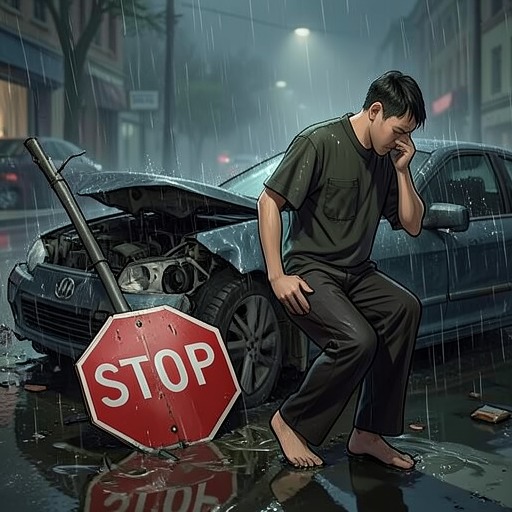
Thirteen Reasons WhyThe fallen Stop sign is a damaged piece of roadside equipment that becomes the tangible link between Jenny Kurtz’s reckless decision and a fatal accident. Knocked from its wooden post on a rainy night, it leaves an intersection unmarked; afterward, the sign’s absence helps explain why one driver died, while the people who know how it happened remain silent. In Hannah Baker’s account, the sign is not merely wreckage: it is the material record of a preventable consequence and of her own failure to stop Jenny from leaving.
The sign before the collision
On the night of the accident, the sign stood on a wooden post at a corner two blocks from the party. It was not the reflective metal sign Hannah later sees in its place: the sign that night had nonreflective letters and had been fastened to wood. The difference matters because the later, intact sign can make the earlier gap in the road’s warnings seem almost impossible to imagine. Hannah recalls that, for part of that night, the corner had no Stop sign at all.
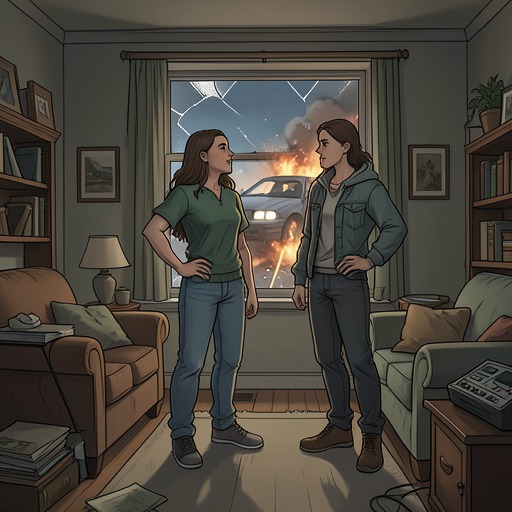
The sign’s destruction begins when Jenny’s car strikes the wooden post. The front wheel on Hannah’s side jumps the curb, and the post hits the front bumper before snapping. The Stop sign then falls backward in front of the headlights, catches beneath the car, and scrapes along the underside as Jenny brakes. Sparks scatter onto the road while the car slides to a stop. In the immediate moment, the collision is a frightening jolt, but the sign has not yet become, for the people in the car, the cause of a death.
Jenny leaves it behind
Hannah tells Jenny to park and proposes that they get a ride home from someone at the party, then return for the car in the morning. Jenny refuses to treat the damage as a reason to stop driving. She argues that people roll through Stop signs anyway, and that with the sign down it will be legal for them to do so. Her joke recasts a missing warning as an advantage, even as Hannah urges her again to pull over.
When Hannah does not take further action, Jenny reverses the car; Hannah jumps back to keep the door from knocking her over. The metal sign grates against the underside of the car as Jenny clears it. Once free, it lies at Hannah’s feet, warped and streaked with silver scratches. Jenny revs the engine and drives away, leaving Hannah on the curb beside the fallen sign. The object records both parts of the episode: the damage Jenny caused and her decision to depart rather than remain and deal with it.
Hannah later measures her own inaction against the choices she might have made. She thinks she could have taken Jenny’s keys, or taken her phone to call the police, and insists that calling for help was the action that would have mattered. Jenny gets home in one piece, but Hannah’s account makes clear that this does not resolve the danger: the sign remains down at the intersection. Its significance shifts from a damaged object beside the car to an absent safeguard on the road.
The missing warning and the fatal accident
The intersection is marked on Hannah’s map as B-6. Two blocks from the party, the missing sign leaves one direction of the crossing without its usual instruction on a rainy night. A pizza delivery driver is trying to make time while another driver, traveling in the opposite direction, turns. Hannah identifies the missing Stop sign as part of the circumstances of their collision, in which one driver dies. The sign does not by itself establish every detail of the crash, but its absence supplies the crucial context connecting Jenny’s departure to the fatal event.
At first, neither the people involved in Hannah’s story nor the police know who caused the accident. Jenny knows what happened at the corner, as does Hannah; Hannah adds that Jenny’s parents may also know, because Jenny’s bumper was repaired very quickly. The repair becomes a further trace of the night, but not a public account of it. The sign’s fall is therefore consequential in two ways: it removes a warning from the road and leaves behind a secret that those who could explain the danger do not disclose.
Hannah never knew the dead driver. He was a senior, and she recognized him only after seeing his picture in the newspaper. She did not attend his funeral. Her recognition of the absent sign’s role comes alongside the belated recognition that a stranger’s death was connected to a choice made near the party—and to her own failure to keep Jenny from driving away. The sign gives that realization a physical point of reference: once bent and scraped beneath a car, then missing from the corner where it was needed, it makes an unseen chain of responsibility visible without making Hannah’s regret reversible.
What the object makes visible
The episode is narrated retrospectively, so the sign’s meaning unfolds after its physical fall. At first, the stop is a jolt, sparks, and a car halted in the rain; only later does Hannah connect the empty corner to the fatal crash. This delayed recognition turns the sign into a hinge in the account: the reader moves from a reckless drive to a death whose cause was initially unknown, while the sign’s temporary absence supplies the connection between them.
The object also concentrates the contrast between warning and response. Hannah repeatedly tells Jenny to stop driving, but her pleas do not become effective intervention; after Jenny leaves, the sign itself—the literal roadside signal to stop—is also gone. The result is not that the sign alone explains the death, but that the narrative sets a disregarded human warning beside a missing traffic warning. In that pairing, the bent metal at Hannah’s feet marks the point where a private act of negligence becomes a danger shared by people who never knew the sign had fallen.
The sign’s force finally lies in the gap between what can be repaired and what cannot. Jenny’s bumper is fixed quickly, and a replacement sign eventually stands at the intersection, but neither repair restores the lost driver or erases the concealed history of the crash. For Hannah, remembering the warped sign means remembering that the accident was not an unknowable event: she and Jenny knew the corner had been left without its warning. The object remains a small, concrete measure of how a choice made in the aftermath of one collision helped expose strangers to another.