Hanna's map
Thirteen Reasons WhyHannah Baker’s map is both a guide to places named on the tapes and a tangible measure of how Hannah’s message occupies Clay Jensen’s present. Hidden for weeks beneath his books, the city map returns as he listens, turning its red stars into directions through the story and eventually becoming an object Clay can no longer bear to carry.
A message hidden in the locker
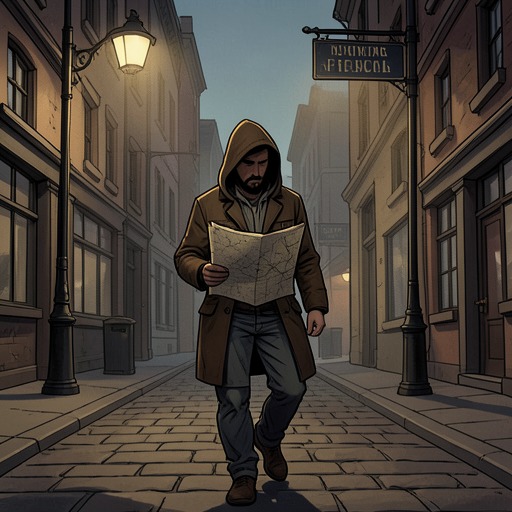
A few weeks before Hannah took the pills, an envelope was slipped through the vent of Clay’s locker. Written across it in red felt-tip marker was the instruction “SAVE THIS—YOU’LL NEED IT.” Inside was a folded city map marked with about a dozen red stars. The map was ordinary in form: Clay remembered similar chamber-of-commerce maps from elementary school, used to teach north, south, east, and west, with small blue numbers keyed to business names in the margins. But the red stars gave this familiar object a private purpose he could not yet understand.
Clay kept the map in his backpack, intending to show it around school and find out whether anyone else had received one or knew what it meant. Instead, it slipped beneath his textbooks and notebooks, where he forgot it. The delay matters: the map had arrived before Clay understood the tapes, but its significance stayed concealed until Hannah’s recorded voice called attention to it. Recalling the object’s hidden place in his bag, Clay recognizes that he is on Hannah’s list and that the forgotten envelope was meant for him after all.
Directions through the taped story
Hannah explains that listeners can visit the city locations she mentions by following the stars on the map. The directions are optional, but they promise additional insight; throwing the map away is presented as an equally available choice. This makes the object more than an illustration of where the story happened. It offers each listener a route from recorded testimony into the city itself, while leaving the decision to follow that route in the listener’s hands.
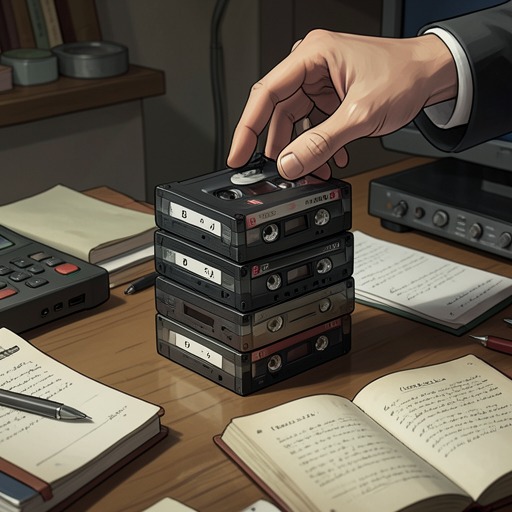
The map joins a carefully ordered set of physical instructions. Hannah’s tapes are numbered by side, and listeners are told to hear all thirteen sides, rewind them, put them back in the box, and pass them to the next person. She warns that copies exist and will be released publicly if the package fails to reach everyone in the chain. Against that sequence of listening, rewinding, and passing on, the map supplies a different kind of navigation: the tapes direct the listener through Hannah’s account, while the stars point toward places around town. Together, the recordings and the map make remembrance procedural as well as emotional—something Clay must carry out in a particular order, with objects that can be hidden, handled, and passed along.
Clay’s memory of the map’s physical weight sharpens this connection. As he hears Hannah’s voice through dusty speakers, he feels his backpack pressing against his leg and remembers that the map is crushed somewhere at the bottom. The tape is speaking from a distance, its voice carried by an old playback system; the map, still inside the bag, is close enough to press against him. One medium makes Hannah audible, the other gives her directions a material presence against Clay’s body.
Stars, places, and remembered scenes
The stars acquire specific meaning as Clay moves through the places Hannah identifies. At the party on Cottonwood, Hannah names the map’s conspicuous red marker: a large, completely filled-in star marked C-6, locating the party at 512 Cottonwood. The map turns the address into a deliberate landmark within the taped account. Its star does not explain what happened there by itself; it marks the place where Hannah’s narration will assign the experience its context, and warns the listeners that their own place in the story will be disclosed in sequence.
Elsewhere, the map’s guidance becomes unnecessary because Clay already knows where to go. At the intersection where Tony turns left, Clay turns right toward the stop sign, saying that the next star is only two blocks away and that he knows exactly where it is. His movement shows how far the directions have entered his understanding: the map first supplies a way to find the sites, but the tapes have taught him the route well enough to navigate from memory.
The map also accompanies Clay’s retrospective reconstruction of Hannah and Courtney Crimsen. When he unfolds it on a small table, he recalls the day after Tyler Down took candid photographs of students. Courtney arrives late to first period, as usual, and the teacher has not yet arrived either. Clay taps Courtney on the shoulder; when she looks at him, they begin to laugh and speak in short phrases, as if expressing the same thoughts. The map’s reappearance beside this recollection places it within the process of revisiting events: it is not only a city guide but part of the physical setting from which Clay listens, remembers, and connects locations to people.
The map crumpled and left behind
After Jenny Kurtz’s car strikes the stop sign, Clay remembers walking out of his way for weeks to avoid Hannah’s old house and the pain associated with his one night with her. When Jenny tells him the police have been called, he is shocked that she has actually reported the accident. He takes the map from his backpack and unfolds it for one last look. Then he learns she did not call the police after all. He crumples the map into a ball the size of his fist, stuffs it deep into a bush, and walks away.
The gesture reverses the map’s earlier function. Hannah had offered it as a route toward greater understanding, and Clay had carried it through his listening, even when it lay forgotten under his books. At the stop sign, it can no longer serve simply as a guide: the accident and Jenny’s decision have made the place an immediate moral and emotional burden. Clay does not merely put the map away; he crushes it and abandons it. At school the next day, he learns who called the police, but the map has already been discarded. Its disappearance marks a break between following the route and withdrawing from what the route has brought him to see.
Object, structure, and return
Near the end of the book, Clay presses his forehead against a locker and thinks that everything began a few weeks earlier, when a map slipped through the vents of his own. The object thus frames the listening experience: first a message arrives through a narrow opening, then the map is rediscovered, used to connect stories to places, rejected after Jenny’s accident, and finally remembered as the beginning of the chain. Its route through concealment, use, destruction, and recollection gives the story a material arc distinct from the tapes’ prescribed circulation.
Hannah’s map also makes absence navigable without resolving it. The stars identify places Clay can reach, but they cannot return Hannah or settle every uncertainty her stories leave behind. Its worn, folded, and finally crumpled presence keeps the difference visible between hearing testimony and acting in the world it describes. By the time Clay recalls the locker vent, the map has become both a practical artifact of Hannah’s instructions and an image of the delayed understanding that brought him to them.