Hannah Baker's former house
Thirteen Reasons WhyHannah Baker's former house is the first home she lived in after arriving in town, and the place where Clay Jensen returns while listening to her account of the past. First remembered as a summer setting for a possible new friendship, it becomes a physical point of contact between Hannah’s early days, the chain of events Clay retraces, and his grief over her death. Its bay window and driveway preserve not only a location but the outline of a meeting that might have changed what followed.
Setting and Early Memories
Hannah and her family lived in the house for only a short time, during the summer before her freshman year. It was their first home in town, and Hannah remembers it as the place where she first saw Justin Foley. School was still two months away; her next-door neighbor, Kat, was the only person she knew. From that position of newness, the house looks outward toward a social world Hannah has not yet entered: Kat already knows Justin, and tells Hannah that he had been interested in her the previous school year.
The front bay window gives this memory its defining vantage point. Hannah and Kat sit there talking for hours, looking out toward the street. The house is not merely where Hannah lived; it is where she watches other people approach, before she knows how consequential their arrival will become. The scene’s small domestic frame holds an early uncertainty: Justin’s earlier attention to Kat may have been accidental, but from Hannah’s perspective it becomes part of the story of how she first encountered him.
The Street and a Near-Miss
In Hannah’s recollection, Justin walks up the road with Zach Dempsey. Two streets meet in front of the house in an upside-down T, and the boys approach along the middle of the road. The bay window places Hannah and Kat inside as observers; the street and the wet grass outside become the threshold between watching and meeting. Justin and Zach step off the road onto the grass, slip, and tumble over each other before reaching the house.
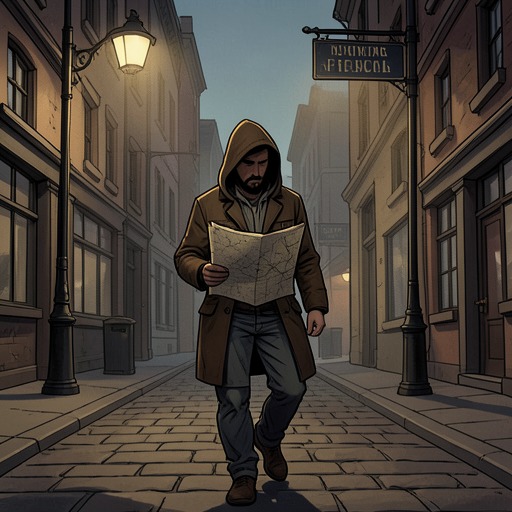
That awkward approach later takes on the force of a missed possibility. On his return, Clay follows the route Hannah described, walking down the center of the road toward East Floral Canyon and the intersection shaped like an upside-down T. At the curb he presses the toes of his shoes against it, steps onto the grass, and stands there. The action is deliberately simple: where the two boys slipped, Clay makes an ordinary step without falling. The physical difference prompts him to imagine a different first encounter—whether Hannah might have fallen for Zach instead of Justin, whether Justin might have disappeared from the picture, and whether the rumors might never have begun. He extends that chain of speculation to the starkest possibility, asking himself whether Hannah might still be alive. The house cannot answer; its unchanged approach only gives his counterfactuals a place to gather.
Clay’s Return
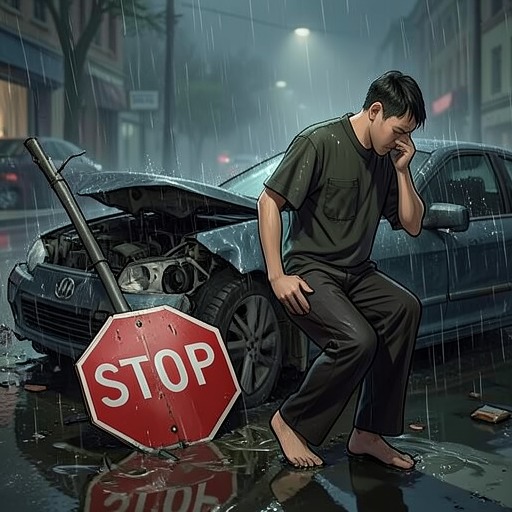
The former house is one of the destinations marked on Hannah’s map. When Clay finds its first red star, the recognition brings disbelief: he has been there before, after a party, but had not understood its connection to Hannah. An elderly couple now lives in the house. Clay remembers a night about a month earlier when the husband, driving a few blocks away while speaking to his wife on the phone, hit another car. A small crowd had gathered around the badly injured student from Clay’s school. Clay asked some people to stay with the student until an ambulance arrived, then hurried to the house to calm the driver’s wife. Only afterward does he recognize that he had been racing toward a place Hannah once lived.
The earlier visit and the later walk give the house two different meanings in Clay’s experience. The first is an accidental crossing of paths: he comes there because of a car crash and the need to reach the driver’s wife. The second is a deliberate return, made with Hannah’s description in mind. He walks toward the intersection, sees the bay window’s curtains closed for the night, and imagines the summer scene behind it. The present house belongs to other residents; the image Clay carries is of Hannah and Kat watching the boys approach. What the address offers him is not access to Hannah, but a route through the difference between a place he once passed and a history he now understands.
The Driveway and the Vanishing Image
Clay also remembers the house from the sidewalk, where the driveway climbs a gentle slope and disappears beneath a weathered wooden garage door. Hannah rode a blue bike to school after arriving in town. In Clay’s reconstruction, she comes down that driveway with her backpack on, coasts past him, and pedals along the sidewalk past trees, parked cars, and houses. The image is intimate but explicitly imagined: Clay can almost picture her, then watches that image disappear down the street.
The sequence ends not with a reunion but with absence. Clay stands watching until Hannah’s image vanishes, turns slowly, and walks away. The house remains occupied, its curtains shut, while the remembered rider belongs to a past Clay cannot enter. The repeated act of returning in imagination makes the residence a vessel for both a concrete memory of Hannah’s first summer and a grief sharpened by what cannot be known. At its curb, a difference as small as slipping or standing becomes, for Clay, the measure of how much he wants to believe that another beginning might have led elsewhere.