Hannah Baker’s loss of privacy and security
Thirteen Reasons WhyHannah Baker’s loss of privacy and security is the lasting consequence of Tyler Down photographing her inside her bedroom while her parents are away. The breach changes more than what she can see through a window: it makes her home feel vulnerable, takes away the private space in which she expected to be safe, and leaves her managing fear by closing herself off. Later encounters show that the loss of control over her own boundaries reaches beyond the house, while the narrative’s recurring concern with whether others notice or respond gives that private violation a wider significance.
The bedroom breach
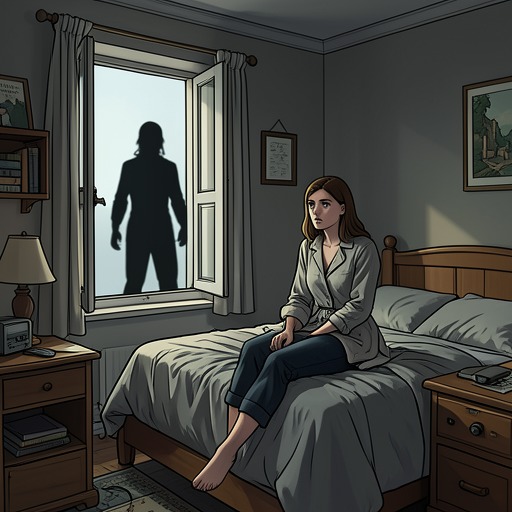
On the first night of her parents’ vacation, Hannah goes inside alone, washes her face, brushes her teeth, and steps into her room. A camera clicks. She keeps the window open an inch or two for fresh air, and that small opening tells her someone is outside. The ordinary sequence of getting ready for bed is abruptly altered: the bedroom, which should be private, has become a place where an unseen person might be watching and photographing her.
Hannah initially tries to deny what the sound means, telling herself she is only frightening herself because she is getting used to being alone. She pulls the blankets over herself and changes into pajamas as slowly as possible, afraid another photograph might be taken. She considers whether another picture could prove the intruder is there and allow her to call the police, but her parents are absent and she is afraid the person outside might see her reach for the phone. She decides that ignoring him is her best option—not because she feels safe, but because she cannot predict what might happen if she acts.
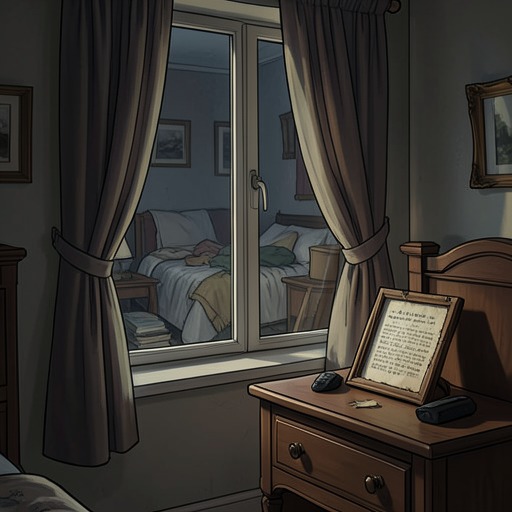
The story also answers the suggestion that the intrusion was simply caused by carelessness. Hannah says her blinds were angled the way she liked them; from her pillow, she could watch stars on clear nights and lightning in storms. The window’s narrow opening for fresh air and the blinds’ familiar position had belonged to ordinary comfort, not an invitation to be seen. The breach turns these domestic details against her: what had made the room pleasant now marks how someone could intrude upon its privacy.
A home remade by vigilance
After Tyler stops coming around her house, his presence nevertheless remains with Hannah. She twists the blinds shut every night, shutting out both the stars and the lightning, then turns out the lights and goes to bed. This repeated change is the clearest measure of the intrusion’s afterlife. The camera’s click occurs once in the scene, but its consequence recurs nightly: Hannah’s former way of inhabiting her room is replaced by a defensive routine.
Her account names what has been taken directly: her house and bedroom were supposed to be safe from what was outside, and Tyler took that sense of safety away. She asks him to consider whether security and privacy matter to him, insisting that their value is not his to decide. The question makes the harm more than a disagreement over the importance of a window or a photograph. Hannah describes a loss imposed on her, then challenges the person who caused it to recognize a boundary whose importance he had no right to dismiss.
The narration’s return to the window and the closed blinds gives this loss a particular shape. The blinds once allowed Hannah to look outward at the night while remaining sheltered inside; afterward, she closes them to keep the outside from looking in. The same room remains physically hers, but its relationship to the world has changed. Safety is no longer assumed; it has to be guarded, and even guarding it costs her a source of comfort.
Privacy beyond the window
The consequences of this breach resonate with later scenes in which Hannah’s control over her body and choices is at issue. During an intimate encounter with Clay Jensen, she tells him to stop, and her hands stop pulling him toward her. Later, she recalls turning her head, clenching her teeth, and fighting back tears during another encounter, while the man touching her sees her distress and tells her to relax. These moments are not the same as Tyler’s act of photographing her, but they extend the narrative’s attention to boundaries: Hannah’s own signals and reactions matter, even when another person fails to respond to them.
When she speaks with Mr. Porter about the later encounter, Hannah is uncertain whether what happened might be considered illegal and answers that she does not think so. Mr. Porter offers the possibility of confronting the boy and discussing what happened at the party, or moving on. The scene does not establish a legal conclusion; it shows Hannah trying to describe an experience whose classification she herself questions, and a conversation that frames her next steps as limited alternatives. In this context, the earlier loss of security at home is part of a broader pattern of having to navigate violations and their aftermath without a dependable sense that others will protect her boundaries.
Signs, recognition, and response
Hannah’s account also sits beside the story’s repeated question of how distress becomes visible to other people. In Mrs. Bradley’s class, students can leave anonymous notes in a paper bag for comments on the teaching or suggestions for discussion. Hannah writes a note saying she has been thinking about suicide, though not too seriously, and rewrites it dozens of times before delivering it. The class does discuss suicide, but the discussion turns to local statistics and the reasons deaths may go unreported or be mistaken for accidents; a thorough conversation does not follow. The scene’s distinction between a sign being present and help actually reaching someone echoes the bedroom incident: an experience can be real and consequential even when others do not see its full meaning.
Other details in the narrative sharpen that contrast between disclosure and recognition. Hannah gives Tony her bicycle because she is done with it, without giving him a reason; he later identifies the gift as a sign he missed. At the rocket slide, she says she needs everything to stop, including people and life, and the narration makes explicit that she wants Mr. Porter to notice and help. These moments do not erase the specific harm of Tyler’s intrusion, but they show how privacy, safety, and being understood are connected in Hannah’s story: she can be watched without being protected, and she can communicate distress without receiving the response she hopes for.
The bedroom’s changed routine remains the most concrete expression of the loss. Hannah once fell asleep looking at the night sky; after Tyler’s visits, she closes the blinds and turns out the lights. That reversal gives the violation a continuing consequence without reducing her later experiences to a single cause. Her home is no longer simply a shelter from the world. It is the first place where the story shows that her privacy can be taken, her safety unsettled, and the burden of adapting left to her.