Hannah Baker’s suicidal thoughts
Thirteen Reasons WhyHannah Baker’s suicidal thoughts are presented as a developing state that moves from thoughts she repeatedly tries to dismiss toward a plan with a stated deadline, then toward one last attempt to seek help. Her account resists a single-cause explanation: the thoughts recur amid a wider accumulation of painful experiences, while the people around her receive fragments of warning without consistently recognizing their urgency. The record of those fragments—the carefully rewritten note, the relinquished bicycle, and direct words spoken to adults—makes the distance between signaling distress and being helped central to the subject.
Early Thoughts and the Unsent Signal
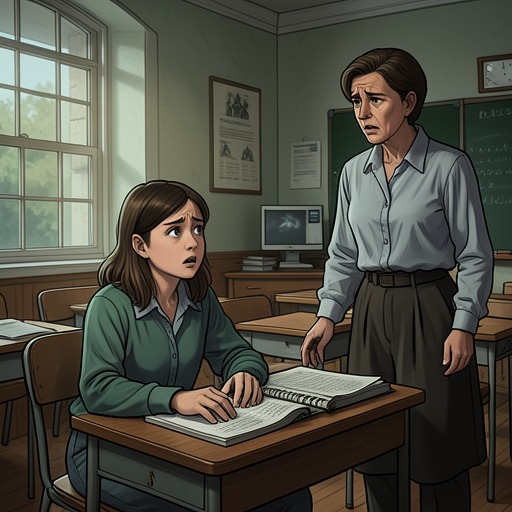
In class, Mrs. Bradley keeps a paper bag on the spinning bookrack for students’ notes about her teaching and suggestions for future discussion topics. Hannah uses this ordinary classroom channel to propose suicide as a subject. Her note says she has been thinking about it, though not too seriously. She rewrites the message dozens of times, discarding and crumpling successive versions before delivering it. The repeated drafting gives the note a significance beyond its brief wording: she is trying to put a private thought into circulation while controlling how much of herself it reveals.
Hannah later says the note’s claim was not literally true in the way it sounded. She had not been considering suicide in detail; the thought entered her mind and she pushed it away. But she also says she pushed it away often. Her distinction matters: the note is not a disclosure of a settled plan at that point, yet neither is it an empty provocation. It names a recurring thought that she has difficulty acknowledging, even to herself.
The note also carries an uncertain appeal. Hannah wonders whether she wanted the class to discuss a subject that might concern other students, or whether, deep down, she hoped someone would identify its author and quietly come to her rescue. She does not claim certainty about her motive, and she takes care not to give herself away. The ambiguity is part of the warning: a request for recognition is present, but deliberately concealed inside an anonymous suggestion.
A Classroom Discussion Without Disclosure
Mrs. Bradley’s class had previously received suggested topics such as abortion, family violence, and cheating, without anyone demanding to know who had proposed them. Suicide is treated differently. Students refuse to discuss it without specifics, and the exchange shifts toward curiosity about an identifiable case rather than the broader question Hannah had placed in the bag. The opportunity to speak collectively therefore narrows just where Hannah’s note had opened it.
For about ten minutes, Mrs. Bradley gives local statistics and explains that suicides involving juveniles may not be reported in the news if they occur outside a public place with witnesses. She says that parents may not want the death described as suicide, leading others to believe it was an accident; as a result, people in the community may not know what is happening to those around them. The information makes the problem of concealed distress explicit, but it does not produce a thorough class discussion. Hannah is left wondering whether her classmates wanted specifics out of concern or nosiness, and concludes that it may have been a little of both.
This episode distinguishes awareness of suicide as a public issue from recognition of an individual student at risk. The class hears statistics about hidden deaths, yet the anonymous note does not lead to a sustained conversation in which Hannah can safely identify herself. Her account preserves both sides of the moment: a teacher supplies serious information, while the social response fails to create the discussion she had hoped might help.
Recurrence, Planning, and a Deadline
Later, Hannah describes the thoughts as recurring whenever something bad happened. Before a party, she had considered giving up many times; after the events she recounts on the tapes, suicide was usually a passing thought. She says the anger and blame have fallen away and that she has made up her mind. The account marks a change in how she can name the thought: what had been pushed aside or spoken of cautiously becomes an explicit part of her narration.
At times the thought becomes more concrete. Hannah lies in bed and wonders what in the house she could use. She considers a gun, then notes that her family has never owned one and that she would not know where to get one. She also thinks about hanging, but cannot get beyond imagining someone finding her suspended inches from the floor. These details show both the movement toward method-related thinking and the limits she encounters in those imagined scenarios; they do not establish that she acted on either possibility.
She ultimately says she has chosen what she regards as the least painful method: pills. She remains unsure what kind or how many, but adds a deadline—tomorrow. The uncertainty about details does not erase the seriousness of the declared intention and timetable. As the recording continues, she connects the decision to giving up on herself, bringing her account back from the actions of others to her own life and the choice she says she has made.
Warning Signs and Missed Recognition
In conversation with Tony, Hannah’s decision to give him her bicycle is later identified as a possible warning sign. She said she was done with it and had no reason for passing it on; she told him he might need a backup because he drove the oldest car at school. Tony remembers that she had thought of him as someone who might need it, and recognizes the act as giving away a possession. The exchange does not show that Hannah explicitly described it as a farewell. Its force comes from the later recognition of a concrete change that was not understood at the time.
Hannah’s own account also returns to signs visible in retrospect, including a haircut and her averting her eyes in the halls. The distinction between signs being present and being understood runs throughout the subject: a clue may be observable without making its meaning clear to other people. The bicycle, like the classroom note, becomes legible as a warning through later reflection rather than through an immediate, decisive response.
Asking for Help and the Unfinished Response
Near the end of her account, Hannah says she is giving life one more chance and is asking for help because she cannot do it alone. She adds that if the listener is hearing the tape, the attempt failed—or the person she has turned to failed—and that if he fails, the outcome is sealed. The appeal is direct, but it arrives within a recording that anticipates failure as a possibility. Her words place help-seeking alongside, not in place of, the previously stated plan and deadline.
In a conversation with Mr. Porter, Hannah says that she needs everything to stop—people and life. Mr. Porter repeats the statement and asks whether she means her life. The exchange shows that her distress is spoken aloud in an adult’s presence and that he recognizes the statement as serious enough to clarify. Elsewhere, he presents two options: confronting the boy involved in what happened at a party, or moving on. Hannah’s narration supplies this limited response but does not establish that it becomes a safety plan or ongoing support.
Taken together, the episodes make Hannah Baker’s suicidal thoughts more than a final revelation. They form a pattern of recurrence, partial disclosure, indirect signals, method-related consideration, and explicit appeals for help. The narrative also preserves uncertainty about what others could have understood at each moment: a note is written as a lie and a possible rescue signal, a bicycle is given away without an explained reason, and a statement to an adult receives a response framed around limited choices. None of these fragments, on its own, accounts for her death; together, they show how distress can be voiced in forms that are noticed incompletely and answered without the sustained support Hannah says she needs.