Hannah and Courtney's party photo
Thirteen Reasons WhyThe party photograph of Hannah Baker and Courtney Crimsen turns a carefully managed social encounter into a lasting record. Hannah arranges for Tyler Down to photograph the two girls together at Courtney’s party; when the print later appears in the scribble book at Monet’s, its contrast between Hannah’s laughter and Courtney’s nervousness exposes a connection Courtney had hoped to keep from becoming permanent.
Creation at the Party
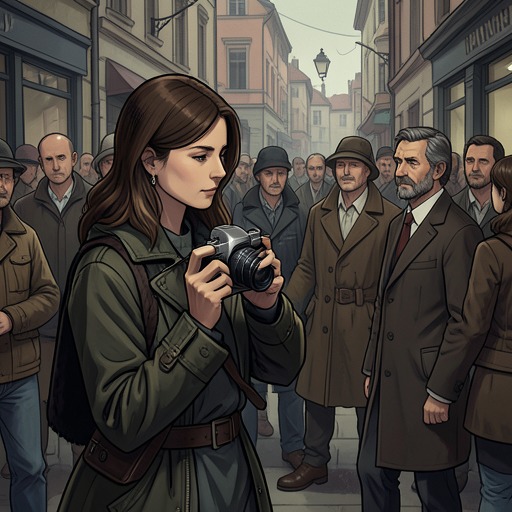
The photograph begins as a purposeful intervention. Hannah has a copy of the image in mind from the scribble book and, after deciding that Courtney’s dismissal of the situation matters, runs to Tyler and leads him across the yard. Tyler protests, mistakenly thinking she wants him to photograph the keg pool; he worries that a yearbook would not print an image showing students drinking underage. Hannah corrects him: she wants a picture of herself and Courtney. The image is not an accidental party snapshot but something Hannah actively makes happen.
Hannah brings Courtney into the frame while Courtney is having her cup filled. She tells Courtney that someone wants a picture, pulls her over to Tyler, and asks her to put down the cup so the yearbook can use the photograph. Tyler’s forehead is glistening as he faces Hannah and Courtney together again. Hannah asks whether he is all right; he insists that he is, in an exact quotation in the narration. The brief exchange registers Tyler’s unease, while Hannah’s attention stays on securing the image.
What the Image Shows
In the photograph, Hannah’s arm is wrapped around Courtney’s waist. Hannah is laughing; Courtney is not. Hannah later studies a copy pressed into the crease between pages, first pulling it out upside down and then turning it right side up. She recognizes herself, notices her long hair, and sees Courtney beside her with a crowd behind them. The students in the dark party scene hold bottles, cans, or red plastic cups.
The contrast in their expressions gives the photograph its force. Courtney does not look angry, but she does look nervous. At first, Hannah can identify the expression without understanding it; after arranging the picture herself, she says she now knows why. The image preserves a visible discrepancy between the girls’ outward physical closeness and Courtney’s discomfort, rather than the uncomplicated picture of friendship that the pose might suggest.
From Party Snapshot to Scribble-Book Evidence
Tyler puts the photograph in the scribble book at Monet’s, where Hannah and Courtney can see it. Its movement from the party to the café changes its function: what began as a posed picture becomes a record preserved beyond the immediate gathering. The photograph is also connected to three sets of initials—J.D., A.S., and H.B.—identified as Jessica Davis, Alex Standall, and Hannah Baker. That marks the page as part of a wider social record, though the photograph itself centers Hannah and Courtney.
For Courtney, the picture is an unwelcome consequence of the party. She had invited Hannah in order to clear her own name after ignoring her for a long time; she had not intended a permanent photograph linking them. When Hannah draws attention to the camera, Courtney tries to pull away and says she does not want to be photographed. The image thus holds both the moment Hannah successfully creates the link and the resistance Courtney makes visible once she understands what is happening.
Significance
The photograph makes social appearance tangible. A pose can imply intimacy, but the expressions preserved within it complicate that impression: Hannah laughs, Courtney looks nervous, and the image outlasts the situation each girl hoped to control. Hannah’s decision to arrange the shot turns the photograph into more than a souvenir; Tyler’s placement of it in the scribble book makes it available for others to see and interpret.
Its significance rests in that mismatch between appearance and intention. Courtney wants the encounter to repair her reputation without binding her to Hannah, while the photograph creates precisely the enduring association she did not plan. The image cannot explain the whole relationship, but it fixes a moment of closeness, discomfort, and exposure in a form that can be revisited after the party is over.