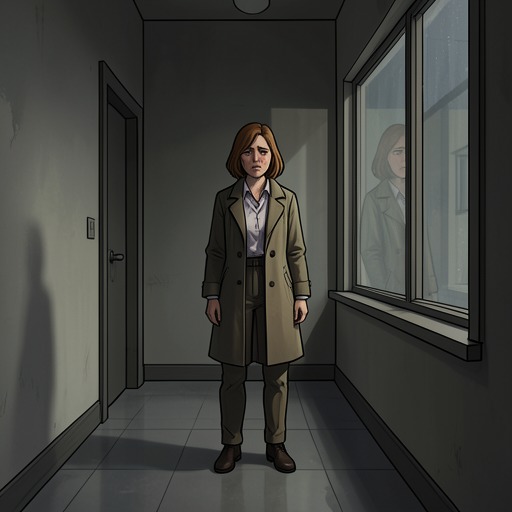
Jessica attacked Hanna at Monet Café
Thirteen Reasons WhyThe attack at Monet’s is the rupture in the relationship between Hannah Baker and Jessica Davis: a rumor about Hannah and Alex becomes, in Jessica’s eyes, more credible than Hannah’s denial, and the disagreement ends in a blow that leaves a small scar above Hannah’s eyebrow. In Hannah’s account, the injury is both physical and relational—a mark that keeps the moment present, and evidence of what it means to be disbelieved by someone who had been a friend.
Causes and Background
At school, Jessica Davis tells Hannah that they need to talk. Hannah understands that Jessica means Monet’s, where the three of them—Hannah, Jessica, and Alex Standall—had made a place for themselves. Their meeting is set against the “Who’s Hot / Who’s Not” list Alex had produced. Jessica brings a copy of it to the table; Hannah recognizes it as the same list she had previously seen upside down on Jimmy’s desk. She knows how Alex ranked her, and she understands that Jessica is sitting opposite her as the list’s supposed counterpart.
The list supplies a framework for suspicion, but the accusation that breaks the friendship concerns a supposed relationship between Hannah and Alex. Hannah tells Jessica that Alex did not choose her over Jessica; he chose Hannah to hurt Jessica, knowing that Hannah’s name would wound her most. Hannah also insists that she had not seen Alex outside school. The distinction matters to her: she can hear the rumors, she says, but cannot know them as truth. Jessica, however, says she knows the rumors. Hannah’s account makes clear that none of the rumors about her and Alex was true, even as Jessica treats them as confirmation of an existing story about Hannah.
The Meeting at Monet’s
Jessica pushes the list across the table. Hannah initially dismisses its importance, telling Jessica that it does not mean anything. But when Jessica says she knows the rumors, Hannah hears the deeper accusation: Jessica is accepting hearsay over Hannah’s own explanation. Hannah recalls trying to explain Alex’s intention and swearing that she had not seen him outside school. Jessica closes her eyes and says Hannah’s name almost in a whisper. Hannah reads that gesture as a sign that Jessica’s mind is already made up, leaving little room for further explanation.
Hannah says Jessica heard her accepting blame. Jessica then rises beside her chair, glares down at her, and swings. Hannah cannot tell whether Jessica means to punch or scratch her; she is lifting a hand and ducking when Jessica catches her. The narration does not treat the blow as an isolated burst of anger: it follows the list, the rumor, and Jessica’s refusal to believe Hannah, turning a dispute over reputation into physical violence.
The Scar and Its Meaning
The attack leaves a tiny scar above Hannah’s eyebrow, shaped by Jessica’s fingernail, which Hannah herself pulls out. The scar becomes a recurring private reminder. Hannah notices it while getting ready for school and sees it again at night; in her narration, it seems to greet her in the morning and wish her good night. The detail gives the conflict a duration beyond the meeting at Monet’s: Jessica’s swing is over quickly, but its visible trace accompanies Hannah through ordinary routines.
Hannah describes the injury as more than a scratch. It is also a punch in the stomach, a slap in the face, and a knife in the back, because Jessica would rather accept a made-up rumor than what Hannah says she knows to be true. The wound therefore carries two kinds of evidence at once: the physical mark left by the attack and the relational injury of being disbelieved. Hannah wonders whether Jessica attended her funeral and, if so, whether she noticed the scar; she then extends the question to the other people who left scars behind. Her account makes the mark a way of registering harm that others may fail to see or acknowledge.
Consequences and Narrative Significance
The encounter turns the three-person friendship associated with Monet’s into a site of mistrust and conflict. Hannah’s earlier sense of the café as a shared safe haven is contradicted by what happens at the table: the list that objectifies and ranks students is brought into the friendship, and rumors determine whose account Jessica accepts. Hannah’s words do not prevent the assault, and the attack gives lasting physical form to the breakdown in trust.
The event is recalled later through Hannah’s recorded account, as Clay Jensen listens and revisits the places named on the tapes. That structure makes the scar more than a detail of appearance: Hannah’s retelling asks the listener to connect a small visible mark with an act of disbelief, and to consider how damage persists after the confrontation has ended. The attack’s significance lies in that contrast between its brevity and its afterlife—in Hannah’s memory, in her daily awareness of the scar, and in the question she leaves about the wounds other people may have caused without noticing.