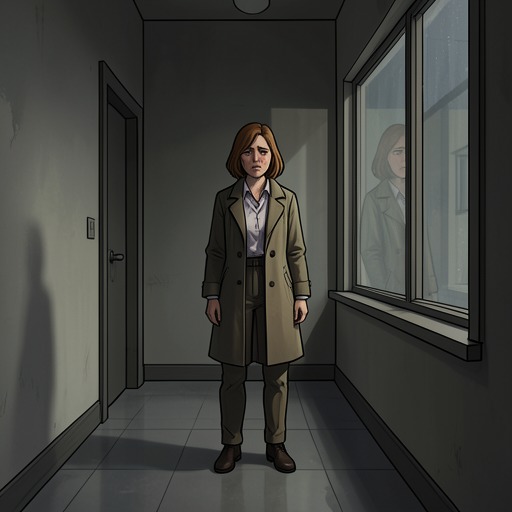
Justin Foley
Thirteen Reasons WhyJustin Foley is Hannah Baker’s first kiss, a senior whose brief relationship with her becomes the starting point of the story she tells. Hannah remembers the connection as unexpectedly powerful and affectionate; she also traces how Justin’s bragging and the rumors that followed turned that private memory into the beginning of a damaging reputation. In later scenes, his presence alongside Jessica Davis and his response to Hannah’s distress reveal how the past continues to intrude on her attempts to begin again.
Identity and Introduction
Justin is introduced in Hannah’s account as a senior and her first kiss. Their story begins before the kiss itself: two years earlier, when Hannah was a freshman and Justin a sophomore, she followed him around school. Because she worked in the attendance office during sixth period, she knew his classes and photocopied his schedule. Hannah imagines that people sorting her belongings after her death might discard the schedule as an irrelevant freshman crush; to her, it matters because it leads back to the beginning of her story.
The detail gives Justin a place in Hannah’s life before he could know he occupied it. What might look like a minor keepsake to someone else records the persistence of her early interest and the deliberate way she constructs her account: she goes back to the earliest point at which their paths entered one another’s orbit. Her narrative makes the crush meaningful not because it predicts everything that follows, but because the later story cannot be understood without the first affection that the rumors will distort.
The First Kiss and Brief Relationship
Hannah tells Justin that he was her first kiss and the first person whose hand she held. She does not describe him as exceptional in any obvious way; she says he was an average guy, while admitting that something about him made her want to be his girlfriend with astonishing force. She cannot explain exactly what drew her to him, but insists that the feeling was real. That contrast—an ordinary boy, an unusually powerful attachment—keeps the memory from being reduced to a simple account of a crush.
The relationship lasted about a month. Hannah remembers the kisses as wonderful, as well as the places they went together, and addresses Justin with sincere gratitude for that time. Her account preserves the early romance as something that once brought pleasure, rather than treating the later harm as proof that the affection was false. The later betrayal therefore works as a change in the meaning of a cherished memory, not as a denial that the memory was cherished.
Bragging, Rumor, and Reputation
The break in Hannah’s recollection comes after Justin starts bragging. A week passes before the rumors reach her; once they do, she reflects that a rumor cannot simply be disproved. She later hears another rumor that Hannah has been felt up at the rocket slide, and by then the school’s talk has overshadowed what he otherwise knew of her. He concludes that she is beyond him and too experienced to consider him. His understanding of Hannah is thus shaped by the same circulating stories that have already begun to shape her standing at school.
Hannah explicitly distinguishes the rumor’s consequences from the idea that a kiss alone caused her death. What it did, in her account, was spoil the hope that the first kiss would remain special, start a reputation that other people believed, and prompt reactions based on that reputation. She describes the process as a snowball effect: one account gathers force as it is repeated, while the person at its center loses control of what others take to be true. Justin’s bragging is a turning point in that chain because it allows an intimate experience to become material for other people’s judgment.
The Past Re-enters the Present
Years later, Hannah enters a living room and finds Justin sitting on one side of a couch with Jessica Davis. Hannah sits at the other end, and the two begin talking. She recognizes the pair without naming them aloud: the boy she first kissed is now sitting with the girl who slapped her at Monet’s. The scene makes the past feel inescapable. Justin is not merely a figure from an earlier romance; his presence brings the first kiss and the later conflict into the same room, while Hannah’s silence keeps the recognition internal.
Justin also remains part of Hannah’s memories of Clay Jensen. When Clay and Hannah kiss, she initially experiences the kisses as offering the possibility of a new beginning. Then the feeling recalls her first kiss with Justin: she remembers the anticipation and Justin’s lips against hers, before remembering how he ruined the memory. She tells Clay to stop and stops pulling him toward her. Justin’s importance here lies in the way the old betrayal interrupts a new moment of intimacy; memory changes what Hannah can bear in the present, and she responds by drawing back.
Responsibility and the Limits of the Record
At a party, after Hannah leaves a room and walks several blocks rather than going home, she sees Justin’s shoes in the light beneath a door. He has taken up a position outside it. When the door opens, he pulls it back and tells another person, “No. Let her rest.” Hannah waits inside, still on the floor, as a friend tries to persuade Justin to let him into the room. The episode places Justin at a threshold: he is present and intervenes to keep the other person from entering, even as Hannah’s account elsewhere describes the distress and uncertainty of that night.
Hannah later tells listeners to be clear that she did not say no or push the boy’s hand away. Instead, she turned her head, clenched her teeth, and fought back tears; he saw her distress and told her to relax. She says she did not tell him to get away, and he did not leave. These details matter to the account of Justin because the available evidence does not make him the boy in that encounter: Hannah addresses the person who touched her directly, and later speaks to a counselor about whether what happened with that boy might have been illegal. The story identifies Justin as present outside the room and as the person who says to let Hannah rest, but it does not establish his knowledge of everything happening inside. A counselor offers Hannah the options of confronting the boy or moving on; that exchange underscores the unresolved questions the narrative leaves around consent, responsibility, and the support available to her.
Justin’s role is therefore neither confined to a first romance nor reducible to a single accusation. Hannah remembers him with gratitude, identifies his bragging as the beginning of a rumor-driven transformation, and later encounters his presence in scenes where past harm and the possibility of starting over collide. The structure of her account holds these truths in tension: a kiss can have been wonderful, and the story told about it can still help make the memory painful and the reputation difficult to escape.