Mrs. Bradley
Thirteen Reasons WhyMrs. Bradley is a teacher whose classroom provides students with an unusual route for raising difficult topics: an anonymous paper-bag system for comments on her teaching and suggestions for discussion. Hannah Baker uses it to write that she has been thinking about suicide. The note makes Mrs. Bradley part of the story’s portrayal of warning signs and missed opportunities—not as the cause of Hannah’s fate, but as an adult whose classroom receives a warning that the school does not successfully turn into help.
Classroom and Anonymous Notes
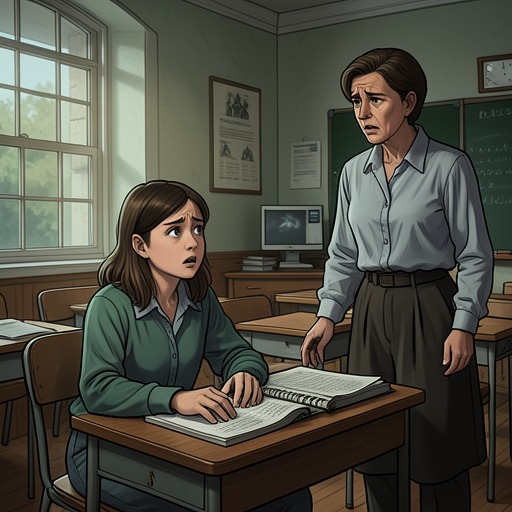
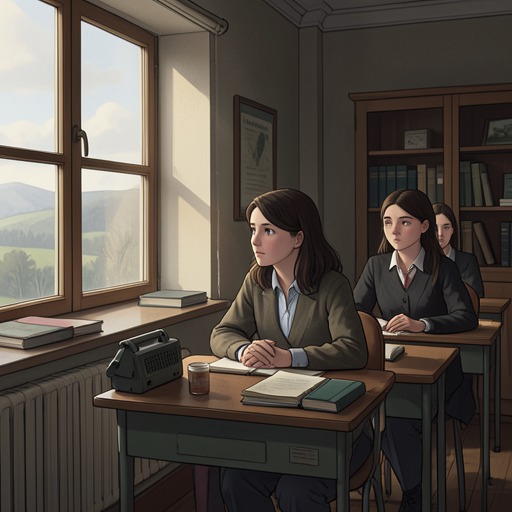
A paper bag for student notes hangs on a spinning bookrack at the back of Mrs. Bradley’s class alongside the students’ bags. She invites comments on her teaching, whether critical or supportive, and encourages students to recommend subjects for future discussions. The arrangement allows a student to raise a sensitive subject without first identifying themselves, a distinction that becomes crucial when Hannah tries to speak indirectly about her state of mind.
Hannah drafts a note saying she has been thinking about suicide, though not too seriously. Before delivering it, she writes the message repeatedly, throws drafts away, and crumples others. Her hesitation gives the anonymous channel a double significance: it makes disclosure possible, but the note’s indirectness and anonymity also leave its author’s distress difficult for others to recognize or address.
The Suicide Discussion
After the note is read in class, one student suggests that its writer merely wants attention and should have identified herself if she were serious. The response exposes the risk built into the class’s demand for specifics: anonymity, which may enable someone to raise a frightening subject, is treated as evidence against taking the subject seriously. Hannah’s account presents the discussion as a setting in which she could not open up.
Mrs. Bradley responds by giving the class local statistics about suicide. She explains that deaths by suicide among juveniles may not be reported in the news when they occur outside public places and without witnesses; families may also keep the cause private, leaving people in the community to believe a death was accidental. The information broadens the class’s understanding of what may remain hidden, but a thorough discussion does not follow. The gap between naming the subject and creating a space in which a student can seek help remains unresolved.
Hannah’s Warning and Its Aftermath
Hannah later recalls that Mrs. Bradley took the note from her bag and read it aloud the day after Hannah caught Tyler Down spying on her and after Hannah had a breakdown in the hall. The chronology means the warning existed in the classroom before Hannah’s death, but the account does not establish that Mrs. Bradley knew who had written it. Hannah also remembers that she had repeatedly pushed suicidal thoughts away, so the note’s wording understates the seriousness of what she was struggling to express.
In the days before taking pills, Hannah’s behavior appears to change: she greets people in the halls and looks them in the eyes after months of seeming unlike herself. Hannah says that Zach Dempsey could have connected this outward return to the note, but that he did not reach out even after the classroom discussion. The narrative thus distinguishes the teacher’s action of reading the note and presenting information from the failure to identify and support its author; it does not claim that Mrs. Bradley knew Hannah’s identity or had been told directly that she was in immediate danger.
Narrative Significance
Mrs. Bradley’s classroom brings together the novel’s recurring tension between disclosure and recognition. A mechanism exists for submitting a note, and a teacher responds to the topic with information, yet the anonymous writer remains unseen and the class does not sustain the discussion. The episode makes institutional attention visible while showing its limits: talking about suicide in general is not the same as discovering who may need help.
The note also acquires meaning in retrospect. Hannah’s repeated attempts to write it, its delivery to the classroom bag, and its reading in class form a chain of concrete warning and partial response. Mrs. Bradley is part of that chain, but the novel does not reduce Hannah’s death to one person’s omission; it places the teacher’s classroom within a wider pattern in which signs can surface without becoming effective care.