Skye Miller
Thirteen Reasons WhySkye Miller is Clay Jensen’s former eighth-grade crush, a once-familiar girl who has withdrawn from nearly everyone around her. Her brief reappearance on a bus and Clay’s eventual decision to call after her in the school hallway give her a small but consequential role in a story shaped by isolation, missed signals, and the possibility—never guaranteed—of reaching out.
Identity and Background
Clay recognizes Skye as the girl he had a crush on in eighth grade. Their past is established through that memory, but the book offers little detail about what their earlier connection involved beyond Clay’s attraction and his recognition of her when they meet again. The distance between that childhood familiarity and their present awkwardness becomes part of the scene’s tension: Clay knows who she is, yet does not know how to speak with her.
By the time Clay sees her again, Skye has become conspicuously apart from school life. He observes that, over a period that seems to have passed suddenly, she stopped wanting to be part of anything. The change is visible to others, but its cause remains unknown. Clay can ask what happened between eighth grade and the present, and why she insists on being an outcast, but he has no answer; the narrative preserves that uncertainty rather than supplying a diagnosis or explanation.
Reappearance on the Bus
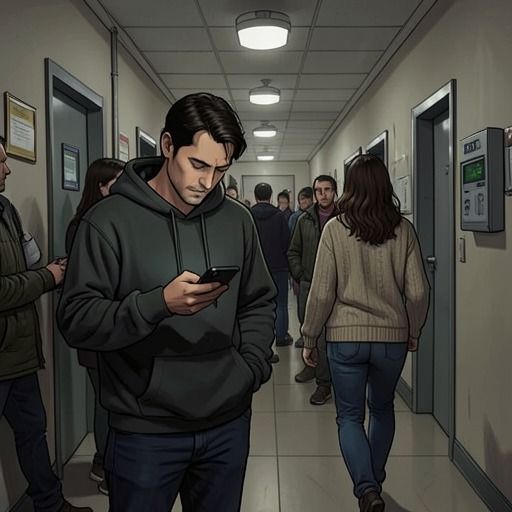
Clay first notices Skye’s reflection in the dark belt of windows across the bus aisle. He turns around and finds her sitting behind him. She smiles—or perhaps smirks—because she knows she has startled him. Clay describes her as someone who has always been pretty but behaves as though the fact has never occurred to her; in the present, she wears dull, loose clothing that seems almost to bury her, including a bulky gray sweatshirt and matching pants. Her appearance is not offered as an explanation for her withdrawal, but it makes her effort to remain unobtrusive visible.
Skye keeps her eyes on Clay and appears to be trying to make him uncomfortable. When she tells him, “I’m not going anywhere,” the remark makes remaining on the bus a live choice for him: his stop lies between two of the tape’s marked locations, and he considers getting off or staying to try to talk with her. He recognizes that any exchange may be nearly one-way, yet he remains interested in the possibility of speaking. Skye ends the encounter with “See you tomorrow,” and Clay answers, “See you later.” The conversation closes quickly; Clay admits that part of him is relieved, a response that exposes the gap between wanting contact and being ready to sustain it.
Withdrawal and Unanswered Contact
Clay’s account of Skye’s isolation is marked by questions rather than knowledge. He wonders what changed after eighth grade and why she no longer wants to belong, but says that no one knows. Her withdrawal is therefore not presented as a mystery Clay solves; it is a condition visible from outside and still inaccessible to him. On the bus, she is physically close enough to speak with, but the encounter offers no easy route through that distance.
The next day, Clay sees Skye in the school hallway. She passes him while he is with another student, and he holds her gaze for a few steps before she turns away and continues walking. Clay remembers that he left the bus without really talking to her: he had wanted to speak and had tried, but had allowed the exchange to slip away. He understands her as someone who has learned to avoid people—everyone—and recognizes that his own hesitation has repeated the pattern rather than interrupted it.
At the hallway lockers, Clay wants to call her name, but his throat tightens. He initially keeps walking. As Skye’s footsteps grow louder behind him, however, the physical distance closes and his own tension begins to ease. Two steps behind her, he finally says, “Skye.” The narrative ends the encounter at that call, without reporting her response. It establishes an act of attempted contact, not a completed reconciliation or proof that Skye accepts it.
Narrative Role and Significance
Skye’s scenes are brief, but their placement gives them weight. The bus encounter presents an opportunity Clay recognizes and then lets end; the following school day gives him another chance, now accompanied by the knowledge that he previously withdrew. His eventual call turns that recognition into action, while the unanswered ending leaves the result open. The movement is modest and concrete: from seeing Skye, to considering conversation, to letting her go, to speaking her name as he catches up.
That small movement resonates with the book’s repeated concern with people who are present but not reached. Elsewhere in the story, Hannah Baker’s account describes people turning away when they see her struggling, while Clay listens to what he did not understand at the time. Skye is not equated with Hannah, and her reasons for withdrawing remain unstated. Instead, her presence makes Clay confront a different, immediate possibility: he can notice someone’s distance without knowing its cause, and still choose whether to make an effort to speak. The final call offers no guarantee of rescue or response; its significance lies in Clay no longer letting the conversation disappear without trying.