Tangierwood Street and South Street Intersection
Thirteen Reasons WhyThe intersection of Tanglewood and South is where a missing Stop sign helped turn a rainy night’s drive into a fatal collision. In Hannah Baker’s account, the corner becomes the point where a chain of choices—Jenny Kurtz’s crash, the failure to alert the authorities, and the decision to leave the sign down—connects private knowledge to a stranger’s death.
The Corner and the Missing Sign
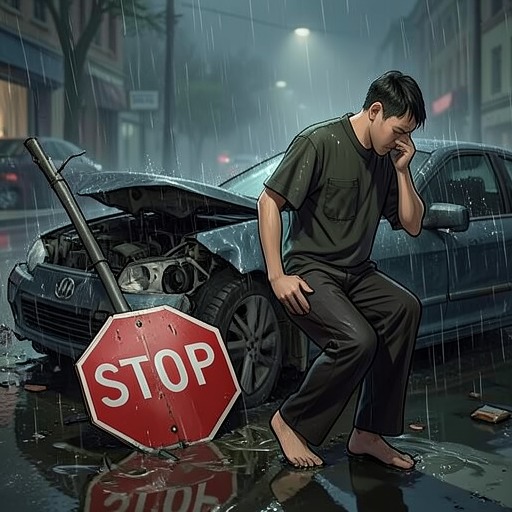
The intersection lies two blocks from the party Jenny was leaving. Hannah marks it as B-6 on her map, fixing the accident to a specific place rather than leaving it as an abstract tragedy. On that night, the Stop sign had been knocked down, and the rain made the already dangerous crossing harder to navigate.
The account reconstructs the conditions at the corner in brief, accumulating details: a pizza delivery driver was trying to keep to his schedule while another driver turned from the opposite direction. Hannah identifies the second driver as an older man. With no Stop sign standing at the intersection, the two cars collided, and one driver died. The passage does not establish precisely how each vehicle approached or assign legal fault for the collision; its concrete emphasis is the absent sign and the fatal outcome.
Jenny’s Knowledge and the Concealed Cause
Jenny made it home in one piece, but Hannah insists that her safe return was not the central issue. The sign was down, and Jenny knew that mattered. Hannah says neither the people around them nor the police knew who had caused the crash, while Jenny did. Hannah knew as well, and Jenny’s parents may also have known; the account points to the rapid repair of Jenny’s bumper as a reason for that possibility, without presenting it as proof.
The concealed responsibility turns the intersection into more than the setting of an accident. For a time, the cause remains unknown even to investigators. The withheld fact is not merely that a driver died, but that the absent traffic control had been knocked down and that Jenny knew the connection. The difference between public uncertainty and private knowledge gives the corner its force in Hannah’s narrative.
Intervention and Its Limits
Looking back, Hannah considers what might have been done: she could have taken Jenny’s keys or taken her phone to call the police. She judges the call the one action that would have mattered. The reflection is framed around an opportunity to act before consequences spread beyond the party, not around a claim that Hannah knows exactly how events would have changed if someone had intervened.
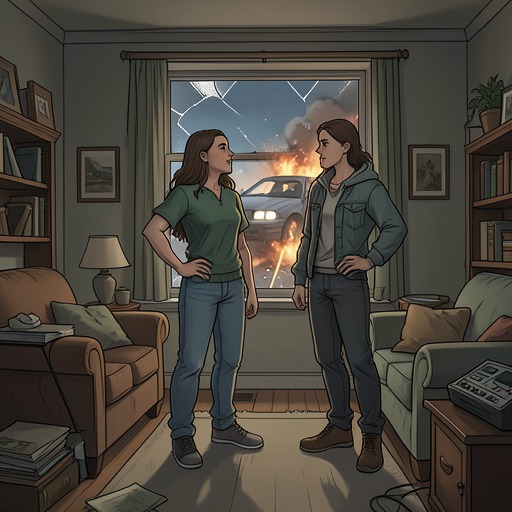
That sense of missed intervention returns when Clay Jensen reaches the intersection in distress. He calls for help and begins to explain his location as the corner of Tanglewood and South, but the person who answers cuts him off and tells him to calm down. Hannah’s earlier story has already attached the place name to a failure to act; Clay’s call brings the same corner into the present as the point where he tries to communicate an emergency while struggling to breathe through tears.
The Death Behind the Location
The dead driver was a senior at school, but Hannah had never known him. When she saw his picture in the newspaper, she did not recognize him; he was one of the many people at school she had never met and never would. She did not attend his funeral, and her narration acknowledges that she might have done so while also describing herself as unable to go.
By giving the accident a location, a missing sign, and a victim who remains personally unknown to her, Hannah makes the cost of the concealed cause legible without turning the dead student into someone she can claim to have known. The intersection joins what the community did not know, what Jenny and Hannah did know, and what could not be undone once the sign was down and a driver had died. Its recurring significance is the distance between witnessing danger and taking the action that might alert others to it.