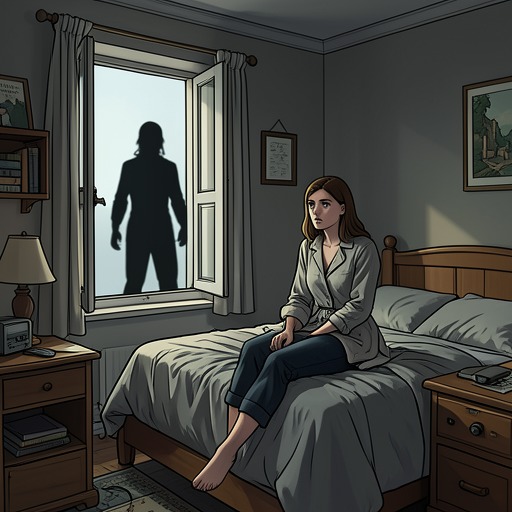
Tyler spies on Hannah and is exposed by her
Thirteen Reasons WhyTyler spies on Hannah and is exposed by her when Hannah turns the repeated clicks of a camera outside her bedroom into a trap. The staged encounter identifies Tyler Down without giving Hannah a clear view of his face; his defensive answer at school strengthens her conclusion, and although he stops coming to the house, the violation continues to shape how safe she feels there.
The Camera at the Window
On the first night of her parents’ vacation, Hannah goes into her room after washing her face and brushing her teeth. A camera clicks. Her window is usually left open an inch or two for fresh air, and that small gap lets her realize someone is standing outside. She initially denies what she suspects, telling herself she is unnerved by being alone, but the camera clicks again. She does not change in front of the window; instead, she sits on her bed, caught between the evidence of the sound and the impulse to dismiss it.
Hannah decides to enlist a girl from school whom she has never actually spent time with. Though they share electives, are friendly in class, and have sometimes discussed hanging out, the invitation is prompted by the intrusion: Hannah tells her that her parents are away and asks whether she wants to help catch a Peeping Tom. The classmate comes over after school, using a school-project explanation to account to her parents for being out late on a weeknight. Their plan depends on keeping their bedroom conversation quiet enough to hear the next camera click.
The Staged Exposure
Hannah and the girl sit cross-legged on the bed, facing one another, and talk in low voices while waiting for the click that will confirm the watcher is still outside. When it comes, the girl whispers that Hannah should pretend not to have heard it and keep playing along. She then performs a calculated invitation to the unseen photographer, asking for a back massage and stretching forward across the bed. Another click follows. Hannah straddles her back, turning the room into a deliberate tableau designed to hold the watcher’s attention—and to make the act of watching unmistakable.
The plan turns from performance to confrontation when the girl insists she will not leave until she learns whether the watcher is someone from their school. She tells Hannah to follow her lead: at the count of three, Hannah should rush the window. Hannah hesitates, thinking the Peeping Tom may already have fled because no click has sounded since she got off the bed. But the girl announces that it is time for body lotion, and the camera clicks again. Hannah’s anger rises; she joins the pretense by directing the watcher toward her top drawer, while the two girls wait for the cue.
At three, Hannah jumps to the window and yanks the cord, sending the blinds up. She looks for the photographer’s face, but he is moving too fast for her to see it clearly. The girl sees him stuffing his penis into his pants and cries out in alarm. Hannah therefore has a direct glimpse of the watcher’s height and hair, but not enough of his face to identify him on sight. Her apology to him does not undo the deliberate exposure: she believes he deserves to be caught, while still expressing regret about what has happened.
Identification and the Loss of Safety
The next day at school, Hannah asks several people where they had been the previous night. Some answer that they were at home, visiting a friend, or at the movies; others challenge her question as none of her business. Tyler Down responds, “What, me? Nowhere.” His denial is conspicuously defensive: Hannah notices his eyes twitch and his forehead break into a sweat, and takes the reaction as confirmation of what the obscured face could not establish. She recognizes his height and hair at the window, but never sees his face clearly enough to identify him by sight alone.
Tyler stops coming around Hannah’s house, but his absence does not restore the privacy he took from her. After his visits, she twists the blinds shut each night, shutting out the stars and the lightning she had once seen through the window. She turns out the lights and goes to bed behind closed blinds. The change gives the spying a consequence beyond the exposure itself: Hannah’s bedroom, which should have been a refuge from the outside, no longer feels safe. The staged encounter catches the watcher, but it cannot make the house feel untouched again.