Mhuirlan's Law of Royal Succession
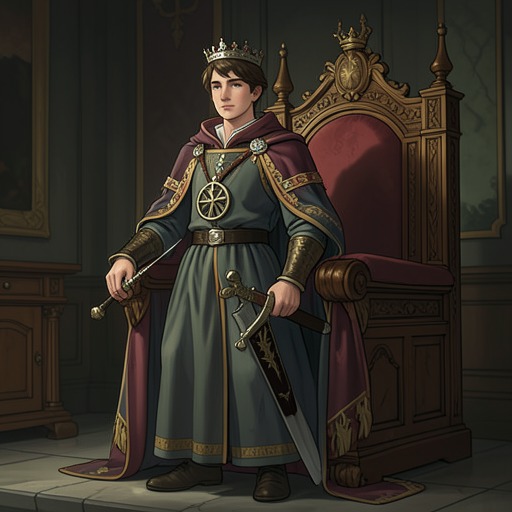
TideMhuirlan's Law of Royal Succession determines who holds the throne when a king’s first son is not yet old enough to ascend. Its clearest application comes when King Leonardo dies: the law explains why his brother had held the throne and why Prince James, now twenty-five, becomes king. Succession is thus presented not simply as a matter of bloodline, but as a transfer governed by the prince’s age and the death of the intervening ruler.
The Rule and Its Operation
Galahad explains that Mhuirlan’s law provides for a king’s younger brother to take the throne if the king’s first son is too young to ascend. When that uncle dies, the prince becomes king. The account gives no broader list of succession conditions, but sets out this sequence directly: a young heir is passed over in favor of his uncle, and the heir succeeds after the uncle’s death.
The rule is applied to Prince James following the death of King Leonardo. Galahad notes that James is twenty-five, four years past the proper age to ascend. His explanation distinguishes the age threshold from the event that brings his succession about: James has already passed the stated age, but it is the death of his uncle that makes him king.
Accession and Public Recognition
James’s change of status is announced publicly in a proclamation. A herald tells the gathered people that the king will be crowned in three days and invites the entire island of Metern to the royal festivities. The announcement gives James his full formal style, Aethelred Alexander Richard Augustus Edward James the First, and presents the coming coronation as a kingdom-wide occasion. The law’s private succession sequence therefore leads into a public ceremony through which the new reign is proclaimed and celebrated.
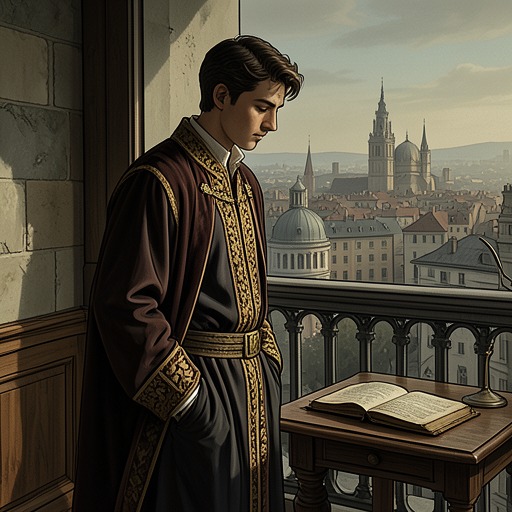
The account also marks the personal cost of the change in status. After explaining the accession, Galahad tells Little Emblyn that James’s responsibilities are now to his kingdom first and his own heart second. The succession rule does not describe James’s feelings or dictate his private choices; it places him in an office whose obligations, as Galahad frames them, take precedence over those choices.
Kingship and Royal Marriage
James’s later public declaration about Lady Beatrix Greigh recalls their long friendship and the support they have given one another through family losses and other hardships. At their wedding, he is formally presented with Beatrix as the bonded pair, King James and Queen Beatrix of the royal house of Mhuirlan. The ceremony confirms their royal titles and marriage, while the earlier succession account explains how James acquired the title of king in the first place.
The distinction matters: the law described here governs the passage of the throne from King Leonardo’s brother to Prince James; the wedding establishes James and Beatrix as king and queen together. The narrative places both transitions within the public life of the monarchy, but does not state that the marriage changes the succession rule or specify what further succession consequences it may have.