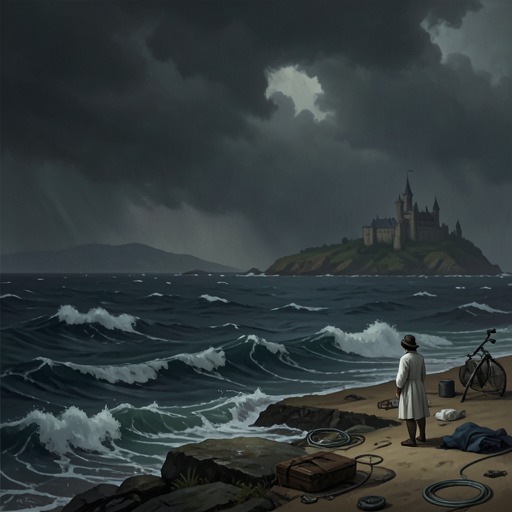
At the opening of the story
Frost at the Border
[Galahad Stormcrane](entity:character-recall-character-galahad-stormcrane-086442dbee3f) rides toward the island kingdom of [Metern](entity:location-recall-location-metern-a0c2f488fb70), noticing unnatural frost inside the southern border of [Spegel](entity:location-recall-location-spegel-6729c1434dbb) despite the summer weather. The sight deepens his concern for [Rose Melhorn](entity:character-recall-character-rose-melhorn-39545e8e75b9), who has been sent to investigate a dangerous curse there.
His journey brings him to the coast, where he boards a royal ship with his raven [Scraw](entity:character-recall-character-scraw-8c969941fe45) and his horse [Thondorfax](entity:character-recall-character-thondorfax-c1eb4679ba9d). The cold beyond the forest foreshadows the spreading magical dangers that will shadow his mission.
After the sea crossing
Arrival at Perlkastel
The ship carries [Galahad Stormcrane](entity:character-recall-character-galahad-stormcrane-086442dbee3f) to the island and on to the splendid palace of [Perlkastel](entity:location-recall-location-perlkastel-67467c01abf4). He insists that [Thondorfax](entity:character-recall-character-thondorfax-c1eb4679ba9d) accompany him inside, making an unmistakable entrance before the court.
There he meets [Prince James](entity:character-recall-character-prince-james-a0636b9dc0d2) and warns him that his kingdom faces an impending attack. The guardian of the great seal beneath the [Sira Channel](entity:location-recall-location-sira-channel-ae2989866078) has vanished, leaving the land exposed to dark powers from the sea.
During Galahad’s first meeting with Prince James
The Missing Guardian
Galahad explains that the ancient seals were established by the Seven Original [Curse-Breakers](entity:organization-recall-organization-curse-breakers-114553daa32a) to protect [Edel](entity:location-recall-location-edel-138539646c70), and that each seal depends on a living guardian. The eastern guardian’s disappearance has made the seal and [Mhuirlan](entity:location-recall-location-mhuirlan-4720c6e349f8) vulnerable.
[Prince James](entity:character-recall-character-prince-james-a0636b9dc0d2) accepts the warning and grants Galahad permission to stay and investigate. He directs him to [Euryor House](entity:location-recall-location-euryor-house-53116b6ccdc2), an island residence stocked with books once owned by his father, [King Orion](entity:character-recall-character-king-orion-63731b9013e6).
A fortnight before Galahad reaches Metern
James’s Shipwreck
[Prince James](entity:character-recall-character-prince-james-a0636b9dc0d2) recounts how his ship was smashed against [Serpent’s Pass](entity:location-recall-location-serpent-s-pass-70733558e7fd) during a storm between [Hanter-broder](entity:location-recall-location-hanter-broder-6792b1375fd9) and [Hanter-hwor](entity:location-recall-location-hanter-hwor-80425c780189). The entire crew was lost, but he awoke unharmed on a beach the following morning.
He remembers a woman’s arms holding him and a voice singing to calm his fear. The rescue changed how he sees life, though he has never told anyone the full story before Galahad.
After rescuing James and before Galahad’s arrival
Meira’s Bargain
[Meira](entity:character-recall-character-meira-cbe0da6117f4), daughter of [King Strom](entity:character-recall-character-king-strom-56b497fb315c), has spent her life guarding the eastern seal beneath the sea. After saving [Prince James](entity:character-recall-character-prince-james-a0636b9dc0d2), she falls in love with him and longs to live on land beside him.
She bargains with [Myrkur](entity:character-recall-character-myrkur-bdb25936d65c) for a human form, surrendering her voice and accepting a deadly condition: she must marry the man she loves or die. The bargain leaves the seal without its guardian and gives Myrkur a path toward her larger designs.
A few days after Meira becomes human
Meira Found on the Beach
Walking the beach at dusk, [Galahad Stormcrane](entity:character-recall-character-galahad-stormcrane-086442dbee3f) and [Thondorfax](entity:character-recall-character-thondorfax-c1eb4679ba9d) discover a naked, shivering young woman sheltering among the rocks. She cannot speak and is frightened by the unfamiliar world around her, but she responds gently to the horse.
Galahad covers her with his cape and carries her to [Euryor House](entity:location-recall-location-euryor-house-53116b6ccdc2). The encounter turns his search for a missing guardian into a personal effort to save the stranger’s life.
That evening at Euryor House
The Princess Identified
After [Little Emblyn](entity:character-recall-character-little-emblyn-3c775e04cf7f) bathes and dresses the stranger, Galahad recognizes the rune on her hand and addresses her in Brimtung. He identifies her as [Meira](entity:character-recall-character-meira-cbe0da6117f4), the eldest daughter of [King Strom](entity:character-recall-character-king-strom-56b497fb315c) and the missing guardian of the seal.
Through yes-or-no gestures, Meira confirms that she chose the transformation herself, and that she rescued [Prince James](entity:character-recall-character-prince-james-a0636b9dc0d2). Galahad realizes that her longing for the prince has placed both her life and the kingdom’s protection in peril.
The night Meira is identified
The Sea Witch’s Terms
Galahad finds the description of [Myrkur](entity:character-recall-character-myrkur-bdb25936d65c) in an old book and learns that she is an ancient sea witch, not an ordinary curse-maker. [Meira](entity:character-recall-character-meira-cbe0da6117f4) confirms that she sought Myrkur’s spell and gave up her voice, her life being the price if the prince marries another woman.
Galahad suspects a [Love Rule](entity:rule-recall-rule-love-rule-7ead8644483c): a marriage based on pity might not satisfy the spell. He decides not to tell [Prince James](entity:character-recall-character-prince-james-a0636b9dc0d2) the truth and instead plans to give Meira every chance to earn his affection.
The following morning
Lessons at Euryor House
Galahad gives [Meira](entity:character-recall-character-meira-cbe0da6117f4) a potion that lets her understand Edeltung, then explains his plan to introduce her at court as an apprentice [Curse-Breaker](entity:concept-recall-concept-curse-breaker-797ce4cc39e1). [Little Emblyn](entity:character-recall-character-little-emblyn-3c775e04cf7f) objects that Meira first needs help with ordinary human tasks, from dressing to eating.
The maid patiently teaches Meira how to use utensils, drink tea, and move through a household. Their lessons give Meira a first foothold in her new life and begin a close friendship between the two women.
Soon after Meira’s first lessons
Breakfast with the Prince
Galahad takes [Meira](entity:character-recall-character-meira-cbe0da6117f4) to breakfast at [Perlkastel](entity:location-recall-location-perlkastel-67467c01abf4), where [Prince James](entity:character-recall-character-prince-james-a0636b9dc0d2) welcomes her warmly. Meira struggles with the unfamiliar table setting and accidentally breaks a teacup, but the prince reassures her rather than taking offense.
His kindness offers Meira hope that she may become dear to him, while Galahad watches the first signs of their growing connection. Meira’s attraction is immediate, though her silence and inexperience make courtship difficult.
During Meira’s first days at Euryor House
A Home of New Skills
[Little Emblyn](entity:character-recall-character-little-emblyn-3c775e04cf7f) teaches [Meira](entity:character-recall-character-meira-cbe0da6117f4) to cook, dress, curtsey, and behave at a noble table. Galahad joins the lessons, taking the part of a gentleman so Meira can practice courtly manners in safety.
Meira learns quickly, but the ordinary sounds and objects of land remain startling after a lifetime in the sea. Galahad begins to see that her apparent awkwardness is not foolishness but the understandable strangeness of an entirely new world.
A few days after Meira’s arrival
The First Court Banquet
Galahad brings [Meira](entity:character-recall-character-meira-cbe0da6117f4) to a royal banquet, where she meets [Sir Gawain](entity:character-recall-character-sir-gawain-13e24e84ada8), [Lady Hollis](entity:character-recall-character-lady-hollis-38d660daa692), [Sir Tristan](entity:character-recall-character-sir-tristan-bb2b8feec68f), and [Sir Lancelot](entity:character-recall-character-sir-lancelot-63f3b4b4957e). The prince introduces her to the court and treats her with gentleness, while Meira learns to navigate the formal meal and attention of the assembled guests.
The company is impressed by her beauty and quiet bearing. Galahad sees that the prince is drawn to her, but he also recognizes that Meira’s silence leaves her unable to take part in the conversation as others do.
During the first week on Metern
Galahad Tests the Seal
At night, Galahad travels alone to the sea and uses his magic to trace the great seal on the seabed. The ring of green fire forms intact, and he senses that it is still holding despite the guardian’s disappearance.
The test confirms that [Meira](entity:character-recall-character-meira-cbe0da6117f4)’s absence has not yet broken the protection, but it cannot guarantee how long the seal will endure. Galahad resolves to investigate quickly before [Myrkur](entity:character-recall-character-myrkur-bdb25936d65c) can exploit the weakness.
Several days into the investigation
A Wreck Beneath the Ruins
[Prince James](entity:character-recall-character-prince-james-a0636b9dc0d2) takes Galahad and his knights to the ruins of [Arghans Ker](entity:location-recall-location-arghans-ker-1e431ee50ddb), the old silver stronghold. In a flooded chamber below the fortress, they find the wreck of the [Cygnus](entity:object-recall-object-cygnus-80b2f2405b77), the ship that carried [King Orion](entity:character-recall-character-king-orion-63731b9013e6) to his death.
James reveals that he wished to see his father again at the old wishing well. Galahad recognizes the wreck’s impossible appearance as hostile magic, not a benevolent answer to the king’s grief.
At the flooded silver mine
A Wish Becomes a Trap
[Prince James](entity:character-recall-character-prince-james-a0636b9dc0d2) intends to send divers down to recover his father’s remains, but Galahad stops him. He argues that the ship’s arrival in an abandoned silver mine, beneath woods once shaped by [Elves](entity:creature-recall-creature-elves-75820362b438), is too unnatural to trust.
Galahad persuades James to remember his father as alive in the light of the [Source](entity:concept-recall-concept-source-baa45c9ec568) rather than as a corpse trapped in wreckage. The king leaves the chamber shaken but agrees not to return until Galahad understands what the magic means.
After the discovery of the Cygnus
Myrkur’s Reach into the Woods
[Meira](entity:character-recall-character-meira-cbe0da6117f4) explains through gestures that [Myrkur](entity:character-recall-character-myrkur-bdb25936d65c) is trying to reach around the sea seal and flood the ruins and forest. Galahad understands that the witch may corrupt the old elven magic with a spell meant to kill anyone who enters.
He reports the danger to [Reola](entity:character-recall-character-reola-7398c7dd44b6), who agrees that Myrkur may be testing the defenses and learning how to exploit the island. The flooded mine becomes the clearest sign that the threat extends beyond the sea and into [Mhuirlan](entity:location-recall-location-mhuirlan-4720c6e349f8) itself.
After Galahad tells Meira about the wreck
A Story Shared in Silence
When [Meira](entity:character-recall-character-meira-cbe0da6117f4) asks about the [Cygnus](entity:object-recall-object-cygnus-80b2f2405b77), Galahad tells her that his younger brother Gaius died as a child and that his mother has never spoken since. He learned to understand her by watching her face, and says he has learned to understand silence.
Meira responds by taking his hand. The brief gesture establishes a different intimacy between them: she recognizes his grief without requiring speech, while he begins to let her see the sorrow beneath his guarded manner.
The following Sunday
The Sunday Picnic
[Prince James](entity:character-recall-character-prince-james-a0636b9dc0d2) joins the household’s picnic on the beach, greeting his former nurse and the other islanders with easy affection. [Meira](entity:character-recall-character-meira-cbe0da6117f4) and [Little Emblyn](entity:character-recall-character-little-emblyn-3c775e04cf7f) play in the surf, and the prince rushes into the water to help when Meira suddenly goes under.
Galahad starts to intervene but sees James reach her first. The moment brings the prince and Meira closer, while Galahad’s reaction reveals a protectiveness and jealousy he has not admitted even to himself.
After the picnic
The King’s Grief
[King Leonardo](entity:character-recall-character-king-leonardo-40b54faef4fd) dies, and [Prince James](entity:character-recall-character-prince-james-a0636b9dc0d2) inherits the throne under [Mhuirlan](entity:location-recall-location-mhuirlan-4720c6e349f8)’s succession laws. Galahad understands that the new king’s duties may soon constrain the freedom he has shown [Meira](entity:character-recall-character-meira-cbe0da6117f4).
He takes Meira to sit with James as he mourns. Rather than offer formal words, she simply sits beside him and holds his hand, giving him the quiet company he needs.
The day after James’s accession
A Dance on the Sea
Galahad goes to find [Meira](entity:character-recall-character-meira-cbe0da6117f4) at the shore and asks whether she misses the sea. Instead of answering, she takes his hand and leads him out across the waves, where she can move on the water as naturally as on land.
At first Galahad struggles to keep his balance, but he soon follows her in leaps and gliding strides. They turn the open water into a ballroom, dancing without words in a moment of joy that belongs to the two of them alone.
James’s birthday evening
Meira’s Birthday Ball
Galahad brings [Meira](entity:character-recall-character-meira-cbe0da6117f4) to the king’s birthday ball, where the court admires her and James dances with her. They move together with a natural understanding, and the assembled guests begin to imagine that the king may marry her.
Galahad slips away after overhearing courtiers discuss the apparent match. He tells Meira he has a headache on the journey home, hiding the pain of watching her share a seemingly possible future with James.
Three days before James’s coronation
A New Guest Announced
A public proclamation announces that James will be crowned king and names [Lady Beatrix Greigh](entity:character-recall-character-7b9d788ce84c) as an honored visitor from [Hanter-broder](entity:location-recall-location-hanter-broder-6792b1375fd9). Galahad learns that she is an old friend of the royal family and James’s oldest companion.
The news unsettles both [Meira](entity:character-recall-character-meira-cbe0da6117f4) and [Little Emblyn](entity:character-recall-character-little-emblyn-3c775e04cf7f). Galahad tries to remain cautious, but the arrival of a beloved childhood friend threatens the courtship on which Meira’s life depends.
The night before the coronation
The Enchanted Sea Gown
Galahad buys three ancient elven fabrics and secretly shapes them into a gown using magic. The dress combines green, turquoise, and storm-blue layers, adorned with luminous patterns and jewels that evoke the sea.
He designs it to make [Meira](entity:character-recall-character-meira-cbe0da6117f4) unforgettable at the coronation ball, but the care he gives the work also reflects an attachment that has grown beyond his original plan to win James’s affection for her.
The night of the coronation ball
Beatrix Meets Meira
Galahad and [Meira](entity:character-recall-character-meira-cbe0da6117f4) arrive at [Perlkastel](entity:location-recall-location-perlkastel-67467c01abf4) for the ball, where Meira’s enchanted gown draws every eye. James watches her dance, but introduces the pair to [Lady Beatrix Greigh](entity:character-recall-character-7b9d788ce84c), whose beauty and warmth immediately impress the gathering.
[Beatrix](entity:character-recall-character-beatrix-9ca4fb42d2d4) welcomes Meira as a friend and praises her dress and dancing. James’s ease with Beatrix, and the closeness between them, leave Meira visibly distressed and Galahad unable to look away.
Later that evening
Galahad’s Coronation Dance
Galahad takes [Meira](entity:character-recall-character-meira-cbe0da6117f4) into his arms and leads her into a sweeping dance. They move with instinctive coordination, the enchanted gown flowing around them as the music and crowd recede from his awareness.
When the dance ends, Galahad realizes the depth of his feelings in a sudden, frightening rush. The moment is interrupted by James, who draws Meira away to meet [Beatrix](entity:character-recall-character-beatrix-9ca4fb42d2d4), leaving Galahad shaken by the possibility of losing her.
During the coronation ball
The King’s Childhood Friend
[Beatrix](entity:character-recall-character-beatrix-9ca4fb42d2d4) tells Galahad that her father remembers him from a childhood rescue. When Galahad recognizes her as the daughter of Eidrid the Halfelfin, he greets her in high elvish and senses ancient power in her touch.
Beatrix turns warmly to [Meira](entity:character-recall-character-meira-cbe0da6117f4) as well, but James stands close beside her, and the two behave like a natural pair. Their affection leaves Meira pale and forces Galahad to confront how unlikely her original plan has become.
The morning after the coronation ball
Beatrix Comforts Meira
On a picnic with the king and court, James sings a love song while looking toward [Beatrix](entity:character-recall-character-beatrix-9ca4fb42d2d4). [Meira](entity:character-recall-character-meira-cbe0da6117f4) listens in silence, and later breaks into tears when Beatrix sings with the other women.
Beatrix realizes that the song has hurt Meira because her voice was taken by a witch. She stops the singing, apologizes tenderly, and embraces her. Meira accepts the comfort, while Galahad recognizes Beatrix’s kindness as genuine rather than rivalrous.
Later that day
The Storm Over Metern
Clouds gather over the sea, turning an ominous greenish grey. Galahad recognizes the danger and urges the party to return to [Perlkastel](entity:location-recall-location-perlkastel-67467c01abf4) or [Euryor House](entity:location-recall-location-euryor-house-53116b6ccdc2) before the storm reaches the island.
He rides home with [Meira](entity:character-recall-character-meira-cbe0da6117f4) as rain and wind overtake them. The storm floods the woods around [Ruined Mount](entity:location-recall-location-ruined-mount-6143e8a4750e), confirming that [Myrkur](entity:character-recall-character-myrkur-bdb25936d65c)’s power has reached inland and is acting against the island’s defenses.
The morning after the storm
Meira Sings Alone
Galahad hears [Meira](entity:character-recall-character-meira-cbe0da6117f4) singing [Lavender’s Blue](entity:expression-recall-expression-lavender-s-blue-26088a5938e1) on a hillside when she believes no one can hear her. Her voice is beautiful, but when a shepherd passes and praises it, she tries to sing again and no sound comes.
Galahad understands that the spell silences her whenever she knows she is being heard. The curse does more than take her voice: it prevents her from using the very gift that might have drawn James to her.
After the storm
James Proposes to Beatrix
James invites his closest friends to a private dinner and speaks of the lifelong friendship he shares with [Beatrix](entity:character-recall-character-beatrix-9ca4fb42d2d4). He recalls how they have supported one another through family losses and personal hardship.
Then James asks Beatrix to be his queen. Her tears and acceptance make clear that their bond has long carried love beneath its friendship, leaving [Meira](entity:character-recall-character-meira-cbe0da6117f4)’s hope of marrying him almost extinguished.
The day after the proposal
A Letter to James
[Reola](entity:character-recall-character-reola-7398c7dd44b6) advises Galahad to give [Meira](entity:character-recall-character-meira-cbe0da6117f4) a [Scríobh potion](entity:object-recall-object-scr-obh-potion-4f0bac40db6c) and let her write honestly to James, in case his proposal to [Beatrix](entity:character-recall-character-beatrix-9ca4fb42d2d4) comes from loneliness rather than settled love. Galahad passes the potion and writing materials to Meira.
Meira writes a letter confessing her feelings and asking James to reconsider. She cannot speak for herself, but the potion gives her one temporary chance to put her heart into words.
That evening
Beatrix’s Wedding Invitation
A letter from [Beatrix](entity:character-recall-character-beatrix-9ca4fb42d2d4) arrives announcing that she and James intend to marry immediately. She asks [Meira](entity:character-recall-character-meira-cbe0da6117f4) to attend the wedding as one of her attendants and invites her to spend the preceding evening at the palace.
[Little Emblyn](entity:character-recall-character-little-emblyn-3c775e04cf7f) reads the letter aloud, and the plan to deliver Meira’s confession still seems possible. Galahad insists that they must not give up, though the invitation will place Meira directly beside the marriage she hoped to prevent.
The afternoon before the wedding
Galahad’s Rebuke
[Little Emblyn](entity:character-recall-character-little-emblyn-3c775e04cf7f) tells Galahad that [Meira](entity:character-recall-character-meira-cbe0da6117f4) does not want to attend the palace gathering. When he confronts Meira, she confirms that she has changed her mind, unwilling to watch James marry [Beatrix](entity:character-recall-character-beatrix-9ca4fb42d2d4).
Galahad responds harshly, insisting that she has no choice because the fate of the seal and the surrounding kingdoms is at stake. His words wound her, but she goes with him to the palace, leaving their closeness strained and unspoken.
The following day
James and Beatrix Wed
Galahad attends the wedding at [Perlkastel](entity:location-recall-location-perlkastel-67467c01abf4), where James and [Beatrix](entity:character-recall-character-beatrix-9ca4fb42d2d4) exchange vows before family and friends. [Meira](entity:character-recall-character-meira-cbe0da6117f4) stands among Beatrix’s attendants, watching quietly as the couple are declared king and queen.
When James kisses Beatrix, Meira closes her eyes. Galahad leaves the hall and rides to the coast, unable to remain beside the celebration as the woman he loves watches another couple become one.
At sunset on the wedding day
The Guardian Reassigned
On the exposed seabed, Galahad performs a powerful rite and transfers the guardianship of the [Mhuirlan](entity:location-recall-location-mhuirlan-4720c6e349f8) seal from [Meira](entity:character-recall-character-meira-cbe0da6117f4) to [Beatrix](entity:character-recall-character-beatrix-9ca4fb42d2d4). He binds the duty to Beatrix’s royal line, so her descendants will inherit it for as long as her house rules.
The act protects the seal without requiring Meira to return to the sea. Galahad then leaves the seabed and turns toward the remaining threat: [Myrkur](entity:character-recall-character-myrkur-bdb25936d65c), who has been manipulating the crisis from the flooded ruins.
That night at Ruined Mount
Myrkur’s Hidden Plan
Galahad summons [Myrkur](entity:character-recall-character-myrkur-bdb25936d65c) in the flooded mine and accuses her of exploiting [Meira](entity:character-recall-character-meira-cbe0da6117f4)’s bargain to weaken the seal. Myrkur denies that she made a curse, insisting Meira sought a spell of her own will, and admits she cannot withdraw the blood spell.
She reveals that she expected James to marry [Beatrix](entity:character-recall-character-beatrix-9ca4fb42d2d4) and had prepared another route: Meira’s sisters delivered an enchanted blade that could restore Meira’s mermaid form if she used it to kill the new queen. Myrkur believes Meira’s longing to live will lead her to murder Beatrix and give the witch control of the seal.
Immediately after Myrkur reveals the blade
A Blood Curse Accepted
Galahad refuses to accept [Myrkur](entity:character-recall-character-myrkur-bdb25936d65c)’s prediction that [Meira](entity:character-recall-character-meira-cbe0da6117f4) will kill the queen. When the witch says the spell cannot be undone, he cuts his palm and declares that he is striking a new deal.
He transfers the deadly spell from Meira to himself, accepting the death that would otherwise have awaited her. The wound begins to drain his strength, but the bargain gives Meira a chance to choose her own future without Myrkur’s blade deciding it for her.
Later that night
The Search for Meira
Galahad races first to [Perlkastel](entity:location-recall-location-perlkastel-67467c01abf4) and then back to [Euryor House](entity:location-recall-location-euryor-house-53116b6ccdc2), looking for [Meira](entity:character-recall-character-meira-cbe0da6117f4) before the spell can kill him. [Sir Gawain](entity:character-recall-character-sir-gawain-13e24e84ada8) helps search the palace, while [Scraw](entity:character-recall-character-scraw-8c969941fe45) guides Galahad home.
He finds Meira in the library with the black enchanted knife. She has returned without using it, and the blade rests on the table between them. Her refusal to kill [Beatrix](entity:character-recall-character-beatrix-9ca4fb42d2d4) confirms that [Myrkur](entity:character-recall-character-myrkur-bdb25936d65c) misunderstood—or underestimated—her capacity to choose love and mercy over survival.
At Euryor House that night
The Knife Rejected
[Meira](entity:character-recall-character-meira-cbe0da6117f4) binds Galahad’s wounded hand as he explains that he has taken the death spell onto himself. She understands that he expects to die at sunrise and that the transfer should leave her human, alive, and free of [Myrkur](entity:character-recall-character-myrkur-bdb25936d65c)’s condition.
Meira refuses to let him face that death alone. She pulls him outside and onto [Thondorfax](entity:character-recall-character-thondorfax-c1eb4679ba9d), then rides him through the dark toward [Megipesk](entity:location-recall-location-megipesk-1c1346692984), determined to find a way to save him.
In the hours before sunrise
A Wedding Before Sunrise
[Meira](entity:character-recall-character-meira-cbe0da6117f4) brings Galahad to the home of a parson and insists on a marriage ceremony. Though weak from the spell, Galahad tries to warn her that a [Curse-Breaker](entity:concept-recall-concept-curse-breaker-797ce4cc39e1)’s marriage binds the wife to her husband’s lifespan, making the choice dangerous.
Meira remains resolute. She takes Galahad’s hands and answers the vows without hesitation, choosing a shared life and death rather than allowing him to sacrifice himself for her alone.
At sunrise
The Curse Breaks
The parson seals the marriage with a kiss, and sunrise pours through the church window. The light of the [Source](entity:concept-recall-concept-source-baa45c9ec568) surges through Galahad, healing his hand and driving [Myrkur](entity:character-recall-character-myrkur-bdb25936d65c)’s spell from his body.
[Meira](entity:character-recall-character-meira-cbe0da6117f4) speaks for the first time since making her bargain and tells Galahad that she loves him. He realizes she has chosen him freely, and the two embrace as the curse that threatened them both breaks.
The next morning
Little Emblyn Learns the Truth
Galahad and [Meira](entity:character-recall-character-meira-cbe0da6117f4) return to [Euryor House](entity:location-recall-location-euryor-house-53116b6ccdc2), where [Little Emblyn](entity:character-recall-character-little-emblyn-3c775e04cf7f) discovers that they married and that Meira has regained her voice. She exclaims over their secrecy and teases Galahad for having been in love with Meira all along.
Meira tells Little Emblyn that she has been her dearest friend, and invites her to breakfast. The reunion confirms that the rescue has made a family of the three of them, rather than simply resolving a magical bargain.
Soon after Meira’s recovery
The New Guardian Revealed
Galahad and [Meira](entity:character-recall-character-meira-cbe0da6117f4) return to [Perlkastel](entity:location-recall-location-perlkastel-67467c01abf4) and explain the danger to [Beatrix](entity:character-recall-character-beatrix-9ca4fb42d2d4). He reveals that Meira was the missing mermaid guardian and that he has transferred the seal’s protection to the queen and her heirs.
He gives Beatrix a protective dragon scale to wear and pass to her firstborn when that heir takes the throne. Beatrix receives the duty with seriousness, while James learns that Meira has married Galahad and is free of the witch’s spell.
During the same visit to Perlkastel
James Hears Meira’s Story
[Meira](entity:character-recall-character-meira-cbe0da6117f4) tells James her own account of the past events, while Galahad gives [Beatrix](entity:character-recall-character-beatrix-9ca4fb42d2d4) the truth about the seal. James listens with deep emotion and kneels to kiss Meira’s hands, grateful for the woman who saved him and stood beside him in grief.
He then returns Meira to Galahad, acknowledging the marriage between them. Their bond remains affectionate, but it is no longer a courtship shaped by the witch’s terms or by the possibility of James becoming her husband.
Before the couple leave Metern
Little Emblyn Joins the Journey
[Meira](entity:character-recall-character-meira-cbe0da6117f4) asks James to let [Little Emblyn](entity:character-recall-character-little-emblyn-3c775e04cf7f) travel with her and Galahad. The king agrees, praising the maid’s courage and resourcefulness and granting her the chance to see more of the world.
Galahad and Meira say their farewells to James and [Beatrix](entity:character-recall-character-beatrix-9ca4fb42d2d4), promising to return for their anniversary if they can. Their departure preserves the friendships they formed on the island while beginning a shared life on the road.
At the ending
Toward Anhaga and Camelot
Galahad and [Meira](entity:character-recall-character-meira-cbe0da6117f4) ride away from [Perlkastel](entity:location-recall-location-perlkastel-67467c01abf4) with [Thondorfax](entity:character-recall-character-thondorfax-c1eb4679ba9d) and [Scraw](entity:character-recall-character-scraw-8c969941fe45), intending to travel to Anhaga to visit Galahad’s parents. At the forest near [Ruined Mount](entity:location-recall-location-ruined-mount-6143e8a4750e), Galahad confirms that [Myrkur](entity:character-recall-character-myrkur-bdb25936d65c) has retreated into the sea.
Meira promises to go wherever Galahad goes, and they kiss before continuing their journey. The king’s news that a squire has drawn the sword from the stone leaves open their next adventure in [Camelot](entity:location-recall-location-camelot-352b4eac6f0e).