Andrew Ramsay
To the LighthouseAndrew Ramsay, the eldest son of Mrs Ramsay and Mr Ramsay, is introduced as an exceptionally able young man whose mathematical promise is recognized even by his father. The novel also gives him an alert, sometimes judgmental intelligence: through him, family tensions and the assumptions governing men and women come into view. His death in the First World War abruptly removes that future, and the novel’s spare announcement of it makes his absence part of the family’s altered world.
Identity and Promise
Mrs Ramsay thinks of Andrew as gifted, and even Mr Ramsay admits that his mathematical talent is extraordinary. This promise is set against the practical demands of a household with eight children: William Bankes wonders how the Ramsays manage to provide for them, and privately associates Andrew with brains. The novel thus places intellectual distinction within the busy, materially constrained life of the family rather than presenting it apart from ordinary obligations.
Andrew’s significance is not limited to what others expect him to become. In the scenes before the war, he is attentive to the social behavior around him, particularly the ways men and women are expected to act. His observations sometimes expose the gap between a convention and a person’s more complicated feelings, even as his own interpretations remain shaped by the gender assumptions of his time.
Family and Social Observation
On the walk to the shore with Minta Doyle, Paul Rayley, and Nancy Ramsay, Andrew resists the men’s overly familiar manner. He feels that the shouting, back-slapping, and easy address do not quite suit the occasion, and he separates from the couple on the beach. His reserve contrasts with Paul’s exuberance and shows Andrew measuring social behavior rather than simply joining in.
When Nancy finds Paul and Minta together, Andrew and Nancy respond with irritation and keep silent as they put on their shoes and stockings. The moment makes them acutely aware of the difference between their positions as a girl and a boy: Andrew is irritated that Nancy is a woman, while Nancy is irritated that Andrew is a man. The scene does not resolve their frustration; instead, its restrained, almost parallel gestures show sibling closeness alongside the divisions imposed by gender.
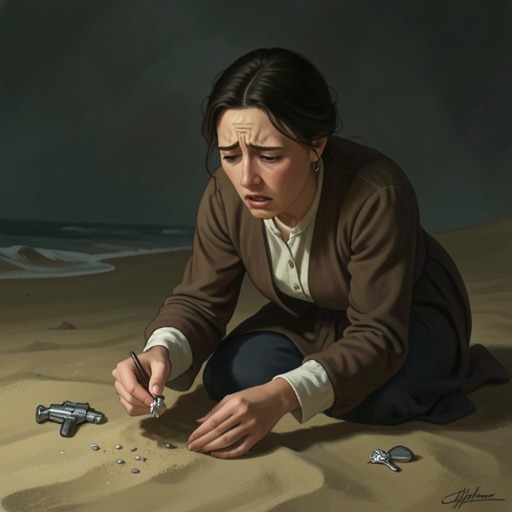
Andrew also interprets Minta’s distress over losing her grandmother’s brooch through a blunt generalization about women and emotion. As the tide rises and the group searches without success, Paul and Andrew decide to mark the place with Rayley’s stick and return at low tide. Their practical response offers no immediate comfort to Minta, who continues to grieve for the heirloom. Andrew’s judgment reveals both his capacity to assess the situation and the limits of his sympathy in that moment.
War and Death
The novel reports Andrew’s death without developing it into a battlefield scene: a shell explodes in France, killing him instantly along with twenty or thirty other young men. The abruptness of the announcement sharply contrasts with the earlier attention to his intelligence and future. Lily Briscoe later recalls that he should have become a great mathematician, making the loss legible not only as a death in the family but as the destruction of an unrealized intellectual life.
The war enters the story’s private world through disrupted domestic time and an altered landscape. In the neglected summer house, night sounds and falling objects punctuate periods of silence; the narrative then names the explosion and Andrew’s death. On the shore, an ashen ship and a purplish stain at sea disturb the scene’s apparent serenity. These details place wartime loss beside familiar domestic and natural surroundings, without suggesting that beauty or nature can compensate for it.
Memory and Narrative Significance
Andrew’s death continues to shape the living characters’ understanding of one another. Lily connects Mr Ramsay’s strained, austere expression to his knowledge of the loss, and recalls that Andrew had been killed instantly by a shell. Her reflection holds the son’s absence together with the father’s difficulty and doubt, making grief part of the emotional background to the later journey to the Lighthouse.
Augustus Carmichael’s response is also remembered through Lily’s limited, uncertain knowledge. She has heard that, on learning of Andrew’s death, he lost interest in life, though she does not know what he actually did. She reads this reported change as evidence of feeling while acknowledging that she knows Carmichael chiefly through outlines rather than intimate detail. Andrew’s death therefore becomes a point around which the novel explores both bereavement and the limits of knowing how another person suffers.
The narrative’s treatment of Andrew is deliberately divided between vivid traces of his earlier presence and the concise fact of his death. He is a brother in a crowded family, a young man whose judgments reveal social divisions, and a mathematician whose promise survives in the memories of others. His fate is not expanded into spectacle; its weight comes from the future it ends and from the way his absence changes the meaning of the people, house, and landscape that remain.