Artistic Creation and Subjective Vision
To the LighthouseArtistic Creation and Subjective Vision is the tension between what Lily Briscoe sees and what she can make a canvas communicate: artistic truth begins in a particular perception, yet must survive the painful passage from inward conception to public form. Her painting does not aim at likeness or fashionable elegance. It seeks to organize color, shape, light, and shadow according to a vision whose meaning is not immediately legible—even to Lily herself when she is not holding a brush. When William Bankes examines the work, the canvas becomes not merely an object on an easel but an exposed record of her experience and a possible ground for human connection.
Perception and the Demands of the Canvas
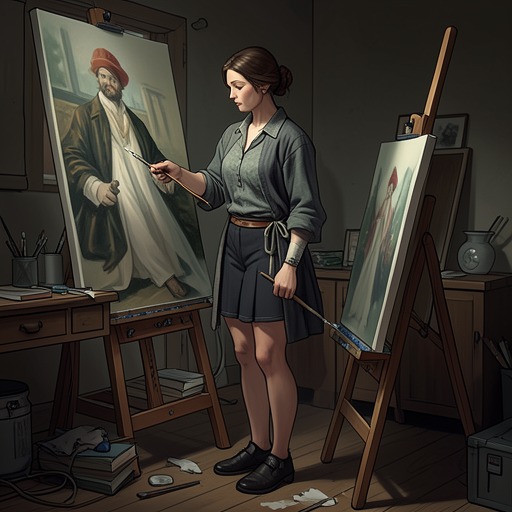
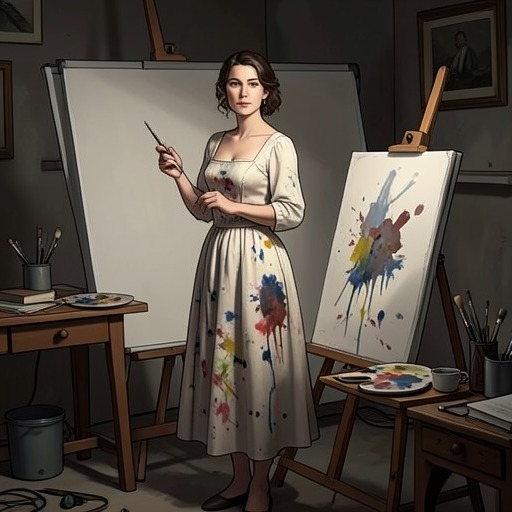
Lily’s difficulty starts with the difference between seeing and painting. The jacmanna appears bright violet against a wall that stares white. She will not soften either color into the pale, elegant, semitransparent effects made fashionable after Mr Paunceforte’s visit, because that treatment would falsify what she sees. Beneath the colors she also apprehends a commanding shape; the difficulty is not a lack of vision but its passage into material work. As soon as she takes up the brush, the clear image seems to change, and the distance between picture and canvas becomes a frightening passage through which her confidence can almost fail.
The effort is bound up with Lily’s sense of herself. She feels beset by her own inadequacy and insignificance, including the fact that she keeps house for her father off the Brompton Road. She nevertheless tries to hold on to a remnant of her perception against the forces that would pull it away. The canvas is therefore not a transparent copy of a scene: it is the difficult, incomplete result of defending a way of seeing while converting it into marks.
Refusal of Convention and the Work’s Ambiguity
The pressure to make the painting legible takes a gendered form in Charles Tansley’s remembered assertion, “Women can’t paint, women can’t write ...” Lily looks at the canvas and judges it terrible, not because she has ceased to value her vision, but because only a few random marks remain where she had seen something richly organized. She knows she could have made the color thinner and more faded and the shapes more ethereal, as Mr Paunceforte would have seen them. That alternative might have made the work conform to taste, but it would not have expressed her perception.
What Lily sees instead is color burning on a framework of steel, with the light of a butterfly’s wing lying upon the arches of a cathedral. The contrast between those vivid, structured images and the apparently random marks on the canvas makes the creative problem concrete: the intensity of an inner design does not guarantee that its material form will convey it. Nor does Lily resolve the problem by supplying a straightforward illustration. When asked what a triangular purple shape means, she identifies it as Mrs Ramsay reading to James, while acknowledging that no one could recognize a human figure there. The scene is present by intention, but the painting’s meaning exceeds resemblance.
Looking, Exposure, and Interpretation
William Bankes’s attention turns the painting into a test of what can be shared. As he raises his glasses and steps back to examine it, Lily feels exposed: she would like to snatch the canvas from the easel, because another person’s eyes might see in it the accumulated deposit of her thirty-three years, including what she has never spoken or shown. The prospect is agonizing and, at once, exciting. The canvas carries an intimacy that is not explained away by its visible subject.
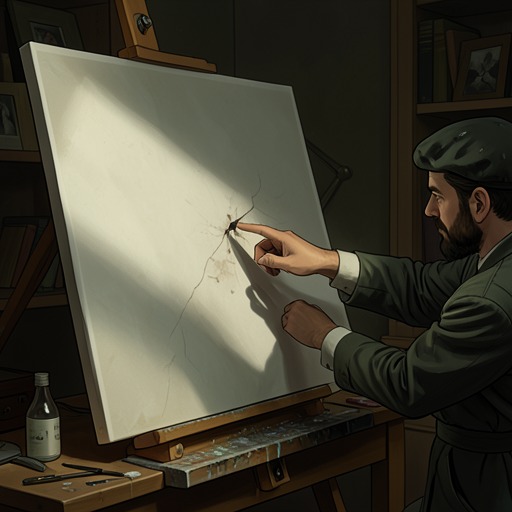
Bankes taps it with the bone handle of his penknife and asks about the triangular purple form. Lily explains that the image is of a mother and child, but not in the sense of a likeness. In one corner she felt the need for brightness; in another, for darkness. The mother and child can be reduced to a purple shadow without irreverence, because a light here requires a shadow there. Her tribute, if a picture must be understood as a tribute, lies in those formal relations rather than in a recognizable portrait.
Bankes responds in good faith rather than dismissing what he cannot immediately interpret. He considers the painting scientifically, asking how its masses, lights, and shadows relate and what Lily wishes to make of the scene. His own acknowledged history is different: the largest picture in his drawing-room is of cherry trees in blossom on the banks of the Kennet, where he spent his honeymoon. He has never before considered the painter’s problem of relating masses of light and shadow. The encounter therefore does not erase the difference between their ways of looking, but makes that difference a conversation rather than a verdict.
Form, Uncertainty, and Artistic Choice
Bankes’s questions cannot produce a final explanation from Lily. Without a brush in her hand, she cannot show him what she wants the picture to become; she cannot even see it clearly herself. Resuming her painting posture, she tries to recover the vision through the ordinary forms around her—hedges, houses, mothers, and children. She remembers the practical compositional problem: how to connect the mass on the right with the mass on the left. She might carry a branch line across the canvas or put an object, perhaps James, into the foreground vacancy. Yet either device might break the unity of the whole.
Her decision to stop is significant. Lily does not force an answer merely to satisfy the question, and she does not want to bore Bankes with an explanation she cannot yet make. She lifts the canvas lightly from the easel, leaving the formal problem unresolved. The painting’s openness is not evidence that any interpretation will do: its possibilities are bounded by the specific relations she is trying to sustain—color against color, light against shadow, separate masses held in a single composition.
Recognition and Connection
Although the canvas remains unfinished in conception, it has been seen. Lily experiences Bankes’s attentive looking as if something profoundly intimate has been shared and taken from her at once. She thanks him, Mrs Ramsay, the hour, and the place, and feels that the world has unexpectedly allowed her to walk away down the long gallery not alone but arm in arm with someone. The encounter suggests that recognition need not depend on a viewer mastering the work or on the artist translating it into a complete verbal account. Bankes’s willingness to look and ask in good faith is enough to make the exposed canvas a point of connection.
The image of the paint-box being closed gives that moment a material boundary. Lily nicks its catch more firmly than necessary, and the small sound seems to enclose the paint-box, the lawn, Bankes, and Cam as she rushes past. The painting remains a struggle against convention and against the failure of marks to equal vision; it is also the means by which Lily’s solitary seeing becomes shareable without becoming simple. Its artistic achievement, in this episode, lies in the persistence of her distinct perception and in the possibility that another person can approach it without reducing it to likeness.