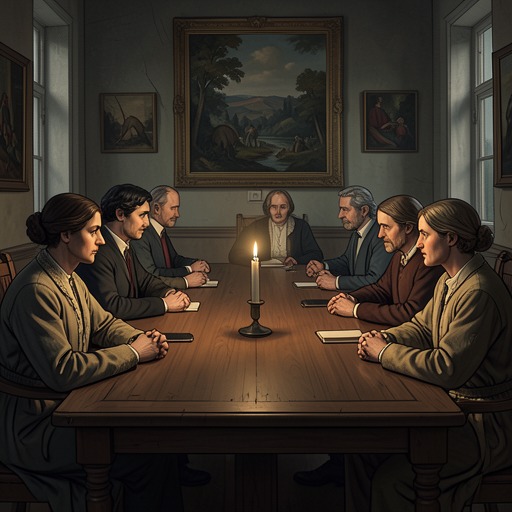
Charles Tansley
To the LighthouseCharles Tansley is a young academic whose conspicuous poverty and intellectual ambition are entangled with a harsh insistence on male authority. At the Ramsays’ summer gathering, he aggravates James’s disappointment about the postponed trip to The Lighthouse; he also repeatedly tells Lily Briscoe that women cannot paint or write. But the novel does not leave him as a simple embodiment of prejudice. Through Mrs Ramsay’s sympathy and Lily’s changing recollections, his brittleness becomes legible as both a social posture and a defense against vulnerability.
Identity and Background
Tansley is called “the atheist” and “the little atheist” by the Ramsay children, who mock him alongside Rose, Prue, Andrew, Jasper, Roger, and Nancy. The teasing belongs to a larger social unease: Nancy describes him as the hundred and tenth young man to pursue the family to the Hebrides, where, she thinks, it would be nicer to be alone. Mrs Ramsay rebukes the children’s incivility. Though she recognizes that Tansley can say disagreeable things, she refuses to let a poor guest become an acceptable target of ridicule.
His background gives the visit a material weight that the children’s mockery overlooks. When Mrs Ramsay invites everyone to the circus, Tansley echoes her invitation awkwardly, then explains that he never went to circuses as a child. He came from a family of nine children; his father was a working man who kept a chemist’s shop, and Tansley had paid his own way since he was thirteen. He often went without a greatcoat in winter, smoked the cheapest tobacco, and could not return the hospitality he received at college. The bare, defensive particulars make clear why an apparently casual invitation exposes a difference in means and childhood experience.
Tansley has built his life around work. He studies for seven hours a day, and his academic vocabulary—dissertation, fellowship, readership, lectureship—runs ahead of Mrs Ramsay’s understanding as they walk. His ambition is real, but its expression can sound like a performance of certainty: after the circus conversation unsettles him, he returns to talking about teaching, settlements, working men, and helping his own class, apparently recovering his confidence as the walk continues.
Life and Plot Trajectory
On an evening walk with Mr Ramsay, Tansley points out that the wind is due west, the worst direction for landing at The Lighthouse. The fact intensifies James’s disappointment. Mrs Ramsay dislikes Tansley for rubbing in the obstacle, but she also resists the family’s impulse to laugh at him. Her defense of him does not erase the sting of his remark; it places his social awkwardness and the children’s cruelty in the same scene, neither wholly excusing nor simplifying either.
The circus invitation briefly shifts the balance between them. Tansley cannot share Mrs Ramsay’s spontaneous excitement in her manner, but her warmth gives him an opening to describe the poverty and discipline behind his life. She recognizes why the invitation has unsettled him and decides that the others should stop laughing at him. His account is not a sentimental transformation: he soon resumes his confident academic talk. The episode instead reveals how quickly an apparent social failure can turn into self-explanation when someone offers attention rather than mockery.
At dinner, Tansley resents what he sees as women’s superficial talk, their attention to dress, food, and trivial remarks. He has no dress clothes and has come down in ordinary clothing; in his mind, the gathering confirms that women make civilization impossible through charm and silliness. He tells Mrs Ramsay that the family will not go to The Lighthouse the next day, asserting himself even as he likes and admires her. His sentence is at once a practical announcement about the weather and a bid to establish his standing in a room where he feels judged.
The conversation about books exposes another kind of unease. When someone asks how long a work will last, Mr Ramsay grows anxious about whether his own writing will endure. Tansley is not the center of this exchange, but his presence belongs to the dinner’s wider contest between knowledge and self-display: Mrs Ramsay thinks that Tansley could correct Paul Rayley and Minta Doyle about books, yet worries that his expertise is mixed with the need to make a good impression. His academic competence does not automatically produce ease or generosity in company.
Relationships and Conflict
Mrs Ramsay responds to Tansley with a mixture of pity, annoyance, and protectiveness. She understands that his poverty marks him out among guests who can treat a holiday and hospitality as ordinary pleasures. She also recognizes his vanity and his capacity to bore: after hearing his account of his family and deprivation, she still thinks him an insufferable bore when he continues his talk in town. Her kindness is therefore not blind admiration. She can see the discomfort beneath his self-assertion while remaining alive to its effects on other people.
His relation to Lily is more openly antagonistic. At dinner he sits opposite her, and she finds his manner meagre and fixed, though she is struck by his deep-set blue eyes. His assertion that women cannot paint or write has a disproportionate effect on her. She knows the claim is not true, and doubts that he even believes it in a straightforward way; nevertheless, it makes her feel herself bow under a wind and then struggle painfully upright. She turns her attention back to the sprig on the tablecloth and to her painting, determined to move the tree toward the center rather than spend her energy arguing with him.
The injury is sharpened by what Lily sees in her own work. She imagines the color burning across a steel-like structure and the light of a butterfly’s wing on cathedral arches, but on the canvas only a few random marks remain. Tansley’s dictum, recalled at precisely this moment of artistic frustration, joins social prejudice to the precariousness of making art: his authority does not determine whether she can paint, but it enters the conditions under which she has to persist.
Memory, Reassessment, and Change
Years later, while painting, Lily remembers Tansley standing close behind her at this very spot, repeating that women cannot paint or write. She recalls his purple book, his work in the sun, his habit of carrying on about shag tobacco at fivepence an ounce, and his tendency to occupy the middle of the view at dinner. These details preserve the irritation of the earlier scenes, but Lily’s memory also reaches beyond them to a morning on the beach.
On that windy day, Mrs Ramsay sat by a rock writing letters while Lily and Tansley threw flat black stones and made them skip across the waves. Mrs Ramsay was so short-sighted that she could not tell whether something floating offshore was a lobster pot or an upturned boat. Tansley, in her presence, became as pleasant as he could be; the two young people got on well and threw stones together while Mrs Ramsay watched. The letters she wrote were so numerous that the wind sometimes carried a page toward the sea, and Lily and Tansley rescued it. The remembered scene gives their relation a form different from the dinner-table antagonism: not a conversion or apology, but a moment of friendship made possible by a third person’s calm presence.
Mrs Ramsay’s part in Lily’s memory is decisive. Sitting beneath the rock, writing, she seemed to bring together what had been scattered: anger and irritation fell away, and Lily’s quarrel and sparring with Tansley became part of a scene of mutual liking. Because Mrs Ramsay’s ordinary act of writing holds the scene together, Lily can remember Tansley without making either his prejudice or her resentment the whole truth about him. The friendship survives in memory as something complete in itself, almost like a work of art.
Lily’s later account also revises her judgment of him in light of what happens after the earlier gathering. Tansley gains his fellowship, marries, and lives at Golder’s Green. During the war, Lily hears him speak in a hall: he denounces, condemns, and preaches brotherly love. She cannot easily reconcile that public language with the man who told her women could not paint, but she recognizes the gap between judging his public performance and understanding his private character.
Narrative Role and Significance
The novel makes Tansley a source of discomfort whose significance lies partly in how other people interpret him. The children reduce him to a comic outsider; Mrs Ramsay sees a poor young man who deserves protection, even when he irritates her; Lily experiences his words as a direct assault on her artistic independence. Later, her recollection exposes the limits of each single view. Tansley’s class insecurity helps explain the defensive precision of his account of tobacco, clothes, and work, but it does not excuse his attempt to deny women’s capacities.
His character also brings social power into the intimate scale of a holiday gathering. He is neither wealthy nor socially assured, yet he can repeat a convention that diminishes Lily’s ambition. The contradiction matters: material disadvantage does not prevent him from wielding a gendered authority that he has not earned through superior artistic vision. Conversely, his own vulnerability does not make him only an oppressor. The beach memory places his capacity for ease and liking beside the injury he caused, insisting that a person can be both the agent of another’s abasement and a participant in a genuine moment of companionship.
Lily’s final way of seeing him is neither absolution nor a return to caricature. She admits that her idea of Tansley was grotesque and that people’s judgments of others can serve private purposes; she had used him as a whipping-boy when out of temper. To take him seriously, she has to borrow Mrs Ramsay’s way of looking at him. Tansley thus remains a difficult figure, but the narrative loosens the fixed outline of the insufferable atheist and lets memory preserve, alongside his cruelty and pretension, the poor student, the aspiring scholar, and the young man who once skipped stones with Lily on the shore.