Factual Truth and Emotional Comfort
To the LighthouseFactual Truth and Emotional Comfort is the tension between Mr Ramsay’s insistence on uncompromising factual judgment and Mrs Ramsay’s effort to preserve hope and tend to other people’s feelings. It comes into focus over the question of whether the family can sail to The Lighthouse: his prediction is grounded in the weather, but the manner in which he asserts it wounds his son and his wife. The scene neither makes truth false nor makes comfort a simple substitute for it; instead, it shows how factual certainty and emotional care can collide, and how intimacy may be restored without the underlying uncertainty disappearing.
The Forecast and Its Stakes
The disagreement begins with James Ramsay’s expectation of the long-awaited excursion. At six, he is absorbed in cutting pictures from the Army and Navy Stores catalogue, and his mother’s words make the prospect of going to The Lighthouse seem almost within reach. Against this expectation, Mr Ramsay stops at the drawing-room window and says, “But,” said his father, stopping in front of the drawing-room window, “it won’t be fine.” The forecast matters not simply as a practical judgment about a voyage but because James has invested the possibility with intense happiness.
Mr Ramsay’s certainty is supported by concrete conditions: the barometer is falling, and the wind is due west, a direction unfavorable for landing at The Lighthouse. Later, when Mrs Ramsay says there is no chance of going the next day, he snaps that there is not the slightest possible chance. In his understanding, telling the children otherwise would give them a hope the conditions cannot justify. His commitment to facts is bound up with a severe view of life: children should learn that it is difficult, and that meeting it requires courage and endurance.
Mrs Ramsay does not claim that the weather is settled in the family’s favor. She replies that the wind may change and says she expects it will be fine. Her answer leaves possibility open where Mr Ramsay closes it. For James, that difference is decisive: an uncertain future can still be imagined as a promise, while his father’s prediction makes disappointment immediate.
Comfort as Practical Care
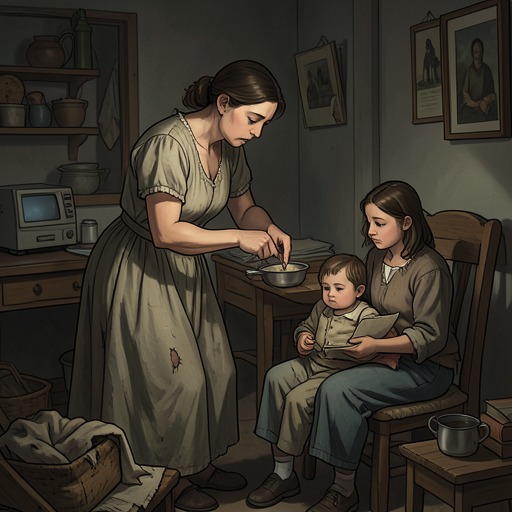
Mrs Ramsay’s response to uncertainty is not limited to encouraging words. She is knitting a reddish-brown stocking for the Lighthouse keeper’s little boy, whose hip is threatened by tuberculosis. She hopes to finish it that night in case the excursion goes ahead, and also intends to send old magazines, tobacco, and whatever else the household does not need. The gifts are directed toward the keeper and his family, whom she imagines isolated on a small rock for a month or more in stormy weather, without letters or newspapers and unable to see their family.
This planned kindness gives her optimism a material form. The stocking does not prove that the journey will happen; it is care prepared against the possibility that it might. Nor does Mrs Ramsay treat the lighthouse keepers’ isolation as an abstraction. She asks her daughters to consider what it would mean to be separated from a wife and children, not to know whether they were ill or hurt, and to face weeks of the same waves and severe weather. The comforts she gathers answer, as far as she can, the loneliness and deprivation she imagines.
Her care also reflects the demands placed on her within the household. She says people come to her all day with one request after another, and that she often feels like a sponge soaked in other people’s emotions. Against Mr Ramsay’s ideal of speaking an unsoftened fact, her daily experience makes emotional need hard to treat as irrelevant. Her response to James’s disappointment and to the keeper’s isolation belongs to the same practice of attending to what other people feel and require.
Truth, Anger, and Repair
When Mrs Ramsay maintains that the weather may improve, Mr Ramsay sees her remark as irrational. He believes that she is making the children hope for what the facts rule out, and interprets this as a failure to face reality. His anger rises from the collision between his demand for accuracy and her refusal to treat the forecast as final. Yet the narration makes the disproportion visible: she has said only that it might be fine the next day, and the text acknowledges that it might be.
The conflict is therefore not a clean division between a truthful husband and a lying wife. Mr Ramsay’s forecast has a factual basis, but his treatment of its implications as certain exceeds what even the weather evidence can settle. Mrs Ramsay’s reassurance does not guarantee a favorable outcome; it preserves hope within uncertainty. The distinction is between recognizing unfavorable evidence and using it to close off every possibility, and between offering comfort and claiming that the desired outcome is assured.
Mrs Ramsay experiences his pursuit of truth without consideration for feeling as an affront to ordinary human decency. She does not answer his outburst. Instead, she lowers her head and bears the exchange in silence. Her reverence for him remains alongside her hurt: she is ready to take his word about the weather, and concludes that the sandwiches need not be cut if the trip cannot happen. This is not agreement that his anger was necessary. It shows how quickly his authority can make her withdraw from defending her own judgment.
The emotional movement changes when Mr Ramsay offers to ask the Coastguards whether she would like him to. His offer follows the anger, and Mrs Ramsay’s practical reply about the sandwiches gives the argument a way to end without resolving the forecast. She then reflects on his contradictory declarations: he had said that it must rain, that it would not rain, and had also cursed her. Even after that, a sense of security opens before her, and she feels deep reverence for him. The exchange reveals both the force of their attachment and the uneven terms on which reassurance is restored.
The Scene’s Larger Significance
The scene places the factual dispute inside a family relationship whose members do not experience truth in the same way. James feels the possibility of the trip as joy before it has become a practical plan. Mr Ramsay sees an obligation to correct that hope with the weather’s evidence. Mrs Ramsay sees both the vulnerability of a disappointed child and the human needs that ordinary plans might allow her to meet. The same forecast thus becomes a test of judgment, tenderness, and authority.
Neither position is wholly detached from care. Mr Ramsay believes that frankness prepares children for a difficult world, rather than sparing them discomfort with comforting falsehoods. Mrs Ramsay’s hopeful answer, meanwhile, is not merely a denial of the barometer or the wind; it also protects room for possibility and expresses her habitual attention to others. The strain lies in the difference between the purposes and effects of their speech: a statement intended as preparation can become cruelty when delivered without regard for its listener, while reassurance can sustain hope without controlling what happens next.
The contrast is sharpened by the small, practical question of whether to cut sandwiches. The possible journey has already organized James’s happiness and Mrs Ramsay’s preparations for the keeper’s family, but the weather may cancel both. In this scene, comfort cannot guarantee the excursion, and factual knowledge cannot make disappointment painless. The emotional resolution instead comes through a renewed gesture of assistance and the persistence of Mrs Ramsay’s attachment to Mr Ramsay, leaving the conflict between accuracy and kindness intact rather than pretending that either need has vanished.