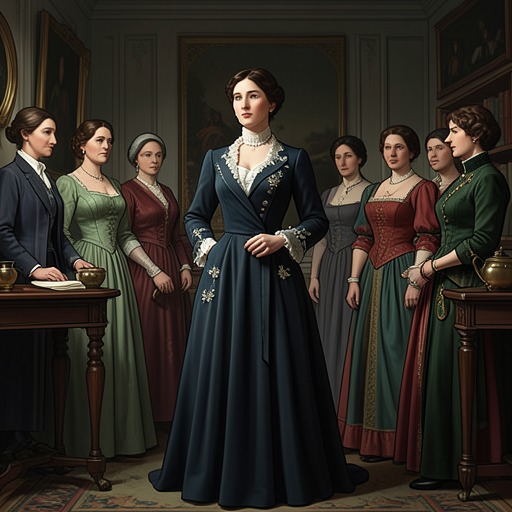
Gender Norms and Women’s Social Position
To the LighthouseGender Norms and Women’s Social Position in To the Lighthouse are made visible in the everyday demands placed on women: they are expected to care for others, protect men’s confidence, and treat marriage as the fullest measure of a woman’s life. Mrs Ramsay often enacts those expectations with authority and generosity, while Lily Briscoe experiences their constraints directly as an artist. Their differing responses reveal a social order that can feel beautiful and binding at once: its ideals of courtesy and care offer connection, but can also make women’s own work and desires seem secondary.
Domestic Duty and Social Authority
Mrs Ramsay’s care extends from her household to people beyond it. She knits a reddish-brown stocking for the Lighthouse keeper’s son, whose hip is threatened by illness, and considers sending magazines and tobacco to the keepers, imagining their isolation on a small rock through long stretches of stormy weather. The gift makes care tangible, but also locates it in the practical, often unrecognized work of anticipating other people’s needs.
That work is not confined to the family. Mrs Ramsay takes responsibility for her guests’ comfort and defends Charles Tansley when the children mock him. She reminds Nancy that Tansley had been invited, not imposed upon them, and resists what she sees as incivility toward a young man who is poor and intellectually ambitious. Her protection expresses a view of men as deserving of deference and care, even when their manner is disagreeable. The narrator links this response to her regard for men’s public authority: they negotiate treaties, rule India, and control finance, while women are expected to recognize and support their importance.
Mrs Ramsay’s authority in the home is real, but it operates through service and standards of conduct rather than freedom from responsibility. She can admonish her daughters for mocking a guest and insist that they treat him properly; at the same time, her own day is shaped by the needs of children, visitors, and household life. The daughters’ silent thoughts of a different existence, perhaps in Paris and less occupied with caring for men, register an alternative to the pattern their mother embodies. Yet they also admire her severity and courtesy, seeing a striking dignity in the way she exercises her domestic authority.
Marriage as a Social Measure
The pressure to marry is most explicit in Mrs Ramsay’s conversation with Lily. In her imagined recollection of their interaction, she insists that an unmarried woman has missed the best of life, presenting marriage as a universal measure rather than one choice among several. The belief has particular force because it comes from someone Lily loves and respects, not merely from an impersonal convention. Mrs Ramsay’s affection does not prevent her from assuming that Lily’s independence is a mistake.
Lily can name what the prescribed future leaves out: her father, her home, and, most importantly, her painting. She likes solitude and does not feel made for marriage, but finds it difficult to make those claims feel equal in weight to the life Mrs Ramsay represents. Her laughter at the thought of Mrs Ramsay calmly presiding over destinies she does not understand gives their difference intimacy rather than simple hostility. Lily’s resistance is real, but she recognizes how easily an independent life can be made to seem incomplete when marriage is treated as the natural destination for women.
The same expectations appear in Mrs Ramsay’s efforts to make social life run smoothly. When she senses that Lily’s refusal to encourage Tansley may leave him unable to assert himself, she appeals to Lily to be kind. Lily complies, asking Tansley to take her to the Lighthouse. In that small exchange, a woman’s social role is framed as helping a young man regain confidence, even when he has belittled women’s capacities. The obligation is not enforced by a formal rule; it works through affection, tact, and the expectation that women will manage the emotional temperature of a room.
Women’s Work and the Denial of Artistic Authority
For Lily, the assumption that women lack artistic authority has a direct and painful form. As she looks at her painting, she sees a particular structure of color and light that she cannot yet make present on the canvas. Tansley’s assertion, “Women can’t paint, women can’t write ...”, intrudes upon her sense of the work. The statement does not prove his judgment right; its power lies in how it makes her question herself and renew her effort to hold on to what she sees.
The conflict is not only between one man’s insult and one woman’s ambition. Tansley believes that women’s charm and talk make civilization impossible, and he treats domestic and social life as evidence of their superficiality. Yet he also wants recognition and a chance to display his own knowledge. Lily sees the desire for self-assertion beneath his discomfort, but refuses to regard supporting him as automatically her duty. She recognizes the social code that asks a woman to make room for a man’s vanity, and considers what would happen if neither person performed the expected act of assistance.
Mrs Ramsay’s intervention changes Lily’s conduct, though it does not settle their disagreement. Lily is kind to Tansley and draws him into conversation; he then tells the others that he once went to a lighthouse with his uncle, who kept its light, and had been there in a storm. The exchange gives him an opportunity to be heard, but Lily knows that her friendliness has been a performance and doubts that the two of them will truly know each other. Her attention returns to the painting and the intended movement of its tree toward the middle. The act of returning to her work marks a limited but important refusal to let social service replace artistic purpose.
Care, Public Need, and the Limits of the Domestic Role
Mrs Ramsay’s concern for others also exceeds the conventional drawing-room ideal of feminine care. She is troubled that there is no hospital on the island and that milk delivered in London can be dirty. She imagines establishing a model dairy and a hospital herself, but immediately confronts the practical obstacle: she has children to care for and hopes she might have time once they are at school. Her public-minded ambitions are therefore both substantial and constrained. The same woman who devotes herself to domestic duties can see unmet social needs, yet cannot easily separate those ambitions from the labor assigned to her at home.
Her account of care is not simply a rejection of women’s domestic role. She loves carrying a baby and wishes her children would not grow up so quickly; she sees the promise and distinct abilities of each child. But her recognition that the children are happier now than they will be later is checked by the knowledge that such remarks anger her husband. The scene shows care as a source of deep attachment, while also showing that even a mother’s interpretation of family life can be subject to a husband’s judgment.
Later, the empty house preserves the material traces of the work and presence that once organized it. Mrs McNab finds Mrs Ramsay’s clothes, including an old grey gardening cloak, among the things left in the bedrooms after the family stopped coming. The garments and household objects persist after Mrs Ramsay’s death, but they cannot restore the person whose care gave them meaning. Their survival makes domestic life legible as labor and memory, even as the woman herself is absent.
Significance
The novel presents gender norms as a lived system rather than a single command: they shape manners toward male guests, expectations about marriage, judgments of women’s intellectual capacity, and the distribution of care. Mrs Ramsay can exercise authority within that system and imagine public improvements, yet she also reproduces its assumptions when she regards marriage as essential for Lily and asks Lily to bolster Tansley. Lily’s response is neither effortless escape nor simple submission. She recognizes the cost of the expected performance, sometimes accepts it, and then turns back toward the work she considers her own.
The contrast between the women does not make one a symbol of oppression and the other a complete emancipation. Mrs Ramsay’s care is powerful and meaningful, but it can obscure ambitions that do not fit her model of fulfillment. Lily’s artistic independence is vulnerable to social judgment, but it persists in the concrete decisions she makes about her painting. By setting intimate gestures beside explicit dismissals of women’s work, To the Lighthouse shows how authority is reproduced through ordinary acts of kindness and courtesy as well as through direct claims about what women can do.