Lily Briscoe
To the LighthouseLily Briscoe is an independent painter whose effort to make a picture becomes a test of whether she can hold to her own vision against artistic convention, social judgment, and the difficulty of turning perception into marks. Her canvas, which includes Mrs Ramsay reading with James, is not meant as a literal likeness: through the relations of color, mass, light, and shadow, Lily seeks a form of tribute that can preserve what she sees without submitting it to conventional ideas of beauty or representation. When she returns years later, after Mrs Ramsay’s death, she completes the painting with one decisive line, giving the novel’s conclusion an artistic act that is both firm and unresolved in its future reception.
Identity and Artistic Vision
At the Ramsays’ summer house, Lily paints in the garden while Mrs Ramsay sits reading with James at the window. Mrs Ramsay regards Lily as an independent creature, doubts that anyone would take her painting very seriously, and supposes she will never marry. Lily’s work nevertheless holds Mrs Ramsay’s attention: remembering that she has promised to keep her head in position, she bends it for the picture. The arrangement places Lily’s art alongside the domestic scene without making it merely an illustration of family life.
Lily’s way of seeing resists the fashionable delicacy associated with Mr Paunceforte. The jacmanna is bright violet and the wall stark white; she refuses to soften those colors simply because a more pale and elegant treatment is in fashion. Yet the passage from seeing to painting defeats her confidence. She can apprehend the shape clearly while looking, but when she takes up her brush, the image changes. The distance between vision and canvas feels perilous: she struggles to hold on to what she sees, fearing that the forces around her will pluck even its remnant away.
That struggle is inseparable from her sense of social and personal insignificance. As she begins to paint, she thinks of her inadequacy and of keeping house for her father off the Brompton Road. She also feels an intense attachment to Mrs Ramsay and to the surrounding scene, but cannot settle it into a simple declaration of love. Her difficulty is not a lack of feeling; it is that feeling, like perception, does not arrive already shaped for explanation. The painting becomes the form through which she tries to give it shape.
The Canvas and the Experience of Being Seen
Lily’s canvas bears the marks of a conflict between an ambitious vision and what she fears she has actually made. In imagination she sees color burning on a framework of steel and the light of a butterfly’s wing on cathedral arches; on the canvas, she sees only a few random marks. She fears the picture will never be seen or even hung. The memory of Charles Tansley whispering that women cannot paint or write turns that private disappointment into a social one: her doubt is sharpened by a judgment that denies women artistic authority altogether.
The painting’s subject is deliberately difficult to identify. When William Bankes examines it, he taps the canvas with the bone handle of his penknife and asks what the triangular purple shape indicates. Lily explains that it is Mrs Ramsay reading to James, while acknowledging that she has not attempted a recognizable likeness. Bankes asks why she included them if no one can tell they are human figures. Lily’s answer is formal rather than descriptive: the picture needs darkness in one place because there is brightness in another, and a mother and child can be reduced to shadow without irreverence.
Bankes’s questions help make the picture’s method explicit. He is interested in how masses, lights, and shadows relate, a problem he says he has never considered before. His artistic preferences have previously lain elsewhere: the largest picture in his drawing room is of cherry trees in blossom beside the Kennet, where he spent his honeymoon. Facing Lily’s canvas, he tries in good faith to understand what she means to make of it. Lily cannot yet explain the whole design. She considers connecting the masses on either side with a branch or placing James in the foreground, but worries that either choice might break the unity of the picture.
Having the work examined exposes how much of herself Lily feels it contains. She braces herself as Bankes looks, recognizing in the canvas the deposit of her daily life mixed with something more secret than she has ever spoken or shown. The ordeal is painful and exhilarating at once. When she takes the canvas from the easel, it has already been seen, and the exchange leaves her feeling that she is no longer alone: Bankes has shared something profoundly intimate, even though he cannot simply be handed the vision she is still trying to realize.
Mrs Ramsay, Bankes, and the Social World
Lily’s relation to Mrs Ramsay combines admiration, affection, and critical distance. Watching Bankes gaze at Mrs Ramsay, Lily finds the intensity of his reverence consoling: it seems to ease the perplexities and burdens of life. She is grateful for the moment and feels herself, by association, praised under the shelter of the regard that covers women. But the scene also makes her aware that she sees Mrs Ramsay differently from Bankes. His gaze idealizes her; Lily adds her own distinct perception, finding Mrs Ramsay extraordinarily lovely and perhaps good, while sensing that she is not the same as the perfect figure Bankes contemplates.
That difference matters to Lily’s artistic independence. She remembers being annoyed by Mrs Ramsay’s high-handedness, and she will not let admiration cancel judgment. Nor does she simply convert her attachment into conventional worship: the feeling she cannot name is directed toward the whole world of the house, the hedge, and the children as well as toward Mrs Ramsay herself. Her picture’s mother-and-child form therefore does not depend on a straightforward portrait or a single explanation of its emotional meaning. It works through the relation of shadow and light, preserving the scene by transforming it.
Mrs Ramsay’s presence also shapes the social movement of the house. Lily observes her taking Minta by the arm and leaving the room with a quiet, decisive air, as though she has chosen something that must be done at once and alone. After Mrs Ramsay departs, the group disperses: Bankes takes Charles Tansley by the arm to continue a political discussion on the terrace, and the evening’s balance shifts from poetry toward politics. Lily registers Mrs Ramsay’s capacity to redirect a gathering, even in leaving it. These observations belong to the same attentive practice as her painting: she watches how gestures, relationships, and changes of attention alter the shape of a scene.
Return, Bereavement, and the Final Line
Years later, Lily arrives at the house late one September evening, with Mr Carmichael coming by the same train. On her first morning back, she is alone at the breakfast table and finds that Mrs Ramsay’s death leaves her unable to say what she feels. She reaches for a phrase to cover the blankness, but it cannot make grief or absence articulate. Meanwhile, Mr Ramsay, James, and Cam are preparing to go to the Lighthouse. The expedition is already unsettled: Cam and James are not ready, Nancy has forgotten to order sandwiches, and Mr Ramsay loses his temper and leaves the room. Lily experiences relief and disappointment when the party has gone, while her sympathy seems to recoil back upon her.
The unfinished painting then draws her attention away from the confusion. Its white canvas seems to rebuke the agitation, yet the old design remains active in her mind. Walking along the Brompton Road or brushing her hair, she has found herself returning to its crossing lines and to the green, blue, and brown mass of the hedge. She knows the difference between imagining the picture and making it: thought can pass over the design freely, but the first physical mark commits the painter to risks and decisions that cannot be undone.
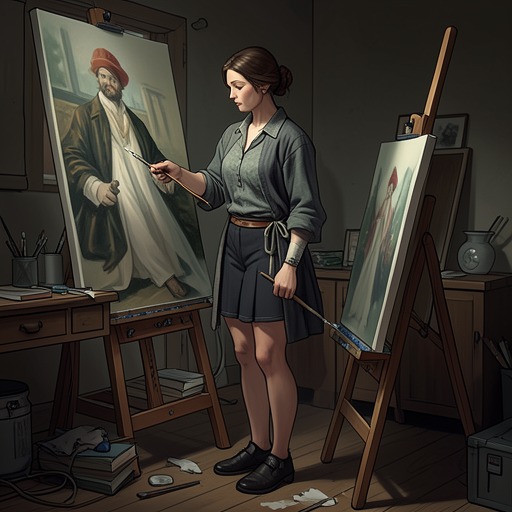
On the lawn, Lily discovers that her brush is wrong and that the easel has been rammed into the earth at the wrong angle. She corrects both. Then she raises the brush and hesitates over where to begin. One line, she understands, entails innumerable risks; what seemed simple in idea becomes complex in practice, like waves that look symmetrical from above but open into gulfs and crests to the swimmer among them. Still, the risk must be taken. She makes a first quick stroke, then a second and a third, working through pauses and movements until brown lines begin to enclose a space. The physical rhythm of painting is not a sudden escape from difficulty but a way of proceeding within it.
As the expedition reaches its conclusion, Lily hears that the travelers have landed and says aloud that it is finished. Mr Carmichael stands beside her, and their brief exchange suggests a shared understanding without requiring further speech. Lily turns back to her own work. The canvas is still blurred; she imagines it might be hung in the attics or destroyed, but this possibility no longer determines whether it matters. Looking from the empty steps to the picture, she sees it clearly for a second and draws a line in the center. She lays down her brush, exhausted, and recognizes that she has had her vision.
Completion Without Guarantee
Lily’s final act completes the painting without resolving every uncertainty attached to it. The picture may never be publicly displayed or valued; she has already imagined it relegated to the attics or destroyed. What changes is her relation to that prospect. At the end, the work’s significance no longer depends on an assurance of recognition. She has made the central line that brings the canvas to completion, and can name the vision as hers without claiming that every earlier doubt has disappeared.
The painting’s development also gives form to the novel’s movement between scenes of domestic life and stretches of time in which people and places change. Lily first works in the presence of Mrs Ramsay and James, and later returns to a house marked by Mrs Ramsay’s absence. The image she has carried in memory survives neither as a fixed photograph nor as an untouched feeling: she must approach it again through the changing conditions of her own attention and the material decisions of painting. Completion is therefore an act of renewed seeing, not a recovery of the past exactly as it was.
Lily’s achievement finally joins artistic independence to connection. The work includes Mrs Ramsay and James, but its tribute takes the form Lily chooses: a shadow here, a light there, and an arrangement of masses whose meaning cannot be reduced to likeness. Bankes’s attentive examination briefly makes the act of being seen less solitary; the final line, by contrast, is Lily’s own decision. The novel closes its central artistic arc not with a guarantee that others will understand the picture, but with the painter’s completed gesture and her recognition that she has seen what she needed to see.