Lily Briscoe and William Bankes’s friendship
To the LighthouseLily Briscoe and William Bankes’s friendship is a quiet alliance founded on proximity, respect, and the rare experience of being understood without being remade. Bankes becomes the first person to examine Lily’s painting in a way that recognizes her own artistic purpose, turning a vulnerable encounter with the canvas into an exhilarating sense of companionship. Their bond matters both for its independence from marriage and for the confidence it gives Lily to return to her work.
How the Friendship Begins
Lily and Bankes become allies through the small, repeated courtesies of living near one another. They have rooms in the village and share the same house; on doorsteps, they exchange remarks about soup, the children, and other everyday matters. The intimacy is not announced by a dramatic confession but built by this modest familiarity, which lets them stand together without requiring constant conversation. Bankes is old enough to be Lily’s father, a widower and botanist, careful in appearance and habit. He has noticed that she gets up before breakfast to paint alone and keeps an orderly life. His regard for her is not founded on the conventional allure he associates with Minta Doyle: he values Lily’s good sense and judges her superior to Minta in that respect.
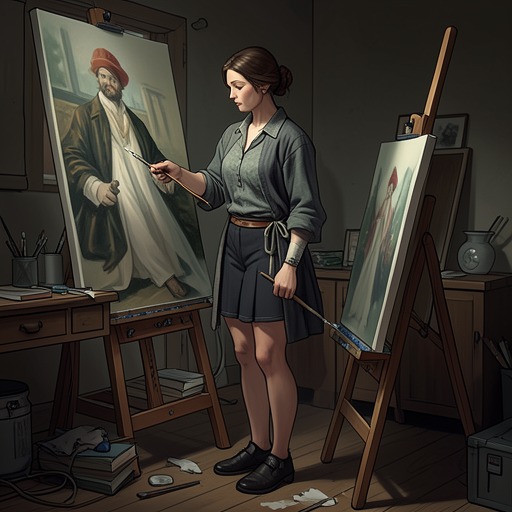
That alliance takes visible shape when Bankes comes upon Lily at her easel. She is alert to the possibility that someone will look at the picture and feels especially exposed to the prospect of Charles Tansley’s judgment. But she recognizes Bankes by his footfall and does not turn the canvas toward the grass. When Mr Ramsay approaches in an agitated, gesturing mood, Lily and Bankes share the discomfort of having witnessed a private disturbance. They do not intrude on it; Bankes suggests a walk, and Lily agrees, though her attention remains with the painting. Their friendship begins, in part, as a practiced respect for boundaries: each can accompany the other without claiming full access to what the other experiences.
Respect, Difference, and Judgment
Lily’s understanding of Bankes deepens through a sequence of impressions that refuse to settle into a single verdict. She admires his severity, goodness, and impersonal devotion to science. She is moved by his loneliness, but her respect is not simple idealization: she also remembers his valet, his objections to dogs on chairs, and his long complaints about salt in vegetables and English cooks. Her thoughts set him beside Mr Ramsay, whose vanity and tyranny she deplores even as she recognizes his love for his children and his vivid, fiery nature. The comparison does not produce a clean ranking. Instead, it exposes how affection and judgment gather contradictory details, and how little a person can be reduced to a single quality.
Bankes, in turn, is willing to give Lily’s work the kind of attention that makes difference a basis for conversation rather than a reason for dismissal. The scene is charged with her fear that another person’s gaze will expose the private substance of her life. She braces herself as Bankes takes out a penknife and taps the canvas with its bone handle, asking what the triangular purple form indicates. Lily tells him it is Mrs Ramsay reading to James, while explaining that she has not attempted a literal likeness. The painting’s meaning depends not on recognizable figures but on the relation between masses, light, and shadow.
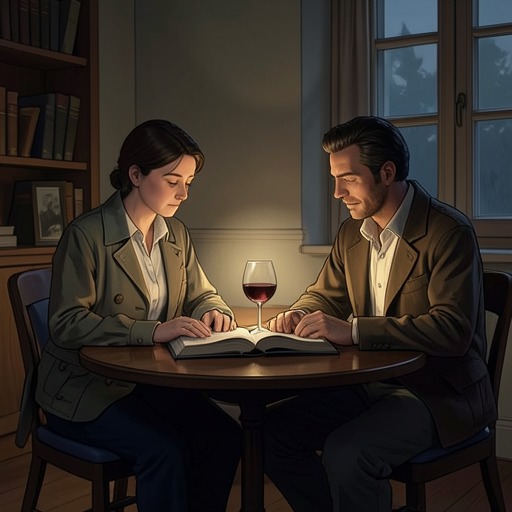
Bankes asks why she introduced the mother and child if they are not meant to be identifiable. Lily answers that the corner is bright and that she felt a need for darkness elsewhere. She describes the picture as a tribute, but one made through visual relations rather than portraiture: a mother and child can become a shadow without being treated irreverently, because a light in one place requires shadow in another. Bankes considers this explanation in good faith. He admits that his prejudices generally lie on the other side and mentions the largest picture in his drawing room, a painting of cherry trees in blossom by the Kennet, which he bought after his honeymoon there. He is not an art theorist, but he is interested enough to ask what Lily is trying to make of the scene and to examine how its forms relate.
The Painting as a Shared Encounter
Bankes’s attention both unsettles and releases Lily. Before he looks, the picture feels like the residue of her thirty-three years, mixed with something she has never spoken or shown. She cannot fully explain what she wants to make of it without a brush in hand. Looking back at the scene, she considers carrying a branch line across to connect the mass on the right with the one on the left, or putting an object, perhaps James, into the empty foreground. Either choice might break the unity of the whole. She cannot resolve the composition at that moment and lifts the canvas lightly from the easel rather than prolonging the explanation.
Yet the picture has been seen, and that fact changes the encounter. Lily feels that Bankes has shared something profoundly intimate with her. She mentally credits him, Mrs Ramsay, the hour, and the place with a power she had not expected: for a moment, she is no longer walking alone but feels herself arm in arm with someone. The image of companionship is not a declaration that they have become identical, nor that Bankes has solved her artistic problem. Its force lies in the fact that he has looked carefully while allowing the work to remain hers. Her firmer-than-necessary snap of the paint-box catch seems to enclose the scene—the box, the lawn, Bankes, and Cam rushing past—in a lasting circle.
This attention is consequential because Lily’s difficulty is not simply a lack of skill or an absence of ideas. She can see the picture with clarity, but the passage from seeing it to making it brings self-doubt, fear of judgment, and competing pressures upon her. Bankes’s respectful questions do not eliminate those pressures. They do, however, show that another person can enter the vicinity of her vision without taking it over. His scientific manner, which might have made the exchange merely an inspection, instead becomes a form of patient curiosity about the relations of masses, lights, and shadows.
Companionship Beyond Marriage
Mrs Ramsay reads the pair differently. Seeing Lily and Bankes strolling together, she decides that they must marry and treats their walk as evidence of an admirable match. Lily, however, does not understand the friendship as a courtship. As she and Bankes talk about art and travel, she recognizes the distinction between their companionship and Mrs Ramsay’s marital ideal. Bankes recalls seeing the Rembrandts in Amsterdam, the Prado closed when he visited Madrid on Good Friday, and the art of Rome and Padua. He explains that his late wife had been in poor health for years, limiting their sightseeing. Lily describes the places she has visited, but observes to herself that looking at more pictures can make an artist hopelessly discontented with her own work.
Bankes answers by resisting the idea that artistic achievement makes lesser artists worthless: not everyone can be a Titian or a Darwin, and he suggests that celebrated figures depend, in a broader sense, on people like themselves. Lily would like to compliment him but knows he does not want praise, so she says only that she will go on painting because the work interests her. He believes she will. Their exchange confirms an important balance in the friendship: Bankes encourages her without demanding gratitude or turning encouragement into a claim over her future.
The imagined marriage is therefore not the necessary completion of their relation. Lily sees marriage represented when she and Bankes watch Mr and Mrs Ramsay standing close together as Prue and Jasper throw a ball. For an instant, the couple becomes a symbol of husband and wife. That symbolic image belongs to the Ramsays’ marriage; it does not establish that Lily and Bankes share the same destination. Their own bond rests instead on work, conversation, and a mutual capacity to observe without forcing their connection into the social role Mrs Ramsay desires for them.
Friendship Across Time
The friendship remains present in Lily’s later memories and in her return to painting. After Mrs Ramsay’s death and the years of absence from the house, Lily is once again at work in the old place, while Mr Ramsay’s repeated approaches make it difficult for her to concentrate. The scene makes clear that Bankes’s earlier attention remains a point of reference: he had looked at her picture without turning its unresolved state into a failure or using his authority to dictate its meaning. The memory offers a contrast to the pressure Lily now feels when another person’s need threatens to occupy the space required for her work.
Bankes’s friendship does not remove loneliness, artistic uncertainty, or the limits of understanding. Lily has her own mistaken readings of other people, and she recognizes that her pity for Bankes may arise from a need of her own rather than from his actual condition. She then remembers that he has his work, just as she has hers. The recognition redirects her attention to the painting: she sees that the tree should move nearer the middle to avoid an awkward gap, and uses the salt cellar on the tablecloth to remind herself of the change. The friendship’s lasting effect is not that Bankes paints for her or finishes her picture. It is that their shared attention helps make solitude compatible with connection: Lily can value another person’s presence and still return to the work only she can do.