Lily Briscoe’s Artistic Struggle
To the LighthouseLily Briscoe’s Artistic Struggle is the conflict between a vision she experiences with force and the uncertain, exposed labor of making it visible. Her canvas tests whether she can retain what she sees against fashionable taste, self-doubt, and the gendered dismissal that women cannot paint. The struggle is not simply to depict a mother and child, but to discover how color, shape, light, and shadow can carry meaning without literal likeness.
Vision and the Difficulty of Execution
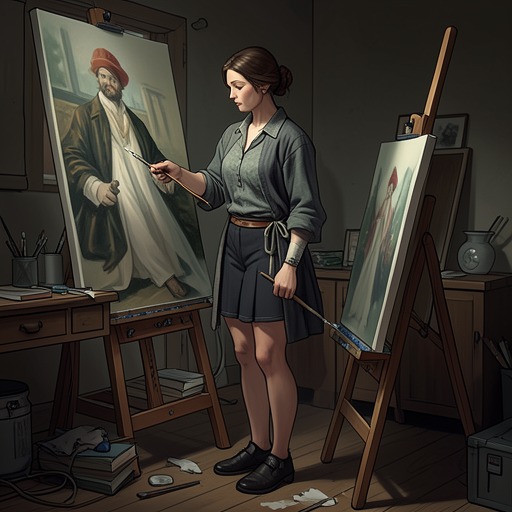
Lily sees the jacmanna as bright violet against a staring white wall and refuses to soften either color to match the pale, elegant, semitransparent style associated with Mr Paunceforte. Beneath the colors, the shape appears to her with commanding clarity. Yet when she takes up her brush, the conception changes. The passage from inward perception to painted work feels like a frightening passage through darkness: forces assail her confidence, and she struggles to keep hold of what she sees rather than substitute what fashion or expectation would prefer.
The canvas therefore registers a gap between seeing and doing, not a lack of vision. Lily tries to assert the truth of her perception to herself, but can preserve only what feels like a miserable remnant of it. She imagines a thousand forces trying to wrench that remnant away. Her difficulty is at once technical and existential: she must make formal decisions while defending the legitimacy of the vision on which those decisions depend.
The pressure of that work summons thoughts of her own inadequacy and insignificance, including her life keeping house for her father off the Brompton Road. She feels an impulse to seek closeness with Mrs Ramsay, but cannot give it a simple name: she rejects the idea that she is in love with Mrs Ramsay, then reaches instead for a love of the whole scene—the hedge, house, and children. The artistic vision thus exceeds a single subject even as it draws upon the intimate world around her.
Color, Composition, and the Mother-and-Child Form
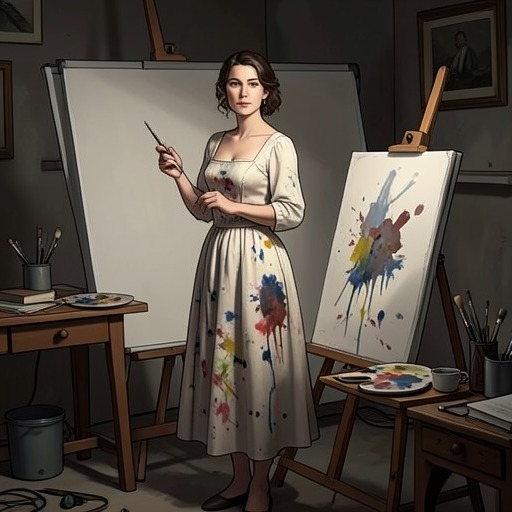
When Lily looks again at her painting, she judges it harshly. She can imagine an alternative in which the colors are thinned and faded and the forms made ethereal, as Mr Paunceforte might have seen them, but that would not be faithful to her own sight. She sees color burning on a framework of steel and the light of a butterfly’s wing lying upon the arches of a cathedral; on the canvas, however, only a few random marks seem to remain. The distance between the richness of the conception and the apparent disorder of the marks makes her fear that the picture will never be seen or hung.
The image of Mrs Ramsay reading to James gives Lily a way to work with a human subject without making likeness her aim. When William Bankes asks what the triangular purple shape indicates, she identifies it as Mrs Ramsay reading to James, while acknowledging that the forms do not announce themselves as human. Their presence is not an attempt at portraiture. Lily has introduced them because the corner needs brightness while another part of the canvas calls for darkness.
She describes the painting’s tribute through the relation of a shadow here and a light there. A mother and child can be reduced to a purple shadow without irreverence; in this design, darkness is not an erasure of their importance but one element in the picture’s balance. Bankes, approaching the canvas in good faith, considers the relation of masses and of light and shadow as a problem he has not previously thought through. His interest makes room for Lily to articulate a formal purpose without pretending that she can yet show him exactly what the finished picture will be.
The Viewer, the Gaze, and Exposure
Bankes’s attention first feels like an ordeal. He puts on his spectacles, steps back, raises his hand, and narrows his eyes to examine the canvas. Lily winces and imagines snatching it from the easel. She braces herself with the thought that the work must be seen, and that Bankes is less alarming as a viewer than someone else might be. Even so, the prospect of other eyes encountering the accumulated residue of her thirty-three years—her daily life mixed with something more private than she has spoken or shown—is agonizing and intensely exciting at once.
That double response defines what is at stake in showing the picture. The canvas is not merely an object to be assessed: it holds a part of Lily’s experience that she has never openly disclosed. Bankes taps it with the bone handle of his penknife and asks about the purple triangle, then asks what she wishes to make of the scene. His questions are not hostile, but they expose how much of the picture’s purpose remains difficult even for Lily to translate into explanation.
She returns to her painting posture, with dim eyes and an absent manner, trying to quiet her impressions and recover the vision she once saw clearly. The right and left masses might be joined by carrying a branch across the composition; alternatively, an object such as James might break the empty foreground. But either solution risks breaking the unity of the whole. She stops rather than force a decision or detain Bankes, and lifts the canvas lightly from the easel. The unresolved composition is part of the struggle: the problem is not simply what to add, but how to connect parts without sacrificing the whole.
Gendered Dismissal and Artistic Resistance
The phrase “Women can’t paint, women can’t write” enters Lily’s consciousness as a remembered voice of dismissal. It stands against the evidence of her own effort, yet its power is not removed merely because she can recognize its injustice. When Charles Tansley asserts that the family will not go to the Lighthouse the next day, Lily asks herself why she minds what he says. She sees him as uncharming and doubts that his claim is true even to him; she suspects that saying it is useful to him for some reason. Still, her whole being seems to bow under the force of the words and to recover only through a painful effort.
Her answer is to redirect attention to the sprig on the tablecloth and her painting: she must move the tree to the middle, and that matters more than the provocation. She considers refusing to argue and taking revenge by laughing at Tansley. Her exaggerated request that he take her to the Lighthouse is a deliberate tease, not a genuine wish to accompany him. The exchange makes visible how artistic concentration has to coexist with social pressure: Tansley’s dismissal can unsettle her, but it does not define what she sees or the formal choices she intends to make.
Lily’s resistance is consequently neither effortless nor complete. The insult can still make her feel abased, and the canvas can still look to her like a failed residue of the original vision. Yet she returns to the specific work of painting—to color, shape, and the placement of a tree—rather than accepting a rule that denies women artistic capacity. The insistence on her own vision is a continuing practice, renewed in the face of both convention and doubt.
Recognition Without Resolution
Bankes’s close examination culminates not in a solution to the composition but in a change in relation. Once the picture has been seen, Lily feels that something profoundly intimate has been shared with him. She credits Mrs Ramsay, Bankes, the hour, and the place with a power she had not expected: she can walk away down the long gallery no longer alone, but with someone beside her. The moment offers connection through attention to the picture, rather than through complete explanation of it.
That recognition does not settle the painting’s unresolved structure. Lily still cannot make the vision fully available in words, and the choices between connecting the two masses, carrying the branch, or placing James in the foreground remain genuine compositional risks. Her struggle persists between an inner certainty about what she sees and the fragility of its material traces. Its significance lies in the effort to keep that vision intact while exposing it to another person’s gaze—and in the possibility that another viewer can share something of it without reducing it to literal likeness or a finished explanation.