Lily Briscoe’s painting
To the LighthouseLily Briscoe’s painting is the unfinished work through which Lily’s private way of seeing becomes both a vulnerable object and a hard-won form. Begun on the lawn with Mrs Ramsay and James as its subject, it does not seek a literal likeness: its mother and child can become a purple shadow, while the picture’s larger problem is how to make its masses, lights, and darks cohere. Across the novel’s two periods, the canvas holds a long struggle between vision and execution, social judgment and artistic independence; its final line brings that struggle to a conclusion without guaranteeing the painting’s public survival.
Subject and Visual Design
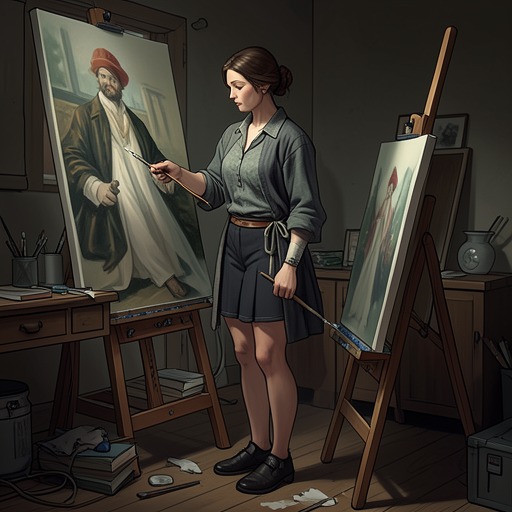
On the lawn, Lily paints while Mrs Ramsay sits at the window with James. The scene supplies a starting point, but not a demand for portraiture. When William Bankes asks what the triangular purple shape indicates, Lily identifies Mrs Ramsay reading to James and makes clear that she has not attempted to render them as recognizable human figures. She has included them for reasons of composition: where one corner is bright, another calls for darkness. The mother and child can therefore be reduced to a shadow without disrespect; their presence is carried by the relations of light and shade rather than by likeness.
The work’s governing problem is the arrangement of its larger forms. Lily considers how to connect the mass on the right to the mass on the left, perhaps by carrying a branch across, or to interrupt the empty foreground with an object such as James. Each solution risks breaking the unity she hopes to achieve. The picture’s subject is thus not exhausted by the people visible in its scene: what matters is the relation among shapes, and the still-uncertain order that might hold them together.
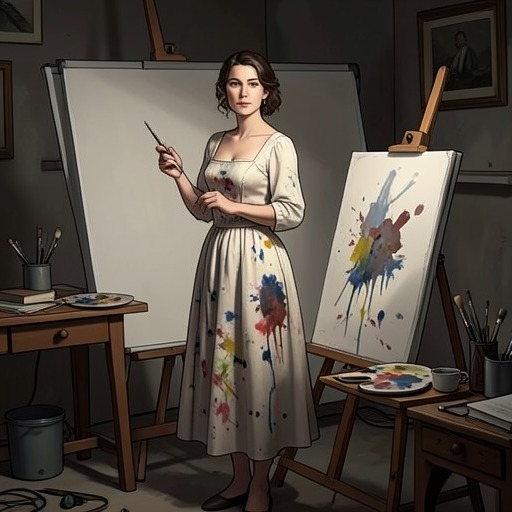
Its color is part of that independent vision. Lily sees the jacmanna as bright violet against a staring white wall and refuses to pale or soften either color merely to follow the fashionable, elegant, semitransparent manner associated with Mr Paunceforte. She imagines color burning on a framework of steel and the light of a butterfly’s wing lying on cathedral arches, although only a few random marks have so far reached the canvas. The gulf between this vivid conception and the visible work gives the painting its early precariousness: its promise is inwardly powerful, but its execution still appears to Lily painfully inadequate.
Exposure, Judgment, and Recognition
The canvas is exposed to other people at moments when Lily would rather keep it private. Mr Ramsay’s sudden approach makes her alert to the possibility that someone might inspect it; with his animated shouting and gestures, he is both alarming and, while he does not stop to look, a kind of protection. Lily fears the judgment of almost anyone else as well. When William Bankes comes to stand beside her, however, she lets the canvas remain on the easel rather than turning it toward the grass.
Bankes’s attention still feels like a trial. He examines the painting through his spectacles and taps the canvas with the bone handle of his penknife, asking about its purple triangle. Lily braces herself because the picture contains more than she has openly told anyone: it is a residue of her years of living, mixed with something secret. Being seen is agony, yet also intensely exciting. The object that she had guarded from scrutiny has become a point of contact between her inner experience and another person’s attention.
Bankes approaches the work in good faith, though his habits of judgment come from another direction. He has previously valued a painting of cherry trees in blossom on the banks of the Kennet, a subject tied to his honeymoon, and admits he has not considered the relations of masses, lights, and shadows that Lily asks him to see. His questions make her articulate the picture’s formal problem, but she cannot yet show him the intended solution: she says that she cannot see it herself without a brush in her hand. She removes the canvas from the easel before settling on how to connect its forms.
The encounter alters the painting’s meaning without resolving its composition. Bankes has seen it, and Lily feels that he has shared something profoundly intimate; she leaves with the exhilarating sense that she is no longer alone. His serious, attentive response offers a contrast to the belittling verdict that echoes in her mind, “Women can’t paint, women can’t write ...” Yet the work does not thereby become secure. Lily still sees its marks as a poor remainder of her conception, and its future exhibition or preservation seems unlikely.
A Long-Deferred Return
Ten years later, the old canvas and its unfinished problem return together. Sitting at the table, Lily recalls a sprig or leaf pattern on the cloth and the earlier insight she had once associated with the picture: move the tree to the middle. She never finished the work then, but it has continued to recur in her mind while she walked along the Brompton Road or brushed her hair. Remembering it now, she decides to paint it.
The interval has preserved the problem without making its solution automatic. Lily can plan the relations of the lines away from the canvas, but beginning again requires an actual decision. At first she has taken the wrong brush in her agitation and planted her easel at the wrong angle. Correcting both lets her quiet distractions and attend to the work, but a single mark will commit her to further choices, each carrying the risk that the apparent simplicity of the idea will turn complex in practice.
Her first stroke is quick and decisive, followed by two more. The brown lines begin to enclose a space; pausing and striking become a rhythm rather than a sequence of isolated attempts. Yet this renewed engagement is also a confrontation. Lily experiences painting as an exacting form of intercourse, a struggle with a truth that emerges behind appearances, and wonders why she must be drawn out of ordinary conversation and companionship into such demanding concentration. The old fear remains beside the renewed work: she imagines the painting relegated to the servants’ bedrooms, rolled up, or stuffed under a sofa, and hears the learned refrain that she cannot paint or create.
Completion and Significance
The painting’s ending joins a public event to a private act of judgment. When Lily hears that the party has landed, she says aloud, “He has landed,” and, “It is finished.” Augustus Carmichael stands beside her and says, “They will have landed”; they have reached the same understanding without needing to explain it. Lily then turns back to the canvas. Its greens and blues, running lines, and attempt at a whole remain open to dismissal: she thinks it may be hung in the attics or destroyed. Its fate, however, no longer determines whether the work has succeeded for her.
Looking at the empty steps and the blurred picture, Lily draws a line in the center. That single placement completes the composition in her own judgment. She lays down her brush in extreme fatigue and recognizes that she has had her vision. The ending does not promise that the picture will be exhibited, preserved, or valued by others; it makes completion depend instead on her act of seeing and deciding. The central line answers the long-standing question of how the picture’s masses might be related, while the work’s uncertain material future preserves a distinction between artistic achievement and public recognition.
The painting gathers the novel’s concern with the limits of likeness and the difficulty of making a durable form from fleeting perception. Its mother and child remain identifiable in Lily’s account but are not reduced to conventional portraiture; its composition is built through the tension between color and shadow, separate masses and unity, private vision and the gaze of others. By returning to a canvas left unfinished for ten years, Lily makes the passage of time part of the work’s history. The picture’s decisive ending is not the assurance that it will endure as an object, but the moment in which she commits the line and can call the vision complete.