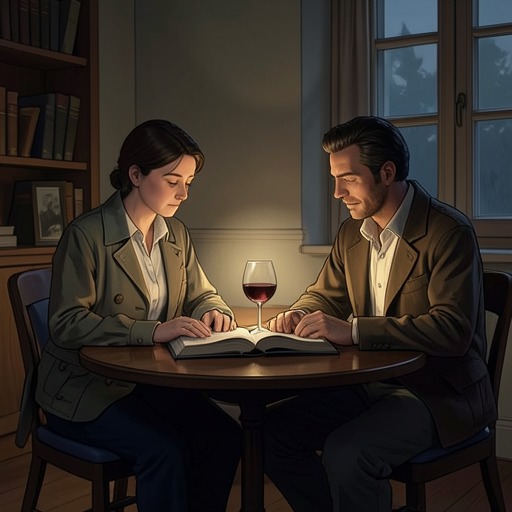
Mrs Ramsay tries to match Lily Briscoe with William Bankes
To the LighthouseMrs Ramsay tries to match Lily Briscoe with William Bankes by drawing them into one another’s company and presenting their shared interests as a basis for marriage. The effort never becomes a courtship: Lily values William as a friend and remains unmarried, while the episode later allows her to measure the force of Mrs Ramsay’s wishes against the independent life she has chosen.
The Proposed Match
Mrs Ramsay sees a natural fit between Lily and William. She describes Lily as scientifically minded and exact, with a liking for flowers, while William is praised as a scientist. She arranges walks for them together and offers these qualities as reasons they might suit one another. Her matchmaking turns observation into intervention: she does not merely notice affinities but tries to shape a relationship from them.
The effort belongs to Mrs Ramsay’s wider habit of organizing connection through practical attention and social arrangement. Her domestic and charitable concerns show the same impulse to notice what people lack and to imagine a remedy. She knits a stocking for the lighthouse keeper’s little boy, who has a tuberculous hip, and thinks about the isolation of the keepers on their rock; elsewhere she laments that the island has no hospital and wishes she could establish one. These concerns do not make the proposed marriage equivalent to charity, but they illuminate how readily she assumes responsibility for arranging other people’s lives.
Lily and William’s Friendship
Lily’s later recollections clarify what the match-making did—and did not—produce. She says that William understood her explanation of her painting: a light needed a shadow, and her treatment of a subject was not irreverent. His scientific mind, she feels, enabled him to understand her work seriously. Their friendship is one of the pleasures of her life, and she loves him; the text presents that attachment as genuine intimacy, not as proof of a concealed romance.
Their companionship has its own considerate customs. At Hampton Court, William leaves Lily time to wash her hands while he strolls by the river; afterward they walk through the courtyards, admiring the proportions and flowers. He talks with her about perspective and architecture, pauses to look at trees and the view over the lake, and shares the ordinary concerns of his household, including the need to buy a new stair carpet. Their closeness rests on conversation, attention, and a shared capacity to look carefully—not on the marriage Mrs Ramsay had hoped to arrange.
Lily’s Refusal of the Marriage Ideal
From the later vantage point of her painting, Lily recognizes how powerful Mrs Ramsay’s matchmaking could feel: Mrs Ramsay seemed to say, in effect, do this, and one did it. Yet Lily also remembers the decisive independence of her own choice. Looking at the tablecloth, she had seen that she could move the tree in her composition to the middle and need never marry anyone; the realization brought her enormous exultation. Her artistic decision and refusal of marriage are linked as acts of self-direction, though the painting remains the concrete choice at the center of the moment.
Lily contrasts the match Mrs Ramsay planned with the lives that followed. Paul Rayley and Minta Doyle became the couple Mrs Ramsay had hoped for others to become, but Lily recalls that Paul later went to coffee-houses and had a mistress. She herself did not marry William. These outcomes expose the limits of trying to secure happiness through marriage: the arrangement Mrs Ramsay imagined for Lily and William never took hold, and marriage elsewhere did not guarantee lasting intimacy.
Memory and Mrs Ramsay’s Legacy
The episode is recollected after Mrs Ramsay’s death, when Lily can answer the absent woman’s pressure to marry with the claim that life has changed and that she is happy as she is. That retrospective argument does not erase Mrs Ramsay’s influence. Lily recognizes the authority of her wishes even while resisting them, and her recollection preserves a complex bond: gratitude for Mrs Ramsay’s presence coexists with a firm defense of an unmarried artistic life.
The proposed match therefore serves less as a failed romance than as a measure of competing ideas about care and fulfillment. Mrs Ramsay’s matchmaking expresses her belief that people can be brought into happiness through attention and arrangement; Lily’s friendship with William shows that closeness can take a form other than marriage. By recalling both the walks Mrs Ramsay set in motion and the painting choice through which Lily claimed independence, the narrative holds affection and resistance together without resolving them into a conventional union.