Mrs. Ramsay’s Solitude and Existential Anxiety
To the LighthouseMrs. Ramsay’s solitude and existential anxiety form the hidden countercurrent to her public life of care. As she knits, reads to James Ramsay, worries over Minta Doyle, and imagines comforts for the Lighthouse keeper’s family, she also experiences life as a private adversary: suffering and death cannot be explained away, and the happiness she tries to preserve for others is necessarily temporary. Her moments alone do not resolve that knowledge, but they give her a distinct inner freedom, most powerfully figured by the Lighthouse’s steady beam and by a happiness she can affirm without pretending that the world is just.
Care and the Knowledge of Suffering
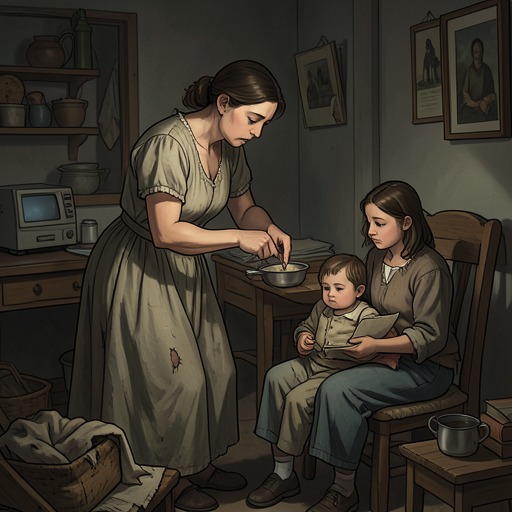
The pressures of this inward life are visible within apparently ordinary acts of care. Mrs. Ramsay knits a reddish-brown stocking for the Lighthouse keeper’s little boy, whose hip is threatened by tuberculosis, and considers sending old magazines and tobacco along with it. She imagines the keeper’s family confined on a rock for weeks in stormy weather, cut off from letters, newspapers, and one another. Her sympathy moves from the boy’s illness to the isolation of the household and the dangers of the keeper’s work; charity begins in a particular garment and expands into an effort to picture another family’s daily conditions.
That practical attention does not mean she believes suffering can be mastered by kindness. She recalls a Swiss maid speaking of the beauty of the mountains at home while her father was dying of throat cancer. There was, Mrs. Ramsay knows, no hope for him. In the memory, the maid’s grief quiets the ordinary scolding and instruction with which Mrs. Ramsay has been occupied; for a moment, she has nothing to say. The recollection later sharpens her irritation with easy religious reassurance, because another person’s terminal illness cannot be reconciled with a benevolent order simply by invoking one.
Her concern also reaches beyond private acts of assistance. Thinking of Minta Doyle and the obligations attached to her stay, Mrs. Ramsay recognizes that some charges of interference may arise from her intense feelings about practical necessities. She would like to establish a model dairy and a hospital on the island: milk delivered in London can be dirty, and the island has no hospital. Yet she asks herself how such projects could be realized while she has children to raise. The distance between her awareness of preventable hardship and her limited power to change it gives her care a frustrated, political edge as well as a domestic one.
A Private Self Beneath Family Life
Mrs. Ramsay’s children draw out tenderness and a keen sense of passing time. She fears that James and Cam Ramsay will grow up and lose the vivid happiness of childhood, and she sees promise in all her children: Andrew Ramsay’s mathematical gift, Rose Ramsay’s skill with her hands, and Prue Ramsay’s beauty. A tenpenny tea set can make Cam happy for days; the children’s ordinary daily return to the dining room seems to them like an event, and at night they make stories from small things they have found. These details make her wish to keep them young concrete, but they also make it impossible to mistake that wish for a belief that time will stop.
When the children have gone to bed, she feels relief at being able to think—or not think—and simply be alone. The expansive activity of family life falls away, leaving what she apprehends as an invisible, dark core of self, free of the roles through which others know her. The image does not deny her attachments; it marks the part of her that those attachments cannot fully disclose. In solitude, she imagines distant places she has never seen, including the Indian plains and a church in Rome, and experiences a horizon that feels limitless. The self that serves and responds to others is not the whole of her; beneath it lies an inwardness that opens onto possibility.
Her reflections on her own life are similarly resistant to a simple label. Mr. Ramsay accuses her of pessimism, but she distinguishes her sense of time and mortality from a settled disposition to despair. Life appears to her as a finite stretch of about fifty years, something real and private that she shares neither with her husband nor with her children. She imagines an ongoing transaction with it: at times there are reconciliations, but more often life seems hostile, ready to pounce. The thought remains unfinished in its first appearance, as if the scale of the question exceeds a neat conclusion; later, however, she names its recurring terms—suffering, death, and the poor.
The Lighthouse Beam and Fleeting Happiness
In solitude, the Lighthouse gives her attention a form. Mrs. Ramsay watches its long, steady stroke and feels herself attach to it until, at moments, she seems to become the thing she is looking at. The light is not simply a symbol of comfort or safety: its impersonal regularity stands beside her, allowing her to gather herself without cancelling the darkness she has recognized. As she watches, phrases and thoughts return, including the fear that children remember disappointment and the conviction that things end. The beam’s recurrence gives these thoughts a rhythm, not a solution.
Her inner quiet is complicated by religious language that does not express what she believes. She finds herself saying that people are in the hands of the Lord, then is annoyed at having spoken insincerely. She has always grasped what she regards as the world’s lack of reason, order, and justice; suffering, death, and poverty remain facts against which no easy providence can be trusted. The Lighthouse seems to meet her like her own searching gaze, testing her inwardly and exposing the false note in the phrase. Its light can accompany her contemplation, but it cannot serve as proof that the world is just.
Even so, her knowledge of injustice does not make happiness impossible. Watching the light over the waves as daylight fades, she experiences an intense happiness and a sense of sufficiency. This is not a denial of what she has thought about death or suffering: the force of the moment comes from its coexistence with that knowledge. The light and sea hold her attention, and for an instant delight is complete without becoming permanent. The experience offers neither a promise that happiness will last nor a reason to dismiss it because it will not.
Solitude Within Marriage and Memory
Mrs. Ramsay’s inward distance is noticed by Mr. Ramsay, who sees the sternness within her beauty and feels unable to protect her. He believes that his own irritability and touchiness make matters worse, including his loss of temper over the proposed Lighthouse trip. He wants to speak when she is alone but refrains, sensing that he cannot simply enter the state of mind in which she sits. Their separation is not an absence of attachment: he wants to reach her, and she understands that he wants to protect her. Yet neither affection nor proximity gives him access to the whole of her private experience.
She eventually turns toward him of her own accord, taking the green shawl from the picture frame and going to him. The gesture establishes a real passage from solitude to intimacy, but it does not erase the inward life that precedes it. The same woman who can offer comfort and companionship also needs a self apart from the needs of her family, and the narrative lets both truths stand without reducing one to the other.
The later image of Mrs. Ramsay’s abandoned clothes gives her solitude a material afterlife. Years after her death in London, Mrs McNab finds the old grey gardening cloak, shoes, and small belongings still in the bedrooms, as if their owner might return. She remembers Mrs. Ramsay coming up the drive with the washing and greeting her. The house has gone untended, and the garden is overgrown; the objects remain while the person whose ordinary life gave them meaning is gone. The scene does not disclose Mrs. Ramsay’s private thoughts anew, but it makes the separation between a remembered person and the household traces she leaves behind tangible.
Narrative Significance
Mrs. Ramsay’s inward life unsettles the apparent completeness of her role as the person who sustains others. Her generosity is real, visible in the stocking, her concern for the Lighthouse keeper’s family, and her attention to her children; so are the limits she encounters in confronting illness, poverty, and the passage of time. The narrative places these forms of attention alongside one another rather than treating domestic care as proof that her own needs or thoughts have disappeared.
The movement between social activity, remembered suffering, solitary reflection, and the recurring beam also shapes how her anxiety is experienced. Ordinary surroundings—the knitting in her hands, a child’s small toy, the steady light—become occasions for a wider perception of life, while the repeated return of death and impermanence prevents that perception from settling into consolation. Her solitude is therefore neither mere withdrawal nor a final escape from responsibility. It is the interval in which she recognizes herself as more than the figure others see, faces the world’s unanswerable injuries, and can still receive a moment of happiness without mistaking it for permanence.