Paul Rayley and Minta Doyle’s Courtship and Engagement
To the LighthousePaul Rayley and Minta Doyle’s courtship and engagement develop from a tentative prospect into an explicit commitment, with a lost family brooch and a private proposal marking the turn. Their relationship is watched and interpreted by Mrs Ramsay, whose encouragement helps Paul imagine himself capable of marriage, while the narrative’s shifts among observers reveal how differently the same intimacy is understood—as romance, embarrassment, social responsibility, and a future already taking shape.
Courtship and Mrs Ramsay’s expectations
Before the proposal is confirmed, Mrs Ramsay reads Paul and Minta’s long afternoon walk as evidence that Minta has reached a decision. When the pair fail to return, Mrs Ramsay concludes that Minta must either accept or refuse him, and suspects she has chosen acceptance. She likes Minta and is already sympathetic to Paul, whom she regards as a good fellow: not necessarily brilliant, but preferable to men whose cleverness takes the form of academic dissertations. The uncertainty matters. Mrs Ramsay is not reporting a decision she has witnessed; she is interpreting an absence, a walk, and the expectations surrounding a young couple.
Her confidence in matchmaking exists alongside an awareness that Minta’s family may judge her interference. Remembering an accusation that she had robbed another woman of her daughter’s affections, Mrs Ramsay objects inwardly to the charge that she is domineering or tyrannical. Yet she acknowledges that she feels passionately about practical matters and would like to make people see what needs attention. Her hospitality to Minta has already brought friction with Minta’s mother, whom she privately nicknames the Owl. In this setting, the courtship is not merely private: Minta’s presence in the Ramsay household, the watchfulness of her parents, and Mrs Ramsay’s own influence all place the couple’s choices within a web of adult supervision and social expectation.
The beach, the kiss, and the lost brooch
During the outing, Nancy runs behind a rock and finds Paul and Minta in each other’s arms, probably kissing. She is indignant, and she and Andrew say nothing about what they have seen. Their silence does not make the scene disappear; it leaves them both irritated and self-conscious, with Nancy resenting that Andrew is a man and Andrew resenting that Nancy is a woman. The episode exposes the limits of the younger pair’s privacy: their intimacy becomes an accidental spectacle, even though its witnesses do not confront them.
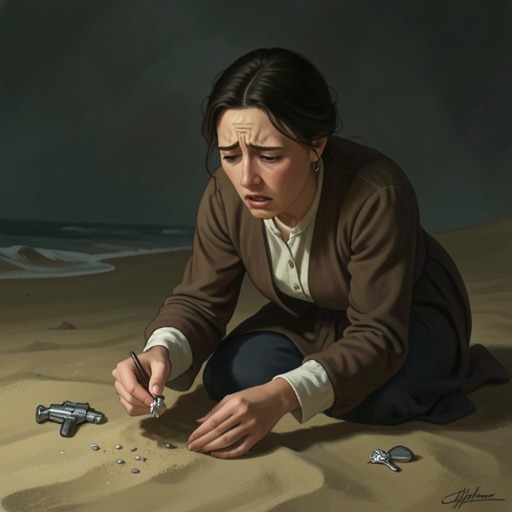
After the group climbs toward the cliff top, Minta discovers that her grandmother’s brooch is missing. It is her sole ornament, a weeping-willow design that her grandmother had fastened to her cap until the last day of her life. Minta would rather have lost anything else, and the group turns back to search. Paul searches urgently around the rock where the couple had been sitting, while the tide advances and threatens to cover the place. When Minta cries that they will be cut off, Andrew judges her fear excessive; Paul, meanwhile, helps calm her. The men decide to leave Rayley’s stick where they had sat and return at low tide, since there is no time for a further search.
Nancy senses that Minta’s sobbing is not only about the brooch. Minta explicitly mourns the irreplaceable keepsake, but the scene lets the loss carry more than its material value: the brooch connects her to her grandmother and to a past that cannot simply be retrieved. The group’s practical plan offers a chance of finding it later, not certainty. Paul’s response, however, turns the search into an occasion to promise care and to present himself as capable of recovering what has been lost.
Proposal and the imagined future
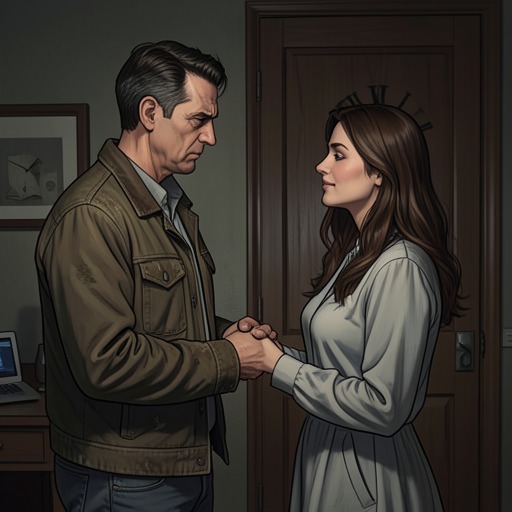
As Paul and Minta walk ahead together, he comforts her by telling her that he is famous for finding things. He recalls finding a gold watch as a boy and becomes determined to rise at daybreak to look for the brooch. If he cannot recover it, he privately resolves to go to Edinburgh and buy another, more beautiful one. Minta refuses to let him get up at dawn and says she knows the brooch is lost; she had, she tells him, a presentiment when she put it on. Their responses differ: she treats the loss as final, while he converts it into an opportunity to prove his resourcefulness and devotion.
Paul’s thoughts move quickly from the immediate crisis to marriage, children, and a shared home. The town lights appearing below seem to him like signs of what is going to happen: his marriage, his children, his house. He imagines the couple retreating into solitude, walking together with him leading and Minta pressing close to his side. Yet the proposal itself has been frightening. Paul thinks it was the worst moment of his life when he asked Minta to marry him, and he wants to tell Mrs Ramsay what he has done. The contrast between his fear at the decisive act and the expansive domestic future he imagines makes the engagement both an achievement and a leap into an idealized life.
He attributes that leap to Mrs Ramsay. Although she has not directly told him to propose, he has felt her watching him throughout the day as if she expected him to succeed and believed he could do what he wanted. He plans to thank her, saying that he has done it because of her. The novel thus presents the proposal not as a purely spontaneous declaration between two lovers but as an action enabled by another person’s confidence in Paul. His sense of agency is real, yet it has been fostered by Mrs Ramsay’s attention and encouragement.
The dinner and the meaning of “we”
Paul and Minta arrive late at the Ramsay dinner with a maid carrying a great dish. Minta tells the company that she has lost her grandmother’s brooch, and Mr Ramsay teases her for scrambling over rocks while wearing jewels. The lost object enters the room as a public story, changing the outing’s intimate incident into dinner-table conversation. Paul’s report to Mrs Ramsay is brief: he says they went back to look for the brooch.
Mrs Ramsay hears particular significance in his use of “we.” She recognizes the effort with which he says the word and understands it as the first time he has spoken of the pair in those terms: they did this, they did that. To her, the small grammatical shift anticipates a shared life, and she imagines that the couple will say “we” throughout their marriage. The engagement is therefore registered not only by Paul’s proposal but also by a change in how he describes himself and Minta—as participants in a common undertaking.
The dinner’s rich boeuf en daube gives Mrs Ramsay a way to mark the occasion. She thinks of celebrating a festival, while holding together two different views of the lovers: their love is serious and consequential, bearing the seeds of death, yet their bright-eyed entrance into romantic illusion also invites affectionate mockery and ceremonial play. In the same scene, William Bankes praises the dish, and Mrs Ramsay attends to the social world around her as carefully as she attends to Paul and Minta. The engagement becomes part of a larger gathering in which food, hospitality, teasing, and observation lend the couple’s private commitment a public setting.
Meaning and limits of the courtship
The relationship’s movement toward marriage is presented through uncertainty rather than a simple sequence of romantic assurances. Mrs Ramsay first infers Minta’s likely acceptance from the couple’s absence; Nancy and Andrew encounter their kiss without being invited into it; the brooch’s disappearance interrupts the walk; and Paul’s proposal, which he experiences as terrifying, opens an imagined future of marriage, children, and shared solitude. Each observer receives only part of the event, so courtship appears as a private bond continually refracted through family expectations and other people’s interpretations.
Mrs Ramsay’s hopes for Minta and Paul also sit beside her broader investment in care and domestic life. She is knitting a stocking for the lighthouse keeper’s little boy, who has a tuberculous hip, and imagines providing the isolated keepers with magazines, tobacco, and other comforts. Elsewhere, she reflects that the island has no hospital and that a model dairy and a hospital would be worth establishing. These concerns do not directly determine the couple’s engagement, but they clarify the practical and moral world in which she acts: she attends to people’s needs, imagines remedies, and tries to shape what others might do, even while questioning the charge that such involvement makes her controlling.
The story gives no account here of whether Paul finds the brooch the next morning. What it does establish is the immediate transformation wrought by the proposal: Paul imagines marriage and family, Minta remains the beloved companion he hopes to lead through life, and Mrs Ramsay sees their newly shared “we” as the beginning of a lasting union. The future is vivid in Paul’s mind, but it remains an expectation rather than a guarantee.