Preserving Moments Through Art
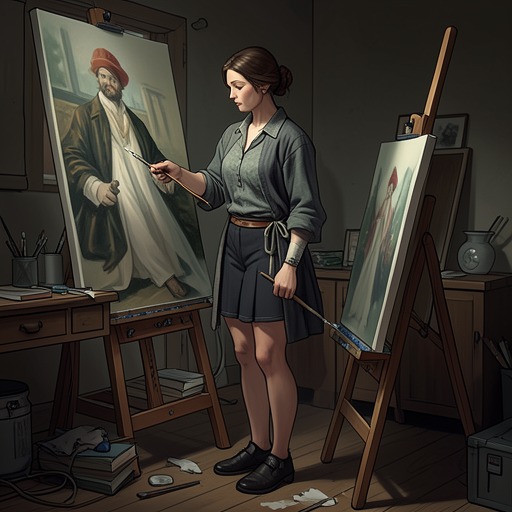
To the LighthousePreserving Moments Through Art names a central tension in the novel: a moment passes, yet memory and artistic form can hold its shape beyond the instant. Lily Briscoe’s painting is not a literal record of a scene but an effort to organize shifting perception into a composition that can endure. The novel sets that effort beside Mrs Ramsay’s ability to bring people into a temporary harmony, and beside the losses that show how little any preserved image can recover. Art offers a form for experience, not a reversal of time.
A moment made durable
Lily’s understanding of preservation begins with a remembered beach scene. She and Charles Tansley had been quarrelsome, but while Mrs Ramsay sat beneath a rock writing letters, Lily and Charles played ducks and drakes with flat black stones. The wind repeatedly carried away pages, and Mrs Ramsay and her companions had to save them from the sea. What remained for Lily was not a complete record of their conversation but the changed relation among the three: Mrs Ramsay’s presence seemed to draw their irritation and spite into a moment of friendship. Years later Lily could return to that memory as something whole, and it affected her almost like a work of art.
The scene’s endurance comes partly from what it does not explain. Mrs Ramsay writes and watches; Lily and Charles throw stones; their words have faded from Lily’s memory. Yet the scene retains its emotional shape. Looking from her canvas toward the drawing-room steps, Lily recognizes that preserving a moment does not mean recovering every detail. The memory has survived through selection and form, with Mrs Ramsay’s quiet presence linking the actions into a composition Lily can still enter.
Painting and the problem of form
Lily’s painting makes this problem material. She wants its surface to appear bright, delicate, and evanescent, with one colour melting into another, while its underlying structure remains firm enough not to be dislodged. As she applies red and grey and works into a hollow in the picture, she is also imaginatively beside Mrs Ramsay on the beach. Past perception and present work do not cancel each other: the remembered scene informs the painting, while the act of painting gives Lily a way to approach that memory again.
For Lily, this process is not a claim to have solved the meaning of life. She thinks that a great revelation may never come; instead there are small daily illuminations, like matches struck unexpectedly in darkness. The beach memory is one such illumination. Mrs Ramsay’s phrase, “Life stand still here,” gives voice to the wish to make a passing instant permanent, while Lily’s own artistic effort tries to do something similar in another medium. The permanence is limited: the moment does not literally stop, but its pattern can be held and revisited.
The image’s formal problem parallels the problem of memory. A painting must allow delicacy and change on its surface while still holding its parts together. Lily’s recollection likewise preserves not a static inventory of facts but a relation that can be entered again. The scene’s force lies in its balance of distinct details—the letters in the wind, the stones skipping over the waves, Mrs Ramsay seated beneath the rock—and in the way those details cohere without making the people fully knowable to one another.
Silence, solitude, and incomplete knowledge
The novel also places artistic preservation beside the limits of intimacy. In Mrs Ramsay’s inward solitude, the roles and appearances by which others recognize a person seem superficial; beneath them she imagines a dark, deep self that is invisible to others. She can be alone even while knitting in company, and in that inward state experience seems to open onto a limitless range. Her attention settles on the Lighthouse’s long, steady stroke, which becomes especially hers in that moment of watching. The image gives a passing perception a private, concentrated form, but it does not make her inner life fully shareable.
Lily’s later return to the beach scene similarly depends on silence. She wonders whether intimacy is spoiled by saying too much, and whether people may be more expressive when they sit beside each other without speaking. She imagines Mrs Ramsay’s silence as a place of rest within the obscurity of human relationships. The memory is vivid, yet it does not grant Lily complete knowledge of Mrs Ramsay or of what either woman felt. Its artistic value comes from holding that uncertainty rather than explaining it away.
This balance between form and incompleteness also appears in the novel’s treatment of calm. Night can briefly present distinct images—the upright hare, the falling wave, the rocking boat—as if they might compose a lasting whole. But the calm is withdrawn: hail breaks and confuses what seemed composed, and the fragments do not readily yield a perfect whole or clear truth. The passage makes preservation neither effortless nor permanent. A glimpse can be real and consequential while remaining only a glimpse.
Loss, time, and the limits of restoration
The movement of time tests the hope that a moment can endure. Mrs Ramsay dies suddenly, and Mr Ramsay’s outstretched arms meet no one. Later, the empty house is exposed to weather and decay; rooms, furniture, clothes, and abandoned belongings remain after the people who animated them have gone. The objects suggest how a human presence can leave traces, but traces are not a return. Mrs McNab finds Mrs Ramsay’s old grey cloak and the clothes left in the cupboards, and remembers her coming up the drive with a child beside her. The house contains the evidence of a life while making its absence unmistakable.
War intensifies this separation between beautiful appearances and human loss. A shell kills Andrew Ramsay in France, and the narrative places the news alongside the weathering house and the sea. The war also interrupts the beach’s consoling scenery: a grey ship appears offshore, and a purplish stain on the sea resists being absorbed into an easy reflection on beauty. Nature does not complete human experience or guarantee a moral order. Its calm can coexist with misery and violence, so neither a beautiful landscape nor an artistic image can honestly erase the historical fact of loss.
Even so, memory can preserve how loss changed the people who remain. Lily recalls that Augustus Carmichael was said to have lost interest in life after hearing of Andrew’s death, though she does not know precisely what he did. She understands him through an outline rather than intimate detail, just as people on the staircases exchanged little more than remarks about the weather. The novel allows this limited knowledge to matter: remembrance need not become omniscience in order to register grief and change.
Completion without permanence
At the end, Lily turns back to her canvas after learning that the boat has landed. The steps are empty and the picture remains blurred, but she draws a line through its centre and recognizes the work as finished. Her completion is not a claim that the painting will last or be valued: she imagines it might be put away in the attic and destroyed. What matters is the achieved act of vision—the line that brings the composition to a conclusion for her.
This ending gives the idea of preserving moments its precise limit and its force. Art cannot bring Mrs Ramsay back, undo Andrew’s death, restore the family’s former life, or settle every question about what people know of one another. It can, however, give a fleeting relation and a changing perception a shape that can be revisited. The finished painting is therefore less a monument to an unchanging past than a record of Lily’s successful encounter with it: temporary experience has become form, even though time continues beyond the frame.