The Lighthouse Beam Imagery
To the LighthouseThe lighthouse beam is a recurring image that makes the novel’s central tensions perceptible: continuity and change, inward solitude and outward connection, and the difference between an object and the meanings a person invests in it. Seen across the bay, its regular strokes can answer a child’s wonder, offer Mrs Ramsay a focus for contemplation, and expose the limits of the consolation she finds in the world. The light is both a real, recurring feature of the landscape and a shifting measure of consciousness.
Appearance and Recurrence
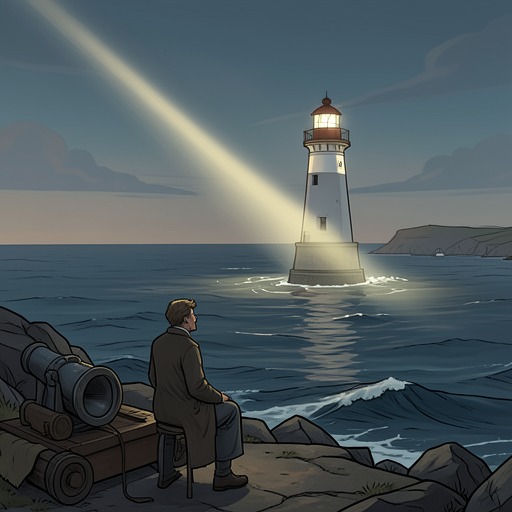
After Mrs Ramsay finishes reading to James, the story’s ending gives way to the view beyond the bay. The Lighthouse has been lit, and its beam crosses the waves in a repeated pattern: two quick strokes followed by one long, steady stroke. This external rhythm punctuates the scene, connecting the child’s absorption in a story to the real light visible beyond the house.
The beam returns as Mrs Ramsay sits with her knitting. Her attention settles particularly on the last, longest stroke, which she claims inwardly as her own. That act of attachment does not make the light literally hers: it is a feature of the distant tower, encountered from where she sits. Rather, the image shows how a person can make one detail in the visible world into a temporary anchor for private thought.
Attention, Solitude, and the Private Self
For Mrs Ramsay, watching the beam is part of being alone after the household’s demands have receded. She can continue knitting while her attention travels beyond immediate tasks and familiar social identities. At such moments, the self seems less like the recognizable person others know than an inward, dark, extensive core. The light gives her contemplation a visible counterpart: something distinct enough to look at, yet available to her imagination as a point of connection.
That relation intensifies until she feels she can become what she watches. The beam seems to carry phrases already moving in her mind, including the remembered thought that children do not forget and the repeated sense that things will end and come. In this passage, looking is not passive observation. The light’s regular motion offers a structure on which thought can recur, change emphasis, and gather into a moment of stillness.
Yet the image also marks a boundary. Mrs Ramsay’s identification with the beam is a temporary inward experience, not proof that she has escaped isolation or merged with the world. The light can seem to express her and still remain separate from her; its constancy provides a form for her feelings without resolving them. The image therefore holds intimacy and distance together rather than allowing one to cancel the other.
Truth, Belief, and Indifference
The beam’s recurrence accompanies Mrs Ramsay’s discomfort when she finds herself saying that people are in the hands of the Lord. She resents the statement because she does not believe it; to her, the world has no assuring order or justice, and suffering and death cannot be reconciled with an easy confidence in providence. The light becomes the focus toward which she turns as she scrutinizes her own words. Its impersonal presence cannot confirm the belief she has rejected, but it helps her recognize the difference between an inherited expression and what she actually thinks.
That searching encounter does not make the beam a moral judge or a divine answer. Mrs Ramsay experiences its third stroke as if it could search her mind, but the force of this moment belongs to her perception. The light seems to test her because she is testing herself; its steadiness sharpens rather than removes her awareness that happiness does not last and that the world can be cruel. Its symbolic force depends on the tension between the clarity of the repeated stroke and the absence of any promise that life itself is just.
Happiness and the Limits of Consolation
At another point in the same vigil, the light accompanies a surge of remembered happiness. As the daylight fades, the beam appears to brighten the rough waves, and Mrs Ramsay feels an intense delight that culminates in the conviction that what she has known is enough. The image does not erase the painful facts she has already faced. Instead, it gives a passing experience of joy a pattern and an outward focus, allowing it to feel complete without suggesting that it will last.
The beam’s steady movement thus holds a striking contrast: it is a remorseless feature of the world, yet it can occasion moments of peace and exhilaration. Mrs Ramsay’s happiness belongs to her response, not to any assurance carried by the light itself. The same visible object can accompany self-scrutiny, solitude, and pleasure because its meaning is made in attention and changes with the mind attending to it.
Narrative Significance
The beam links separate scales of experience. It is the distant Lighthouse seen from the bay, the recurring pattern that organizes Mrs Ramsay’s looking, and a focus through which thoughts about childhood memory, inward identity, belief, and mortality become connected. Its return gives the scene continuity, but that continuity is not the same as emotional security: the light persists while human feelings rise, recede, and contradict one another.
The image’s distinctive effect lies in this refusal of a single, fixed meaning. The long stroke can seem to belong to Mrs Ramsay and remain beyond her possession; its regularity can support a moment of calm without answering her doubts about suffering; its appearance can accompany a remembered happiness that is vivid precisely because it is not permanent. The beam makes private consciousness visible as a changing relation to the world, while leaving the world’s indifference intact.