The Sea and Wave Imagery
To the LighthouseThe Sea and Wave Imagery gives the novel a shifting measure of human experience: the sea can seem to guard and sustain, invite thought and shared attention, or steadily consume the ground on which people stand. Its beauty does not promise safety or moral order. As the waves move from a soothing rhythm to an emblem of exposure, destructive weather and signs of war break the hope that nature will complete or console human life.
A changing presence in daily life
For Mrs Ramsay, the waves first register among the sounds of the household. While she sits with the children, their measured fall seems to repeat a cradle song, as though nature were assuring her that it guards and supports them. But when the men's conversation stops and the other familiar sounds fall away, the sea's voice changes. It sounds hollow and forceful; her thoughts turn to the island's destruction and engulfment, and to the fact that her day, spent in one quick task after another, is as ephemeral as a rainbow. The change is not in the sea but in the meaning its sound takes on as her attention shifts: a source of reassurance can suddenly make impermanence impossible to ignore.
The waves also organize an evening ritual shared by Lily Briscoe and William Bankes. They walk down the garden past the tennis lawn and the pampas grass, through a break in the hedge, to look across the bay. The water first floods their view with blue and seems to release thoughts grown stagnant on land; the body's sense of relief is checked in the next moment by the blackness of the ruffled waves. Behind a great rock, a spurt of white water appears irregularly, making the wait for it part of the pleasure, while successive waves lay a smooth, mother-of-pearl film along the pale beach. Movement and stillness, brightness and darkness, are present in the same view.
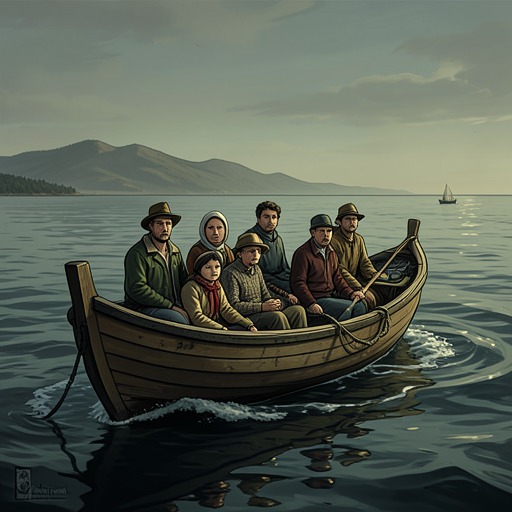
Their shared delight in the moving waves rises again as they watch a sailing boat cut across the bay, pause, and let its sails drop. The scene seems to complete itself when they turn toward the distant dunes. Yet completion brings sadness as well as exhilaration: Lily thinks the far views outlast their observers and belong already to a sky looking upon an earth at rest. The sea makes companionship possible in a common act of looking, but the completed image also brings forward the limits of individual lives and the distance between the present observer and an enduring landscape.
Solitude, erosion, and human limits
The bay connects William Bankes's present thoughts to his memory of Mr Ramsay. Looking toward the dunes, he recalls Ramsay on a road in Westmorland, walking alone with solitude as his natural air. In Bankes's recollection, a small incident once illuminated Ramsay's sympathy: he stopped to admire a hen protecting her chicks. But after Ramsay married, their friendship lost its earlier freshness; repetition replaced newness, although Bankes insists inwardly that his affection has not diminished. The distant sandhills hold the friendship in memory, as something still acute and real even though its former closeness has passed.
The sea's erosion gives this inward solitude a material counterpart. Mr Ramsay comes to the edge of the lawn as if compelled by fate to stand on land the sea is slowly eating away. There he strips away social gestures and consolations and confronts human ignorance: people know little, while the sea continues to consume the ground beneath them. The image makes intellectual uncertainty and physical vulnerability converge. His wife, seeing him there, feels reverence, pity, and gratitude; he turns from this stark contemplation toward the consolation of his family and ordinary happiness, while recognizing himself as the father of eight children.
At another evening encounter, the bay frames a difference between the Ramsays' inward lives. Mr Ramsay wants to tell Mrs Ramsay what he felt while walking on the terrace, but he hesitates to intrude on her solitude. She has been thinking privately, and their thoughts do not become something they can share. Though the Lighthouse is visible again at the gap between the red-hot pokers, she refuses to look at it. She turns instead to the town and harbour lights, which seem like a net marking something sunk. The sea and its adjoining landscape thus provide not only a scene for reflection but also a boundary: one person may stand beside another without gaining access to the other's private experience.
The sea as a figure for private life
The waves enter Mrs Ramsay's reflections on life, which she finds terrible, hostile, and ready to pounce. Suffering, death, and poverty persist even in this beautiful place; the thought that a woman is dying of cancer prevents domestic surroundings from seeming like a shelter from human pain. Knowing that her children must face love, ambition, and loneliness, she wonders why they must grow up and lose their present happiness. Yet she answers her own fear by insisting that they will be happy, and her efforts to arrange Minta Doyle's marriage to Paul Rayley belong to this effort to shape a life that otherwise seems exposed to forces she cannot control.
The sea's apparent power to join the visible world with inward feeling appears differently when Mrs Ramsay sits alone with her knitting. At such times she feels herself as a hidden, solitary self beneath the social presence others recognize. Looking toward the Lighthouse, she attaches herself to its long, steady beam and feels herself becoming what she watches. The light offers a moment of peace and apparent eternity, while the sea and its repeated movements remain part of the world through which that moment passes. The passage does not make this stillness permanent: its language turns toward endings and what will come, keeping the felt unity shadowed by time.
This use of landscape as a possible answer to inward distress is tested during the years of loss and upheaval. In the changing nights, fleeting images—the hare standing upright, a falling wave, a rocking boat—appear as distinct treasures, as if human effort and penitence had briefly parted a curtain. But the respite cannot be kept. Hail covers and breaks what seemed composed, and the fragments make it difficult to recover a whole or read clear truth in what remains. The image of the sea and the rocking boat belongs to a temporary order, not a guarantee that loss can be repaired by contemplation.
Storm, war, and the failure of consolation
The severe weather makes that instability explicit. Winds bend the trees and scatter their leaves across the lawn and into gutters and rain pipes; the sea tosses and breaks itself. A solitary sleeper who goes down to the beach hoping for an answer or a companion finds no ready vision capable of ordering the night or reflecting the soul. The voice of the waves overwhelms rather than explains. In this passage, nature is not a dependable language through which a person can read a moral response to suffering.
The loss of Mrs Ramsay is set against this indifference. On a dark morning, Mr Ramsay reaches out as he stumbles along a passage, but his arms remain empty: she died suddenly the night before. The novel places that intimate absence within a larger world of night and weather, not within a landscape that supplies consolation or explanation. The human consequence is sharply particular, while the surrounding natural forces continue on their own scale.
War further breaks the expectation that coastal beauty can support serene reflection. An explosion kills Andrew Ramsay among the young men in France, and the war's effects enter the landscape through the image of an ashen-coloured ship that appears and vanishes and a purplish stain on the sea. These marks interrupt the familiar sequence of sunset, dawn, moonlight, fishing boats, and children at play. They are difficult to overlook or dissolve into an account of beauty mirroring inward beauty. Nature sees human misery, meanness, and torture with equal composure; the imagined sharing between solitude and the seascape proves to be a reflection in a fragile mirror, which breaks.
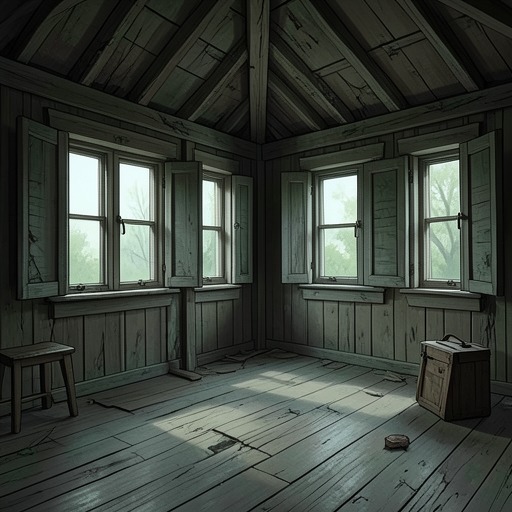
The sea's changing force is therefore central to the novel's refusal to make beauty equivalent to goodness. Its rhythms can soothe, draw people into shared attention, and give form to private insight, but the same landscape exposes isolation, erosion, death, and the damage of war. In the empty summer house, storms and waves continue through night and day in a shapeless tumult, indifferent to human purposes. The imagery holds together what its human observers would prefer to separate: beauty and danger, temporary harmony and irreversible loss, the desire for an answer and a natural world that does not provide one.