The Social Expectation That Women Should Marry
To the LighthouseThe Social Expectation That Women Should Marry is presented as a domestic ideal that Mrs Ramsay actively advances, especially by arranging relationships and imagining marriage as a route to happiness. Yet the novel places that ideal beside her unease about life’s suffering, Prue Ramsay’s death following childbirth, and Lily Briscoe’s independent future. Marriage is thus both an expression of care and a prescription whose limits become visible across generations.
How the Expectation Is Enacted
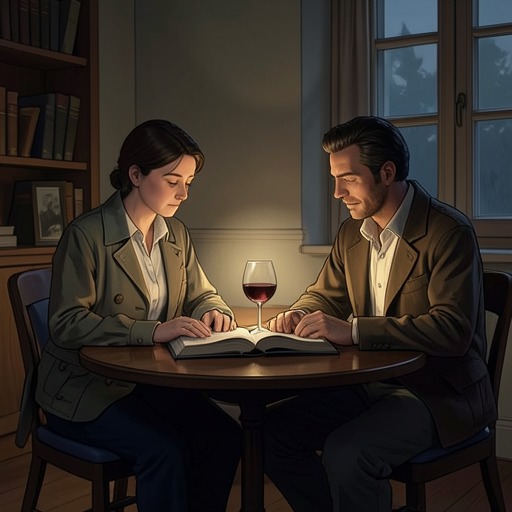
Mrs Ramsay’s influence works through ordinary acts of attention and arrangement. She encourages the match between Minta Doyle and Paul Rayley and imagines the young couple’s love as a promise of happiness. At dinner she watches Prue respond shyly to Minta’s excitement, interpreting her daughter’s attention as the beginning of a future in which Prue, too, will experience romantic love. Her inward assurance that Prue will be happy reveals how readily she connects a daughter’s prospects with the heterosexual happiness represented at the table.
The expectation is not expressed only in explicit advice. Mrs Ramsay’s matchmaking with Lily Briscoe and William Bankes takes the form of walks arranged for them and flattering descriptions of their compatibility: Lily has a scientific mind, appreciates flowers, and is exact. Mrs Ramsay praises Bankes’s intellect and regrets that his house lacks someone to arrange its flowers. The pairing rests on a domestic model in which a woman’s abilities and tastes can be presented as reasons she would suit a man, while care for the home supplies part of the imagined benefit of marriage.
Care, Motherhood, and Private Doubt
Mrs Ramsay’s faith in marriage sits beside her deep resistance to time and loss. She wishes James and Cam could remain children and fears that growing up will strip away their present happiness. She remembers the children’s small treasures and daily pleasures, and wonders why they must grow up and lose them. Her attachment to motherhood is physical and immediate: she is happiest carrying a baby, and the prospect of her children entering adult life brings apprehension rather than uncomplicated hope.
Her reflections widen from family life to suffering, death, and poverty. She thinks of a woman dying of cancer even on the island and recognizes that her children will encounter love, ambition, and loneliness. Although she tells herself that they will be happy, she feels life to be hostile and liable to strike without warning. Against this knowledge, her insistence that people must marry and have children appears partly as a response to her own experience—experiences she does not name even to herself—and partly as an attempt to direct younger people toward a familiar structure of life. The novel preserves the tension: her counsel is sincere, but it cannot guarantee safety or happiness.
The Ideal Meets Loss
The narrative places the language of promise beside the facts of bereavement. Prue Ramsay is given in marriage in spring, admired for her beauty, and described by observers as a fitting bride. That public picture of fulfilled expectation is sharply reversed when she dies that summer from an illness connected with childbirth. The transition from wedding to death makes marriage and motherhood no assurance against tragedy; the hopeful future imagined for Prue is cut short by the very life event associated with that ideal.
The larger chronology reinforces the contrast between private hopes and historical violence. A shell explodes in France, killing twenty or thirty young men, including Andrew Ramsay, whose death is instantaneous. The deaths are not presented as consequences of the marriage norm, but they belong to the same account of how little human expectation can command. The tranquil forms through which people seek assurance—spring, domestic life, and the beauty of the landscape—do not cancel the losses that enter them.
Lily Briscoe’s Refusal and Retrospective Judgment
Years later, Lily measures Mrs Ramsay’s matchmaking against the lives that followed. She recognizes that Mrs Ramsay had planned a match between her and William Bankes and wonders whether, had Mrs Ramsay lived, she would have compelled it. Lily remembers being told she had a scientific mind and liked flowers, qualities used to make her seem suitable for Bankes. Her own life does not fulfill that plan: she never marries, including not Bankes, and continues to paint.
Lily’s recollection of Mrs Ramsay’s imagined injunction, “Marry, marry!”, captures the expectation in its most imperative form. From the distance of years, Lily can answer that life has changed and that people are happy in ways Mrs Ramsay’s prescription did not foresee. Her response is not a claim that marriage makes no one happy: she recognizes the Rayleys’ early excitement and the force of being in love. Rather, her own unmarried life and artistic work resist the assumption that a woman’s fulfillment must take the form Mrs Ramsay arranged. The tension between them preserves both the emotional power of Mrs Ramsay’s influence and Lily’s right to live otherwise.
Significance
The novel renders the marriage expectation through relationships rather than abstract rules. Mrs Ramsay’s matchmaking grows from attention to others and from a wish to secure happiness, but her private fear of suffering complicates that wish. Prue’s death exposes the vulnerability concealed by the celebratory language surrounding her marriage, while Lily’s later perspective shows that a woman’s life can exceed the future others design for her. The norm remains emotionally persuasive, yet it cannot be treated as a universal guarantee or measure of women’s happiness.