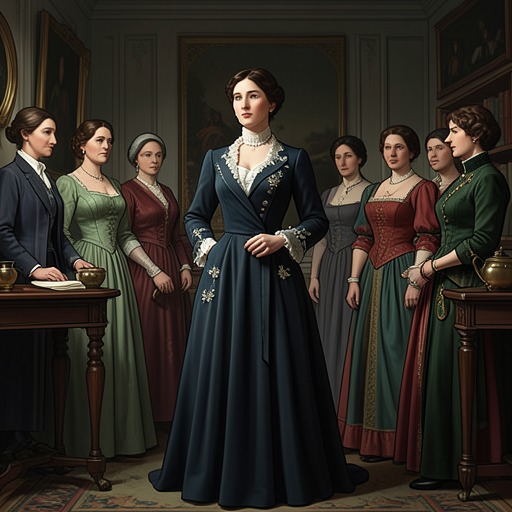
The Social Norm That Women Should Marry and Have Children
To the LighthouseThe Social Norm That Women Should Marry and Have Children is a powerful social expectation in the Ramsay household, expressed in Mrs Ramsay’s insistence that people marry and have children and in her efforts to arrange matches. Its significance lies in the tension between care and coercion: Mrs Ramsay sincerely believes marriage offers a central form of human fulfillment, but her certainty presses against Lily Briscoe’s desire to remain independent and cannot guarantee happiness or protect a family from loss.
The Ideal and Its Domestic Setting
Mrs Ramsay’s matchmaking grows out of her understanding of family life. She treasures her children’s daily enthusiasms, their small possessions, and their stories, and wishes they could remain young rather than enter the hardships of adulthood. At the same time, she recognizes life as hostile and unpredictable, with suffering, death, and poverty among its persistent realities. Her desire to give people marriage and children is therefore bound up with a wish to secure happiness against a world she cannot master.
That ideal is sustained by domestic labor as well as conviction. Mrs Ramsay reads to James, measures the stocking intended for the lighthouse keeper’s son, tends to her children at bedtime, and organizes a dinner whose carefully timed centerpiece is boeuf en daube. These acts place marriage and family within a daily world of care, provisioning, and social arrangement. The novel shows the work that makes household life possible while also showing how readily care becomes a means of directing other people’s futures.
Matchmaking and Its Pressures
Mrs Ramsay tries to imagine Lily with William Bankes, reasoning that they share interests and arranging opportunities for them to walk together. She sees Lily’s independent character as a quality a suitable, older man might appreciate, yet her interpretation of Lily’s prospects remains organized around marriage. The proposed match is Mrs Ramsay’s project, not a future that Lily has chosen.
Her certainty becomes sharper in Lily’s recollection of their conversations. Mrs Ramsay maintains that an unmarried woman has missed the best of life; Lily, by contrast, tries to defend her father, her home, and her painting, and says she likes being alone and being herself. The disagreement is intimate rather than abstract: Lily remembers laughing almost hysterically while resting her head on Mrs Ramsay’s lap, even as she encounters the older woman’s serious conviction that she is foolish to reject marriage. The episode makes the norm’s pressure visible without reducing Mrs Ramsay to a tyrant or Lily’s resistance to a simple victory.
Mrs Ramsay’s matchmaking also extends to Minta Doyle and Paul Rayley. She worries that she may have hurried Minta, who is only twenty-four, into deciding, and asks herself whether she has used her influence too strongly. Yet she continues to believe people must marry and have children, drawing on a quality in her own marriage that she regards as essential. The belief is thus both a general prescription and a projection from a relationship whose particular conditions she cannot simply impose on others.
The Limits of the Promise
At dinner, Paul reports that he and others went back to look for Minta’s lost brooch. Mrs Ramsay hears the change carried by his use of “we” and treats it as a sign of the lovers’ emerging bond. The elaborate meal becomes, in her imagination, a celebration of their love: serious because love carries the seeds of death, but also an occasion for playful ceremony. This moment shows how matchmaking gives her a way to interpret small gestures as the beginning of a shared life.
The novel places that hopeful interpretation beside outcomes no marital ideal can prevent. Prue Ramsay is given in marriage amid public approval of her beauty and the apparent promise of her future, but she dies that summer from an illness connected with childbirth. Andrew Ramsay is later killed instantaneously when a shell explodes in France. These losses do not establish that marriage or family life is inherently futile; they do show that social approval and domestic hope offer no protection from bodily danger, war, or bereavement.
Narrative Significance
The norm is presented through a contrast of voices and experience. Mrs Ramsay’s care gives the expectation warmth and emotional credibility, while Lily’s inward argument exposes the cost of treating marriage as every woman’s necessary fulfillment. Mrs Ramsay herself is not free from uncertainty: she questions whether she has pressed Minta and recognizes that marriage requires a quality she does not name but associates with her own bond to her husband.
By following both the intimate acts of household care and the later deaths that interrupt family continuity, the narrative refuses to equate conventional milestones with guaranteed happiness. Marriage and children remain powerful sources of attachment and meaning, but they cannot settle the question of how a woman should live, nor can they defeat time, suffering, or chance. The expectation persists as a force shaping relationships precisely because its promise is emotionally compelling and its limits are real.