
Main Story Flow
TorahMajor events ordered chronologically by story time.
increasing Bearing strength in each event
 decreasing
Bearing strength in each eventdecreasingCreation

In Genesis, Creation is the ordered beginning of the world and the pattern that gives sacred significance to time: God brings light, land, celestial lights, and living creatures into place by command, creates humanity in the divine image, and declares the completed work very good. The account closes with God resting and hallowing the seventh day.
Order from the Unformed Earth
The account opens with the earth unformed and void, darkness covering the deep, and the spirit of God hovering over the waters. God’s command, “Let there be light,” begins a sequence of divisions and names: light is separated from darkness and called Day, while darkness is called Night. The repeated cycle of evening and morning measures the work as days unfold.
On the second day, a firmament divides waters above from waters below and is called Heaven. On the third, the waters beneath Heaven gather in one place, exposing dry land, which God calls Earth; the gathered waters are called Seas. The land then produces grasses, seed-bearing herbs, and fruit trees, each after its kind. God sees that these works are good.
The Heavens and Living Creatures
On the fourth day, lights are placed in the firmament to divide day from night and to serve as signs for seasons, days, and years. The greater light rules the day, the lesser light the night, and the stars join them in illuminating the earth. Their placement gives the created order a framework for marking time as well as distinguishing light from darkness.
On the fifth day, the waters swarm with living creatures and birds fly above the earth. God creates the great sea monsters, other water creatures, and winged birds, each after its kind, and blesses them to multiply. On the sixth day, the earth brings forth cattle, creeping things, and beasts, also after their kinds; the sequence of life expands from the waters to the land.
Humanity and the Goodness of Creation
Humanity is made in God’s image, male and female, and receives a distinctive place within the living order. God blesses them, commands them to be fruitful and multiply, and grants them dominion over fish, birds, cattle, and the other creatures. Their food is assigned from seed-bearing plants and fruit trees; green plants are given to the beasts, birds, and creeping things.
The account’s repeated judgments that the works are good culminate in God’s seeing everything made as very good. The final assessment gathers the differentiated parts of creation into a whole: the world’s order, its living kinds, and humanity’s place within it are presented as a completed and blessed work.
Completion and the Seventh Day
The heaven and earth and all their host are finished. On the seventh day God ceases from the work of creation, blesses that day, and hallows it because of the rest. The narrative thus ends not with another created domain, but with time itself marked as sacred: the completed work gives way to a day set apart from the preceding labor.
Fall of Man
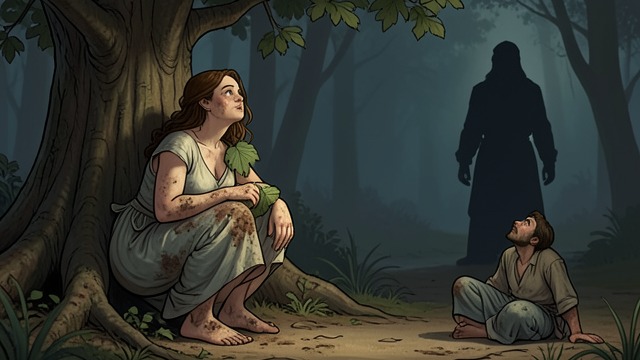
The Fall of Man is the Genesis account of Adam and Eve’s disobedience and expulsion from the garden of Eden. After the serpent persuades Eve to eat from the forbidden tree and she shares its fruit with Adam, their new knowledge is accompanied not by freedom but by shame, estrangement, hardship, and exclusion from the tree of life.
The Command and the Choice
Adam and Eve begin in the garden without shame. The LORD God permits them to eat from every tree except the tree of the knowledge of good and evil, warning Adam that eating from it will bring death. The serpent challenges that warning, telling Eve that they will not surely die and that their eyes will be opened, making them like God in knowing good and evil.
Eve sees that the fruit is good for food, pleasing to the eyes, and desirable for gaining wisdom. She eats, then gives fruit to Adam, who is with her, and he eats as well. The narration presents a shared transgression, but the serpent’s deception and the couple’s decision lead directly to a changed awareness: they recognize their nakedness, sew fig leaves into coverings, and hide among the garden’s trees when they hear the LORD God.
Confrontation and Consequences
When the LORD God calls to Adam, Adam answers that he is afraid because he is naked and has hidden himself. Asked whether he ate from the forbidden tree, Adam points to the woman given to him; Eve, in turn, says that the serpent beguiled her. The exchange traces responsibility through the three participants without undoing the act or its consequences.
The judgments alter each participant’s circumstances. The serpent is cursed and condemned to crawl; enmity is set between it and the woman and between their offspring. The woman is told of increased pain and travail in childbirth and of her relation to her husband. Adam is told that the ground is cursed on his account: it will yield food through toil, produce thorns and thistles, and require the sweat of his face until he returns to the ground from which he was taken.
Expulsion and the Guarded Tree
Adam names his wife Eve because she is the mother of all living. The LORD God makes garments of skins for Adam and Eve and clothes them, a provision that follows their improvised fig-leaf coverings even as their former life in the garden ends.
The LORD God sends Adam out of the garden of Eden to till the ground from which he was taken, then drives him out and stations cherubim and a flaming sword east of the garden to guard the way to the tree of life. The expulsion closes off access to eating from that tree and living forever. The story’s decisive reversal is therefore both material and existential: the first human pair move from an unashamed garden existence to labor outside it, under mortality.
Narrative Significance
The account links human disobedience to conditions that shape life beyond Eden: painful childbirth, difficult cultivation, and return to the ground. Its sequence turns a prohibition into a lasting rupture, marked first by opened eyes and concealment, then by judgment and departure. The guarded tree of life gives that departure its finality, while the clothing and the later naming of Eve register that life continues beyond the garden.
Cain murders Abel
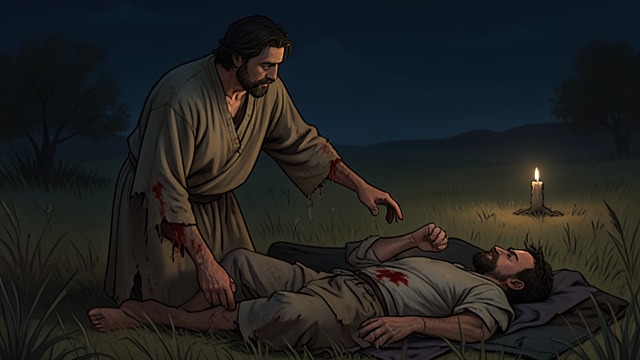
Cain murders Abel after God accepts Abel’s offering but not Cain’s. The killing transforms a conflict over worship into the first recorded fratricide; confronted by God, Cain is cursed to become a fugitive, yet receives protection against being killed in turn.
Offerings and Conflict
Cain and Abel are the sons of Adam and Eve. Abel keeps sheep, while Cain cultivates the ground. In time, Cain brings an offering of the ground’s produce to God; Abel brings firstlings of his flock and their fat. God regards Abel and his offering, but not Cain and his, and Cain grows angry, his face falling.
God warns Cain that sin lies at the door and that he may master it. The warning places a choice before Cain, but the narrative moves from the unequal reception of the offerings to violence: when the brothers are in a field, Cain rises against Abel and kills him.
Confrontation and Judgment
God asks Cain where Abel is. Cain denies knowledge and asks whether he is his brother’s keeper. God answers by naming Abel’s blood as a witness crying from the ground, the same ground Cain had worked and from which his offering came.
Cain is cursed from the ground, which will no longer yield its strength to him. Instead of remaining a cultivator in place, he must live as a fugitive and wanderer. Cain says the punishment is unbearable, fears that whoever finds him will kill him, and laments being hidden from God’s face.
Protection and Aftermath
God declares that anyone who kills Cain will face sevenfold vengeance and sets a sign to prevent others from striking him. Cain then leaves God’s presence and settles in the land of Nod, east of Eden. The judgment thus combines expulsion and insecurity with a limit on retaliatory violence: Cain is condemned to wander, but not abandoned to immediate vengeance.
The episode’s consequences extend beyond the brothers. Eve later bears Seth, describing him as another offspring appointed in place of Abel, whom Cain killed. The narrative presents Abel’s death as a rupture in the first family and Cain’s exile as a lasting change in his relation to the land, his brother’s memory, and God.
Narrative Significance
The murder follows the expulsion of Adam and Eve from the Garden of Eden, carrying the story of sin from disobedience into human violence. Cain’s evasive answer contrasts with the ground’s testimony, while his claim that his punishment is unbearable follows the judgment he brought upon his brother. The episode establishes bloodshed as answerable to God and makes the ground both the place that receives Abel’s blood and the source from which Cain is alienated.
Noah's Flood
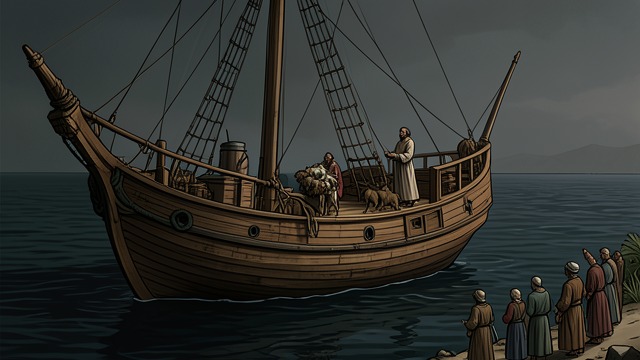
Noah's Flood is the judgment upon a world described as corrupt and filled with violence, and the catastrophe through which Noah, his family, and living creatures are preserved in the ark. The waters erase life from the land, but their recession leads to renewed habitation, Noah’s sacrifice, and God’s enduring covenant with all flesh, marked by the bow in the clouds.
Causes and Preparation
The narrative sets the flood against pervasive human wickedness: the LORD sees that human thought is continually evil, while the earth is corrupt and filled with violence. Noah stands apart as righteous and whole-hearted, one who walks with God. God announces that all flesh will be destroyed, but establishes a covenant with Noah and directs him to build an ark.
The vessel is specified as three hundred cubits long, fifty cubits wide, and thirty cubits high, with rooms, a side door, and lower, second, and third stories. Noah is to bring his wife, sons, and sons’ wives aboard, along with two of every kind of living creature and food for all. The instructions distinguish clean animals, of which seven pairs are taken, from other animals, of which one pair is taken; Noah carries them out as commanded.
The Flood and Survival
When the waters come, Noah is six hundred years old. The rain falls for forty days and nights, the ark rises above the earth, and the waters cover the high mountains by fifteen cubits. Every creature on dry land in whose nostrils is the breath of life dies; Noah alone remains alive with those in the ark. The waters prevail for a hundred and fifty days.
After God remembers Noah and the living creatures with him, the waters begin to subside. The ark comes to rest on the mountains of Ararat, and Noah tests the retreat of the waters by sending out a raven and then doves. A dove returns with a freshly plucked olive leaf, showing that the waters have abated; on a later flight it does not return. The ground dries in the six hundred and first year of Noah’s life, and God then tells the family and the animals to leave the ark and multiply on the earth.
Renewal and Covenant
Noah builds an altar to the LORD and offers burnt offerings from clean animals and birds. In response, God promises not again to curse the ground in this way or to destroy every living thing by a flood, and declares that the rhythms of seedtime and harvest, cold and heat, summer and winter, day and night will continue while the earth remains. The survivors’ return to the land is thus followed not only by renewed life but by an assurance of continuity.
God’s covenant extends beyond Noah and his descendants to every living creature that went out of the ark. Its pledge is that the waters will never again become a flood to destroy all flesh. The bow in the cloud is given as its sign: when it appears, God will remember the everlasting covenant between God and every living creature. The flood therefore ends with a limit placed on future destruction and a visible sign of that promise.
Narrative Significance
The episode moves from violence and universal loss to preservation, sacrifice, and a future secured by covenant. The ark protects life through the catastrophe, while Noah’s altar marks the transition from survival to renewed relationship with God. The promise is addressed not only to humanity but to all living creatures, making the flood’s aftermath a reordering of the relationship between the earth’s inhabitants and divine judgment.
Noahic Covenant

The Noahic Covenant is God’s enduring promise to Noah, his descendants, and every living creature that the waters will never again become a flood destroying all life. Made after the deluge and the family’s departure from the ark, it turns a story of judgment and survival toward continuity: the earth’s seasons will persist, living creatures will again multiply, and the bow in the cloud will mark the covenant across generations.
Background and Setting
The covenant follows a world described as corrupt and filled with violence. Noah, distinguished as righteous and whole-hearted in his generation and as one who walked with God, is told to build an ark of gopher wood, sealed with pitch and divided into rooms. Its specified dimensions are three hundred cubits long, fifty cubits wide, and thirty cubits high. Noah enters with his wife, his sons Shem, Ham, and Japheth, and their wives; animals are also preserved inside.
After the floodwaters cover the earth and all life on dry land perishes, Noah and those with him survive in the ark. When the waters recede, the ark comes to rest on the mountains of Ararat. Noah sends out birds to test whether the land has emerged: a dove eventually returns with a freshly plucked olive leaf, and later does not return. Once the earth is dry, God tells the family and the animals to leave the ark and spread across the earth.
Sacrifice and the Promise
Noah builds an altar to God and offers burnt offerings from every clean beast and clean bird. Following the offering, God declares that the ground will not again be cursed on humanity’s account in this way, and that every living thing will not again be struck down as it has been. The promise does not depend on humanity becoming wholly good: the account still describes the human heart as inclined to evil from youth.
God promises that, for as long as the earth remains, seedtime and harvest, cold and heat, summer and winter, and day and night will not cease. He blesses Noah and his sons and commands them to be fruitful, multiply, and fill the earth. Animals are placed under human dominion, and moving creatures are permitted as food, with the life-bearing blood withheld. Human life is treated as accountable: God requires an account for the shedding of human blood, grounding the rule in humanity’s creation in God’s image.
Parties and Sign of the Covenant
The covenant is not limited to Noah and his household. God establishes it with Noah and his descendants, and explicitly includes every living creature with him: birds, cattle, and all the beasts that left the ark. Its scope is reiterated as extending to every creature of all flesh on earth, and its duration is described as perpetual.
God appoints the bow in the cloud as the token of the covenant between God and the earth. When clouds come and the bow appears, God says that he will remember the covenant, and that the waters will not again become a flood to destroy all flesh. The sign thus makes the promise visible in the very weather associated with the catastrophe, while the text presents its function as remembrance of an enduring commitment.
Aftermath and Significance
The covenant establishes a future after the flood without erasing the danger and violence that preceded it. Its assurance is ecological and temporal as well as human: the rhythms on which life depends are promised continuity, while Noah’s descendants are charged with repopulating the earth and respecting the sanctity of life.
Later covenant language in Deuteronomy recalls the flood as the event from which God’s promise that all flesh would not again be cut off by floodwaters stands apart. The Noahic promise therefore serves as a foundational assurance of preservation, broader than a pact with one family: it embraces the living world and binds the post-flood future to a sign in the clouds.
Call of Abraham
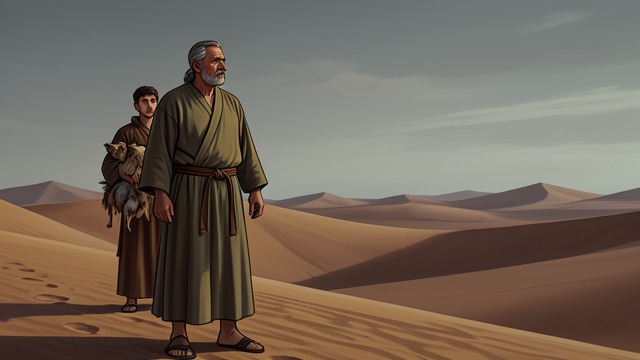
The Call of Abraham launches the patriarchal story with a journey from Haran into Canaan and a promise that reaches beyond Abram’s household: he will become a great nation, receive blessing, and become a source of blessing to all the families of the earth. The narrative then tests that promise through famine, migration, reproductive struggle, inheritance, and the shaping of a lineage whose future remains tied to the land.
Departure and Promise
Abram’s family had already left Ur of the Chaldees for Canaan, but Terah’s household settled in Haran, where Terah died. Sarai was barren and had no child. From this point of suspended movement and uncertain succession, the LORD commanded Abram to leave his country, kindred, and father’s house for a land yet to be shown.
The call paired departure with an expansive promise. The LORD would make Abram a great nation, bless him, make his name great, and make him a blessing; those who blessed him would be blessed, and the families of the earth would find blessing through him. Abram obeyed at seventy-five, taking Sarai, his nephew Lot, their substance, and the people they had gathered in Haran, and they came to Canaan.
A Promised Land, a Vulnerable Household
At Shechem, where the Canaanites were already living, the LORD appeared and promised the land to Abram’s seed. Abram built an altar there, then moved to the mountain east of Bethel, pitched his tent between Bethel and Ai, built another altar, and called upon the LORD. His route southward established a repeated pattern: movement through the land, divine promise, and acts of worship.
Famine interrupted that pattern and drove Abram into Egypt. Fearing that the Egyptians would kill him because Sarai was his wife, he asked her to say that she was his sister. Pharaoh’s officials praised Sarai to Pharaoh, and she was taken into his house; Abram received livestock and servants on her account. The LORD afflicted Pharaoh’s household, and Pharaoh confronted Abram for concealing the marriage, restored Sarai, and sent the couple away. The episode shows the promised household exposed to danger even as it prospers materially.
The Promise Tested by Descent and Inheritance
Sarai’s barrenness became an enduring crisis within the household. After Abram had lived ten years in Canaan, Sarai gave her Egyptian handmaid Hagar to Abram as a wife, hoping to build a family through her. Hagar conceived; conflict followed between the women, and Sarai dealt harshly with her. Hagar fled, but the angel of the LORD found her at a spring in the wilderness on the way to Shur, promised that her descendants would multiply, and told her that she would bear Ishmael. Abram was eighty-six when Ishmael was born.
The birth of Ishmael did not settle the question of succession. After Isaac’s birth, Sarah demanded that Hagar and her son be sent away so that Ishmael would not share the inheritance with Isaac. Abraham was distressed, but God told him to heed Sarah: the covenant line would be called through Isaac, while Ishmael too would become a nation because he was Abraham’s offspring. Hagar and Ishmael departed with bread and water; when the water ran out in the wilderness of Beer-sheba, God heard the boy, showed Hagar a well, and preserved them. The narrative thus distinguishes the line through which the land promise continues from the care and future also granted to Ishmael.
From Household to Lineage
Isaac’s birth to Sarah fulfilled the promise after years of barrenness. Abraham was one hundred; he named the child Isaac and circumcised him at eight days, as God had commanded. At Isaac’s weaning Abraham held a great feast. The naming, covenant sign, and feast mark the promised heir’s place in the household, even as his presence intensifies the conflict over Hagar’s son.
The same concerns of descent and household order recur in the next generation. Jacob’s marriages to Leah and Rachel, and the children born to them and their handmaids, produce the sons who become the family’s principal branches. When Rachel died in childbirth on the journey to Ephrath, she named her son Ben-oni, but Jacob called him Benjamin; her death and the birth of this final son sharpen the cost and continuity of family growth. The account later counts Jacob’s descendants who entered Egypt as seventy, presenting the small household linked to the original call as a large, named lineage.
Near the end of Jacob’s life, the promises of land and multiplication are recalled and reshaped through Joseph’s sons. Jacob adopted Ephraim and Manasseh as his own, placing them alongside Reuben and Simeon for inheritance. Though Joseph tried to guide his father’s right hand to the firstborn Manasseh, Jacob deliberately blessed the younger Ephraim with the greater future, while promising that Manasseh too would become a people. The call’s concern with descendants therefore continues through contested birth order, recognized kinship, and blessings that do not simply follow seniority.
Narrative Significance
The call is not a single departure that resolves the family’s future. It establishes the framework through which subsequent episodes are read: Canaan is both inhabited territory and promised inheritance; children are both members of a household and bearers of competing claims; and blessing extends beyond the chosen line even as the narrative distinguishes that line. The repeated movement between promise and obstacle—barrenness, famine, expulsion, bereavement, and contested blessing—gives the journey its long reach.
Geography carries that tension. Abram leaves Haran for Canaan, builds altars at Shechem and near Bethel, and goes south into Egypt under famine’s pressure; later generations carry the family into Egypt, where it multiplies. The story’s direction is therefore not simply forward: the promise of land accompanies a migration that eventually takes the family away from it, while the assurance of descendants grows through a succession of births, separations, and inheritance decisions.
Covenant between the Pieces
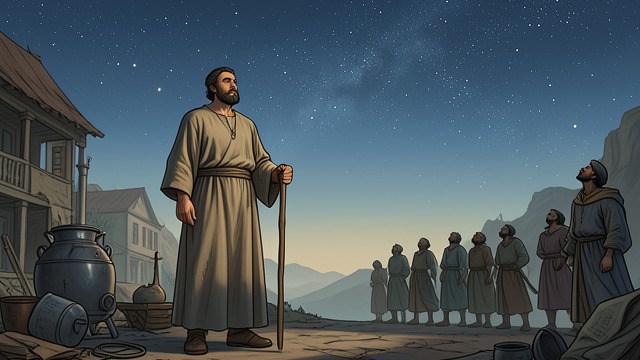
The Covenant between the Pieces is the solemn confirmation of God’s promises to Abram: descendants from his own line and possession of the land. Its dramatic rite follows Abram’s question about how he can know the promise will be fulfilled, while its prophecy places his family’s future within a much longer history of affliction, judgment, and return.
Background and Promise
The episode follows Abram’s rescue of Lot and his refusal to keep the recovered goods of Sodom. God comes to Abram in a vision, telling him not to fear and promising to be his shield and reward. Abram answers with the unresolved problem of his childlessness: his household heir is Eliezer of Damascus, since he has no child of his own.
God rejects that proposed succession and promises that Abram’s heir will come from his own body. Abram is brought outside and told to look toward heaven and count the stars; his descendants, God says, will be as numerous. Abram believes, and his faith is counted to him as righteousness. God also recalls bringing him from Ur of the Chaldees to give him the land as an inheritance.
The Covenant Rite
When Abram asks how he can know that he will inherit the land, God instructs him to bring a three-year-old heifer, a three-year-old she-goat, a three-year-old ram, a turtle-dove, and a young pigeon. Abram divides the larger animals and places the halves opposite one another, while leaving the birds undivided. He drives away birds of prey that descend on the carcasses.
As the sun sets, a deep sleep and great darkness fall upon Abram. God declares that Abram’s descendants will live as strangers in a land that is not theirs, serve its people, and endure affliction for four hundred years. The nation they serve will be judged; afterward, they will leave with great substance. Abram himself is promised a peaceful death and burial in old age, while his descendants will return in the fourth generation, after the iniquity of the Amorites has reached its full measure.
At sunset, amid thick darkness, a smoking furnace and a flaming torch pass between the divided pieces. The narrative identifies this moment as the making of the covenant: God gives Abram’s descendants the land from the river of Egypt to the Euphrates, naming the peoples whose territory it encompasses.
Promise Across Generations
The covenant joins a personal assurance to a collective future. Abram’s immediate anxiety concerns an heir, but the answer extends from his own descendants to their eventual possession of a defined territory. The promise therefore reaches beyond Abram’s lifetime and includes both a period of foreign servitude and a return to the land.
Later covenant language in the book echoes this long horizon. The covenant in Moab is made not only with those physically present but also with those absent, and it recalls the promises sworn to Abraham, Isaac, and Jacob. Its warnings describe exile for abandoning the covenant, while its restoration promise speaks of gathering the dispersed and bringing them back to the land. These later passages develop a national covenant history consistent with the future already disclosed to Abram.
Narrative Significance
The rite gives the land promise a visible, enacted form: the divided offerings frame the passage of fire through their midst, while Abram remains under the darkness of the vision. The text presents the covenant as God’s commitment and anchors its fulfillment in a sequence of promised events rather than in Abram’s immediate circumstances.
The episode also establishes a recurring structure of promise, obligation, and consequence in the book’s covenant narratives. Later, Israel hears the law as a covenant made with the generation standing before Moses, and the people are called to keep its words; the law and song are preserved as witnesses. Against that wider frame, Abram’s covenant is an ancestral foundation: it links descendants, land, hardship, and return in a promise whose scope unfolds across generations.
Hagar's Flight and Ishmael's Birth
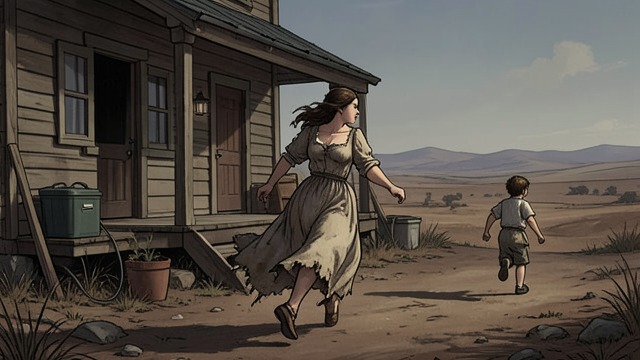
Hagar's Flight and Ishmael's Birth is a turning point in the household of Abram and Sarai: their attempt to secure offspring through Hagar produces conflict, while Hagar's encounter in the wilderness brings a promise of descendants and establishes Ishmael's place in the family. The episode joins a household crisis to a divine assurance that the future will extend beyond Sarai's present childlessness.
Household Crisis
Sarai had borne Abram no children and had an Egyptian handmaid named Hagar. After Abram had lived ten years in the land of Canaan, Sarai gave Hagar to him as a wife, hoping to be built up through her. Abram agreed, and Hagar conceived.
Hagar's pregnancy altered the household relationship: she came to regard Sarai with contempt, and Sarai accused Abram of responsibility for the wrong she felt she had suffered. Abram left Hagar's treatment to Sarai. Sarai dealt harshly with her, and Hagar fled.
Hagar in the Wilderness
The Angel of the LORD found Hagar beside a spring on the way to Shur and asked where she had come from and where she was going. Hagar answered that she was fleeing from Sarai. The Angel told her to return and submit to her mistress, while also promising to multiply her descendants beyond counting.
The message addressed Hagar directly as a pregnant woman and promised that she would bear a son, Ishmael, a name connected to the LORD having heard her affliction. It also foretold a life of conflict for the son, describing him as a wild ass of a man, with hostility between him and others and a dwelling in the face of his brethren. Hagar named the LORD who spoke to her as a God who sees; the spring was thereafter called Beer-lahai-roi, between Kadesh and Bered.
Birth and Family Significance
Hagar returned and bore Abram a son. Abram named him Ishmael, and was eighty-six years old at the time. The account thus gives Hagar an encounter and a promise in her own right, while locating Ishmael's birth within Abram's household and the continuing question of descendants.
Narrative Significance
The episode contrasts the household's attempt to address Sarai's childlessness with the assurance given to Hagar in the wilderness. Her flight follows the strain created by pregnancy and harsh treatment; the encounter does not erase that conflict, but it gives her son's future a divine promise and a name that recalls that her affliction was heard.
Binding of Isaac
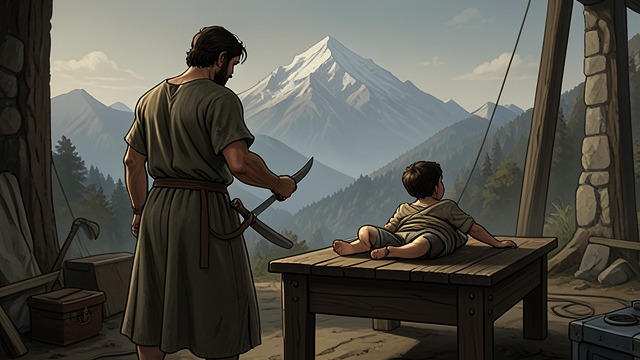
The Binding of Isaac is the account of Abraham’s journey to offer Isaac as a burnt-offering, the last-minute intervention that spares his son, and the ram offered in Isaac’s place. Its decisive reversal joins a test of Abraham’s obedience to a renewed promise that his descendants will multiply and become a blessing to the nations.
The Command and the Journey
After the agreement with Abimelech at Beer-sheba, God tests Abraham by commanding him to take Isaac, his only beloved son, to the land of Moriah and offer him as a burnt-offering. Abraham rises early, saddles an ass, takes Isaac and two young men, prepares the wood, and travels to the place God will show him.
On the third day Abraham sees the place at a distance. He leaves the young men with the ass and tells them that he and Isaac will go to worship and return. He carries the fire and knife, while Isaac bears the wood; the narrative stresses that they go together.
The Interrupted Offering
Isaac asks his father where the lamb for the offering is. Abraham replies that God will provide one. At the appointed place, Abraham builds an altar, arranges the wood, binds Isaac, and lays him on it. As Abraham reaches for the knife, the Angel of the LORD calls to him from heaven and commands him not to harm the boy.
The intervention interprets Abraham’s action as proof that he has not withheld his only son from God. Abraham looks up and sees a ram caught by its horns in a thicket. He takes it and offers it as a burnt-offering in Isaac’s place, so the demanded sacrifice is not completed and Isaac is spared.
Provision and Renewed Promise
Abraham names the place Adonai-jireh, a name linked in the account to the saying, “In the mount where the LORD is seen.” The ram’s substitution gives concrete form to Abraham’s earlier assurance that God would provide the offering.
The Angel of the LORD speaks again, conveying an oath from the LORD: Abraham will be blessed, his descendants multiplied like the stars of heaven and the sand on the seashore, and his descendants will possess the gate of their enemies. The promise extends beyond Abraham’s family: through his descendants all nations of the earth will be blessed, because he hearkened to God’s voice. Abraham then returns to his young men, and they travel together to Beer-sheba, where he dwells.
Place in the Larger Narrative
The episode’s movement is from command, through the preparation of an offering, to interruption and substitution. Its ending does not report Isaac’s death; instead, the ram takes his place, and Abraham and Isaac return from the mountain.
The book later recalls the ancestral covenant as a promise sworn to Abraham, Isaac, and Jacob, and presents Israel’s future in relation to that inheritance. In the Binding account itself, the promise following the test specifically links Abraham’s obedience with multiplied descendants and blessing for all nations.
Sarah's Death and the Purchase of Machpelah
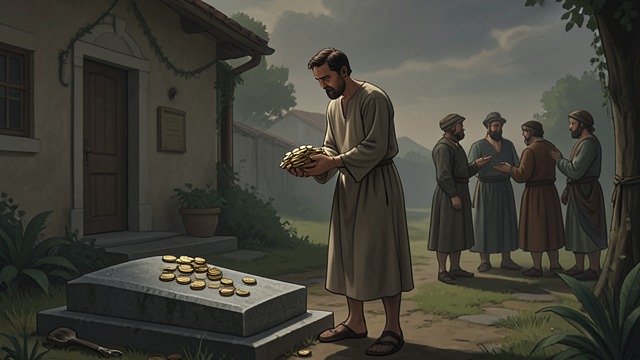
Sarah’s death at 127 leads Abraham to obtain a permanent burial place in Canaan: he pays Ephron four hundred shekels of silver for the field and cave of Machpelah, and then buries Sarah there. The episode joins private mourning to a public, formally witnessed acquisition of land.
Death and the Search for a Burial Place
Sarah dies in Kiriath-arba, identified as Hebron, in the land of Canaan. Abraham comes to mourn and weep for her; afterward, he addresses the Hittites, describing himself as a stranger and sojourner among them and asking for a burial possession where he can bury his dead.
The Hittites respond by addressing Abraham as a mighty prince and offering him the choice of their tombs. Abraham nevertheless asks them to approach Ephron son of Zohar on his behalf, seeking the cave of Machpelah at the edge of Ephron’s field as a burial possession at its full price.
Negotiation and Purchase
Ephron answers publicly, offering both the field and its cave. Abraham bows before the people of the land but insists on paying for the field. Ephron names a price of four hundred shekels of silver, and Abraham weighs out that amount as current merchant’s money.
The transaction encompasses the field at Machpelah, the cave within it, and all the trees and boundaries belonging to the field. The property is secured to Abraham in the presence of the Hittites and those gathered at the city gate; the community then confirms it as his burial possession.
Burial and Significance
After the purchase, Abraham buries Sarah in the cave in the field of Machpelah, before Mamre—identified as Hebron—in Canaan. The account closes by reaffirming that the field and cave have been made sure to Abraham as a burial place.
The episode moves from grief to a documented transfer of land. Sarah’s burial is therefore bound to a specific possession secured through negotiation, payment, and public recognition, rather than resting on the Hittites’ initial offer of access to an existing tomb.
Marriage of Isaac and Rebekah
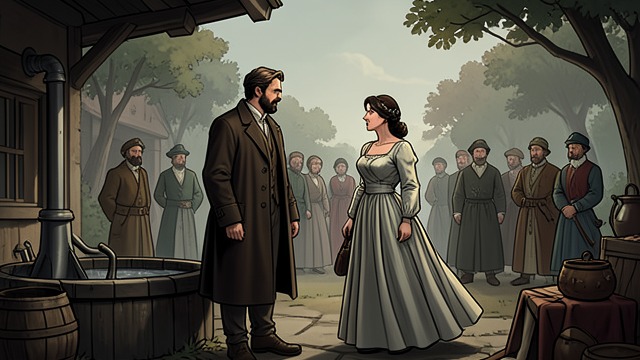
Marriage of Isaac and Rebekah is the carefully arranged union of Abraham’s heir with a woman from his extended family. Abraham’s servant reads the successful meeting at a well as divine guidance; Rebekah freely agrees to depart, and Isaac receives her as his wife, carrying the promised family line forward while finding comfort after his mother’s death.
Marriage Arranged Around the Promise
In his old age, Abraham commissions the senior servant who governs his household to find a wife for Isaac among Abraham’s own kindred, rather than among the daughters of the Canaanites. He binds the servant by an oath and insists that Isaac must not be taken back to the land from which Abraham came. The journey is therefore directed outward from Canaan to the family’s former homeland, while Isaac is to remain in the land promised to his descendants.
Abraham’s assurance rests on divine guidance: he says that the God who brought him from his father’s house will send an angel before the servant. If the woman refuses to follow, the servant will be released from the oath, but he must not return Isaac to the ancestral land. The conditions preserve both the marriage mission and Isaac’s place in Canaan.
The Meeting at the Well
The servant travels with ten camels and his master’s goods to Aram-naharaim, stopping at a well outside the city of Nahor in the evening, when women come to draw water. He prays that the woman appointed for Isaac will respond to his request for a drink by offering to water the camels as well. Before he has finished speaking, Rebekah arrives with her pitcher; she gives him water and then hastens back and forth to draw for all the camels.
Rebekah is identified as the daughter of Bethuel, son of Milcah and Nahor’s family. The servant gives her a gold ring and two bracelets, then bows and blesses the LORD for leading him to his master’s kin. Rebekah’s brother Laban and her father Bethuel accept the match as proceeding from the LORD. The servant gives Rebekah gifts of silver, gold, and clothing, and presents precious things to her mother and brother.
Rebekah’s Choice and the Journey
When the servant asks to depart, Rebekah’s family proposes that she remain for at least ten days. He urges them not to delay, and they leave the decision to Rebekah herself. Asked whether she will go with the servant, she answers that she will. Her departure, accompanied by her nurse and attendants, turns the household’s consent into a journey undertaken with her own assent.
Her family blesses her with the hope that she will become the mother of many descendants and that her offspring will possess the gate of their enemies. The servant then leads Rebekah and her attendants by camel toward Isaac. The narrative links this new marriage to the earlier promise of numerous descendants, while leaving the familiar land behind as Isaac remains in the south.
Marriage and Its Place in the Family Line
Isaac is in the field at evening when he sees the approaching camels. Rebekah sees him, dismounts, and covers herself with her veil; the servant tells Isaac what has happened on the journey. Isaac brings Rebekah into Sarah’s tent, takes her as his wife, and loves her. The account closes the journey with a household transition: the tent associated with his dead mother becomes the place where Isaac receives his bride, and he is comforted for Sarah.
The marriage also establishes the next generation within Abraham’s household. Later, Abraham gives Isaac all that he has, while sending gifts to his other sons and away from Isaac; after Abraham’s death, Isaac and Ishmael together bury him beside Sarah in the Cave of Machpelah. The account thus places Isaac’s marriage within a larger succession: the promised land and inheritance remain associated with Isaac, while his union with Rebekah begins the continuation of his line.
Esau Sells His Birthright
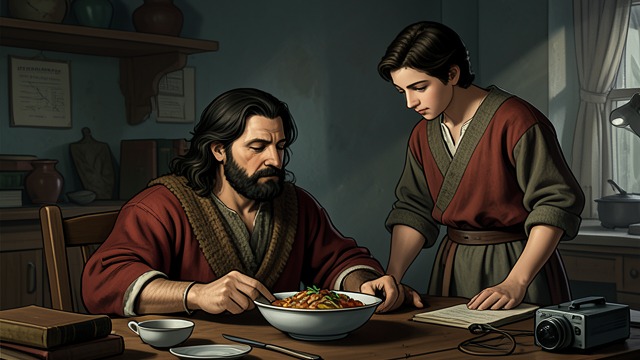
Esau Sells His Birthright is the first explicit contest between Jacob and Esau over the inheritance attached to their place in the family. Esau, exhausted and hungry after returning from the field, swears away his birthright for bread and lentil pottage; Jacob secures the transfer, and the narrator concludes that Esau despised his birthright.
Family and Foretelling
The twins’ conflict begins before either can act. Their mother, Rebekah, experiences them struggling in her womb and asks the LORD about it. She is told that two peoples are within her, that they will be separated, and that the elder will serve the younger. The birthright exchange later gives this prediction a concrete family setting: the younger brother claims from the elder a privilege associated with birth order.
Esau emerges first, ruddy and covered with hair; Jacob follows, holding Esau’s heel. Their father Isaac loves Esau for the game he brings, while Rebekah loves Jacob. The account thus presents the transaction within a household already divided in its affections, though it does not say that either parent arranged or witnessed the exchange.
The Exchange
Jacob is cooking pottage when Esau comes in from the field faint with hunger. Esau asks for some of the red pottage, describing it as something to swallow; the narrator connects this red food with the name Edom. Jacob makes the food conditional on Esau first selling him his birthright.
Esau answers that he is at the point of death and questions what profit the birthright can offer him in that state. Jacob requires an oath before handing it over, and Esau swears. Jacob then gives him bread and lentil pottage. Esau eats and drinks, rises, and goes on his way: the scene’s spare sequence moves from urgent appetite to sworn bargain and ordinary departure.
Meaning and Narrative Role
The exchange establishes a sharp contrast between immediate need and inherited status. Esau treats the birthright as having no use against his present hunger; Jacob recognizes its value and insists on a formal oath. The text does not specify the material contents or legal terms of the birthright, so the episode’s emphasis rests on the brothers’ unequal valuation of it and on the transfer itself.
The closing judgment that Esau despised his birthright gives the transaction its narrative weight. The episode does not resolve the brothers’ larger conflict, but it makes their rivalry over precedence explicit and anticipates the continuing struggle between the elder and younger brother already announced to Rebekah.
Jacob Steals Esau's Blessing
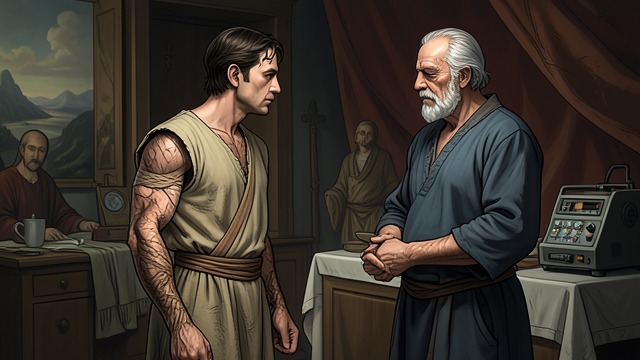
Jacob Steals Esau's Blessing is a deception over the patriarchal blessing: with Rebekah’s help, Jacob impersonates Esau before their blind father, Isaac, and receives the words of prosperity and authority intended for his elder brother. The blessing cannot simply be transferred back when Esau arrives, and the household’s contest over inheritance ends in grief, threatened violence, and Jacob’s departure.
Background and Plan
Isaac is old and his eyesight has failed. Believing that he does not know when he will die, he sends Esau to hunt game and prepare the savoury food he loves, so that he may bless his elder son before his death. Rebekah overhears the arrangement and turns it into a plan for Jacob, her younger son, to receive the blessing instead.
Jacob hesitates because Esau is hairy and he is smooth. He fears that Isaac will discover the impersonation and curse him rather than bless him. Rebekah accepts responsibility for that risk and directs him to fetch two young goats; she prepares the food, dresses Jacob in Esau’s garments, and covers his hands and neck with the goats’ skins.
The Deception and Blessing
Carrying the food and bread, Jacob enters Isaac’s presence and identifies himself as Esau, claiming to have done as his father asked. Isaac questions how he has returned so quickly. Jacob attributes his success to the LORD, but Isaac remains uncertain: he recognizes Jacob’s voice, then feels the goat skins and concludes that the hands are Esau’s. Jacob repeats the false identification when asked directly.
Isaac eats and drinks, asks Jacob to kiss him, and smells the garments. That evidence persuades him, and he blesses the son before him with heaven’s dew, the earth’s abundance, grain and wine, dominion over peoples, and rule over his brothers. The blessing’s language makes the immediate deception consequential: it assigns Jacob both material plenty and precedence within the family.
Discovery and Conflict
Jacob has scarcely left when Esau returns from hunting with the meal he has prepared. When Isaac realizes that he has already blessed another son, he trembles greatly and confirms that the blessing has been given and will stand. Esau cries out bitterly and pleads for a blessing of his own; Isaac tells him that his brother came with guile and took it.
Esau describes the loss as the second time Jacob has supplanted him, recalling that Jacob had taken his birthright as well. Isaac says he has made Jacob Esau’s lord and given him his brothers as servants, while also sustaining him with grain and wine. Esau weeps and asks again for a blessing. Isaac gives him a separate pronouncement: his dwelling will have the earth’s fatness and heaven’s dew, he will live by the sword and serve his brother, but may eventually break free of his yoke.
Flight and Aftermath
Esau hates Jacob because of the blessing and resolves to kill him after the period of mourning for Isaac. When Rebekah learns of the threat, she warns Jacob and sends him to her brother Laban in Haran, hoping Esau’s anger will subside. She fears losing both sons in one day.
Rebekah also raises the prospect of Jacob marrying among the local Hittite women, as Esau has done, and says she is weary of life because of those marriages. Isaac therefore sends Jacob to Paddan-aram, instructs him not to marry a Canaanite woman, and directs him to take a wife from the family of Rebekah’s brother. He blesses Jacob again, invoking fruitfulness and the blessing of Abraham, including inheritance of the land promised to Abraham. The journey that follows is thus both an escape from Esau and a family-directed departure to secure a wife and continue the ancestral promise.
Narrative Significance
The episode stages inheritance as a conflict among birth order, parental preference, and spoken blessing. Its central reversal depends on the gap between Isaac’s senses: the voice sounds like Jacob, the hands feel like Esau’s, and the garments provide the final assurance. The blessing is secured not through open contest but through impersonation, and the discovery comes only after Isaac has spoken words he considers irrevocable.
The consequences extend beyond the scene. Esau’s remembered loss of both birthright and blessing fuels his murderous intention; Rebekah’s intervention sends Jacob away; and Isaac’s renewed blessing connects Jacob’s departure to the promised descendants and land. The household’s immediate rupture becomes the condition for Jacob’s journey to Paddan-aram.
Jacob's Ladder
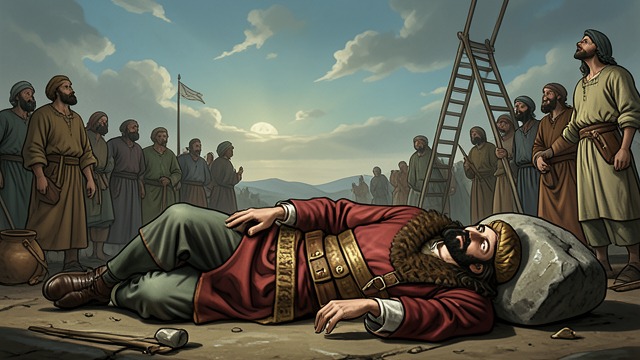
On his journey from Beer-sheba to Haran, Jacob dreams of a ladder linking earth and heaven, with the angels of God ascending and descending upon it. The LORD stands beside him and promises land, numerous descendants, blessing for all families of the earth, protection on the journey, and a return. Jacob awakens to recognize the place as sacred, names it Bethel, raises his stone pillow as a pillar, and vows allegiance and a tenth of what he receives.
Journey and Vision
Jacob is travelling alone after leaving Beer-sheba for Haran. When sunset brings him to an unnamed place, he stops for the night, takes one of its stones for a pillow, and lies down. In his dream, a ladder stands on the earth and reaches to heaven, while the angels of God ascend and descend upon it.
The LORD stands beside Jacob and identifies himself as the God of Abraham and Isaac. The vision’s promise addresses Jacob’s precarious journey and his place in the family line: the land where he lies will belong to him and his descendants, who will spread in every direction and become a source of blessing to all the families of the earth.
Promise and Response
The promise is not limited to territory and descendants. The LORD pledges to remain with Jacob, keep him wherever he goes, and bring him back to the land, declaring that he will not leave until the promise is fulfilled. The dream thus connects Jacob’s departure with a promised return and carries forward the land-and-descendants promise given to Abraham and Isaac.
Awakening, Jacob recognizes that the LORD is present in the place, though he had not known it. He responds with awe, calling it the house of God and the gate of heaven. The ordinary resting place is thereby transformed, in Jacob’s understanding, into a point of encounter between earth and heaven.
Bethel and the Vow
Jacob rises early, takes the stone he used as a pillow, sets it upright as a pillar, and pours oil on it. He names the place Bethel; it had previously been called Luz. The stone preserves the encounter in a material marker, while the new name identifies the site with the presence Jacob has recognized there.
Jacob then makes a conditional vow: if God accompanies and protects him, supplies food and clothing, and brings him safely back to his father’s house, the LORD will be his God. The stone will stand as God’s house, and Jacob promises to give God a tenth of what he receives. His response turns the vision’s promise into a stated commitment, while leaving its fulfilment ahead in the journey.
Narrative Significance
The episode places a divine promise at the threshold of Jacob’s departure from home. Its ladder image makes the connection between heaven and earth visible within the dream, while the spoken assurance gives Jacob protection and a future return amid separation from his family and homeland.
Bethel becomes significant through the sequence of vision, recognition, naming, memorial, and vow. Jacob’s raised stone does not itself fulfil the promise; it marks the place where the promise was given and where he undertook an obligation in response.
Jacob Leaves Laban
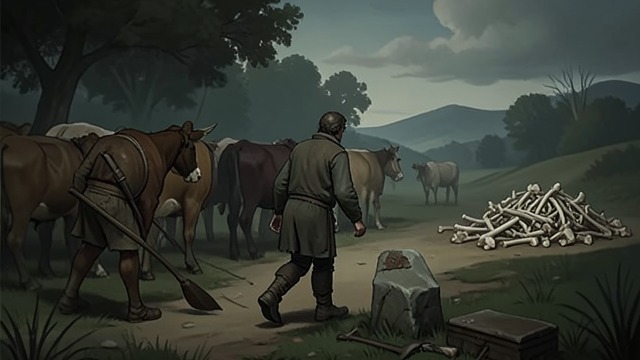
Jacob Leaves Laban is the turning point at which Jacob ends twenty years in Laban’s household and sets out for his father’s land. His prosperity, accumulated through years of labor and a contested flock agreement, sharpens Laban’s sons’ resentment and Laban’s changed attitude; a divine command to return prompts Jacob to leave with his wives, children, and possessions. The flight becomes a confrontation, but ends not in violence: Jacob and Laban establish a stone-marked covenant defining a boundary between them.
Service, Prosperity, and the Decision to Leave
Jacob’s departure follows a period of service in which his own household grows alongside Laban’s wealth. After Jacob asks for wages, he and Laban agree that Jacob’s share will consist of speckled and spotted goats and dark sheep. Laban removes the animals matching those terms and puts three days’ journey between them, leaving Jacob to tend the remaining flock.
Jacob uses peeled rods of poplar, almond, and plane-tree at the watering troughs, and the flocks produce streaked, speckled, and spotted young. He separates his animals from Laban’s, and the stronger animals become his while the weaker remain Laban’s. Jacob’s holdings expand to include large flocks, servants, camels, and donkeys.
The increase changes the household’s balance of power. Laban’s sons accuse Jacob of taking their father’s wealth, and Jacob sees that Laban no longer regards him as before. The LORD tells Jacob to return to the land of his fathers and kindred, promising to be with him.
Family Consent and the Secret Flight
Jacob calls Rachel and Leah into the field and explains that he has served their father with all his strength, while Laban has repeatedly changed his wages. He attributes the transfer of the flocks to God’s protection and recounts a dream in which the Angel of God identifies the marked he-goats and commands him to leave, recalling the God of Bethel and Jacob’s vow there.
Rachel and Leah support the departure. They say they have no inheritance remaining in their father’s house and that their father has treated them as outsiders; they regard the wealth God has taken from him as belonging to them and their children. They tell Jacob to do as God has directed.
Jacob puts his sons and wives on camels and takes the livestock and property he has acquired in Paddan-aram toward his father Isaac in the land of Canaan. While Laban is away shearing sheep, Rachel takes her father’s teraphim. Jacob leaves without telling Laban, crosses the River, and heads toward the mountain of Gilead.
Pursuit, Accusation, and the Search
Laban learns of the flight on the third day and pursues Jacob for seven days, overtaking him in the mountain of Gilead. Before they meet, God warns Laban in a night dream not to speak to Jacob either good or bad. Laban challenges Jacob for leaving secretly and taking his daughters away, while also accusing him of stealing the household gods.
Jacob says fear of Laban’s taking his daughters by force had motivated the secret departure. Unaware that Rachel has the teraphim, he declares that whoever possesses them will not live and invites Laban to search. Laban searches Jacob’s, Leah’s, and the servant women’s tents before entering Rachel’s. She has hidden the objects in a camel’s saddle and remains seated on it, telling her father she cannot rise; Laban searches but does not find them.
The failed search gives way to Jacob’s defense of his years of service. He says he has spent twenty years in Laban’s household, fourteen serving for Laban’s two daughters and six for the flock, while his wages were changed ten times. He describes bearing the losses of animals taken by wild beasts and enduring heat by day and frost by night. Jacob credits the God of Abraham and the Fear of Isaac with seeing his affliction and judging between them.
The Covenant and the Parting
Laban answers that the daughters, children, flocks, and everything Jacob sees belong to him, but proposes a covenant between them. Jacob sets up a stone as a pillar; the others gather stones into a heap, and they eat beside it. Laban calls the heap Jegar-sahadutha, while Jacob calls it Galeed.
The heap and pillar serve as witnesses and as a boundary. Laban says neither man will cross the marker toward the other to do harm, and he invokes God as judge between them. He also calls God to witness concerning Jacob’s treatment of Rachel and Leah and whether he takes other wives. Jacob swears by the Fear of his father Isaac, offers a sacrifice in the mountain, and shares a meal with Laban’s party.
Laban rises early, kisses and blesses his children, and returns home. Jacob continues on his way, and the angels of God meet him; he names the place Mahanaim. The episode closes the conflict with Laban through a negotiated separation, while Jacob’s journey toward his kin continues.
Narrative Significance
The departure reverses Jacob’s position from dependent laborer to a man able to leave with a substantial household and flock. His prosperity has intensified conflict rather than secured a peaceful place within Laban’s family, and the escape brings accusations, a search, and a face-to-face reckoning.
The final heap and pillar turn that confrontation into a witnessed limit on future harm. The text attributes Jacob’s protection and changed fortunes to God, while leaving the disputed household gods unresolved: Laban searches but does not recover them, and Jacob does not know Rachel took them. Jacob leaves Laban behind, but the appearance of God’s angels signals that the journey is continuing.
Jacob Wrestles at the Jabbok

On the eve of his meeting with Esau, Jacob is left alone at the Jabbok and wrestles with a mysterious man until dawn. The encounter strains his thigh, changes his name to Israel, and ends with a blessing; Jacob names the place Peniel because he believes he has seen God face to face and survived. He crosses at sunrise limping, carrying both a new identity and the bodily mark of the struggle.
Fear and Preparation
Jacob's return brings him toward the brother he had wronged and whose response he cannot predict. He sends messengers to Esau in Seir, describing his years with Laban and the wealth he has acquired. The messengers return with news that Esau is coming to meet him with four hundred men, and Jacob becomes greatly afraid and distressed.
He divides his household, herds, and camels into two camps so that one might escape if Esau attacks the other. In prayer, Jacob recalls God's command to return to his country and God's promise to do him good. He contrasts his present abundance with his earlier passage over the Jordan carrying only his staff, and asks to be delivered from Esau, fearing that his brother may strike him and the mothers with their children.
Jacob also prepares a substantial gift: successive droves of goats, sheep, camels, cattle, and donkeys are sent ahead with instructions to leave space between them. Each group is to identify the animals as a present from Jacob to Esau, while Jacob himself follows behind. He hopes the repeated gifts will appease his brother before they meet.
The Night at the Jabbok
After the gift has crossed ahead, Jacob remains in the camp. During the night he takes his two wives, two handmaids, and eleven children across the ford of the Jabbok, along with all that he possesses. Once he has sent them over the stream, he is left alone.
A man wrestles with Jacob until daybreak. When the man sees that he does not prevail, he touches the hollow of Jacob's thigh, straining it. As dawn approaches, the man tells Jacob to let him go; Jacob refuses unless he is blessed. Asked his name, he answers, Jacob.
A New Name and a Wounded Crossing
The stranger declares that Jacob will no longer be called Jacob but Israel, because he has striven with God and with men and prevailed. Jacob asks the stranger's name, but receives no answer; instead, the man blesses him there. The encounter thus gives Jacob a new name and a blessing without resolving the stranger's identity in ordinary terms.
Jacob calls the place Peniel, explaining that he has seen God face to face and his life has been preserved. At sunrise he passes beyond it limping because of his thigh. The narrative makes survival inseparable from injury: Jacob emerges from the night blessed and renamed, but physically marked by the encounter.
The injury is also given a continuing communal consequence. The account says that the Children of Israel do not eat the sinew of the thigh-vein at the hollow of the thigh, because the wrestler touched that place on Jacob's body.
The Reunion with Esau
After the night at Peniel, Jacob sees Esau approaching with the four hundred men. He arranges his family with the handmaids and their children first, Leah and her children next, and Rachel and Joseph at the rear. Jacob goes before them, bowing to the ground seven times as he approaches his brother.
The anticipated violence gives way to an embrace: Esau runs to Jacob, falls on his neck, kisses him, and they weep. Jacob presents his family and presses Esau to accept the gifts, saying that God has dealt graciously with him. Esau first says he has enough and tells Jacob to keep what is his, but accepts after Jacob insists.
The wrestling therefore stands between Jacob's fearful preparations and an unexpectedly affectionate meeting. The story does not say that the encounter at the ford causes Esau's welcome; it places Jacob's night of struggle immediately before the reunion, which unfolds through bows, tears, and the exchange of gifts rather than attack.
Dinah and the Massacre at Shechem
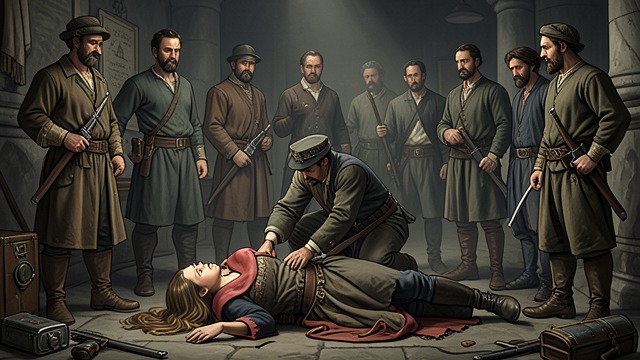
Dinah and the Massacre at Shechem is the account of how the assault of Jacob’s daughter leads to deceptive negotiations and a retaliatory attack that devastates Shechem. The episode moves from a proposed marriage and alliance to mass killing and seizure of property, ending with a sharp dispute between Jacob and his sons over the danger their actions have brought upon the household.
The Assault and the Proposed Alliance
Dinah, the daughter of Leah and Jacob, went out to see the women of the land. Shechem, son of Hamor the Hivite and a local prince, took her and lay with her. The narrative then says that he loved Dinah and spoke comfortingly to her; he asked his father to obtain her as his wife.
Jacob heard that Dinah had been defiled but held his peace until his sons returned from the field. When they heard what had happened, they were grieved and angry. Hamor approached Jacob to negotiate, presenting Shechem’s desire for Dinah as the basis for a wider arrangement: intermarriage, residence, trade, and possession of land. Shechem offered to pay whatever bride-price or gift Dinah’s family demanded.
Deceptive Negotiations
Jacob’s sons answered Hamor and Shechem with guile because Shechem had defiled their sister. They made circumcision the condition of marriage and of a proposed union between the two peoples, saying that they would intermarry and live together if every male in the city accepted it. Otherwise, they said, they would take Dinah and leave.
Hamor and Shechem agreed, and Shechem acted promptly because he desired Dinah. At the city gate, the two men urged the townspeople to accept circumcision, describing Jacob’s family as peaceful neighbors and the land as spacious enough for them. Hamor and Shechem also appealed to the city’s material interests, suggesting that the family’s livestock and possessions would become theirs. The men who went out of the gate agreed, and every male in the city was circumcised.
The Attack and Its Consequences
On the third day, while the men of the city were in pain, Simeon and Levi, Dinah’s brothers, came upon the city unawares and killed all its males. They killed Hamor and Shechem, took Dinah from Shechem’s house, and departed. The other sons of Jacob then came upon the slain and plundered the city, taking its flocks, herds, asses, wealth, children, and wives, as well as what was in the houses and fields.
Jacob condemned Simeon and Levi for making him odious to the Canaanites and Perizzites. He feared that the surrounding inhabitants would gather against his small household and destroy it. His sons replied by asking whether their sister should have been treated as a harlot. The account closes on this unresolved conflict: their defense of Dinah stands beside Jacob’s alarm at the danger their retaliation has created.
Narrative Significance
The episode’s central reversal is that a proposed alliance, secured through a condition accepted by an entire city, becomes the means by which its inhabitants are left vulnerable to attack. The narrative distinguishes the initial grievance, the brothers’ deliberate deception, the killings, and the broader seizure of people and property; the scale of the retaliation reaches far beyond the original marriage negotiations.
The consequences also extend beyond the immediate dispute. Later, Jacob tells his household to put away foreign gods and purify themselves before they leave for Bethel; the journey proceeds without pursuit because terror from God falls on the surrounding cities. Much later, in Jacob’s final words to his sons, Simeon and Levi are rebuked together for their anger and violence. Their attack thus remains a defining family conflict, remembered both for its immediate danger and for the judgment attached to their conduct.
Rachel's Death and Benjamin's Birth
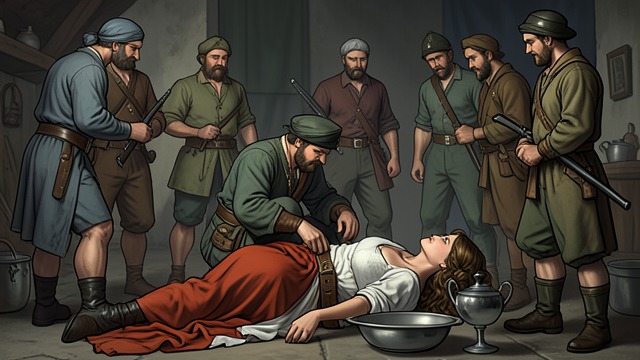
Rachel's Death and Benjamin's Birth is the account of Rachel's fatal labour on the journey from Beth-el to Ephrath, where Jacob's youngest son is born. Rachel names him Ben-oni as she dies; Jacob renames him Benjamin and raises a pillar over her grave, fixing a moment of family loss within the journey of Jacob's household.
Journey and Birth
After God appeared to Jacob at Beth-el, blessed him, and reaffirmed the land and descendants promised to Abraham and Isaac, Jacob set up a stone pillar at the place of their meeting. The family then travelled onward, with Ephrath still some distance ahead when Rachel went into hard labour.
The midwife reassured Rachel that she was bearing another son. Rachel died in the course of the labour, and the child survived: at the moment of her death she named him Ben-oni, while his father called him Benjamin. The passage gives both names, placing Rachel's final act of naming beside Jacob's different name for their son.
Burial and Family Consequences
Rachel was buried on the road to Ephrath, identified as Beth-lehem. Jacob set up a pillar over her grave, described as the pillar of Rachel's grave still standing in the account's present. The roadside marker preserves her memory at the very point where the family's journey continues.
The narrative next says that Israel journeyed on and pitched his tent beyond Migdal-eder. It then reports that Reuben lay with Bilhah, his father's concubine, and that Israel heard of it. The episode thus places Rachel's death within a changing household: her son Benjamin remains among Jacob's twelve sons, while the account turns immediately to another rupture within the family.
Place in the Ancestral Narrative
Rachel's death follows the renewal of Jacob's identity as Israel and the promise that his descendants will become a nation and a company of nations, with kings among them. Benjamin's birth adds the final son named in the ensuing list of Jacob's children, while Rachel's burial makes the promised continuity inseparable from personal loss.
The narrative's attention to the two names and the grave pillar gives the episode its distinctive shape: a birth is recorded through the mother's death, and the family's onward movement is punctuated by a permanent marker. Later covenant speeches recall the promises to Abraham, Isaac, and Jacob, but this episode itself stays with the immediate cost and consequence of the journey.
Joseph and Potiphar's Wife
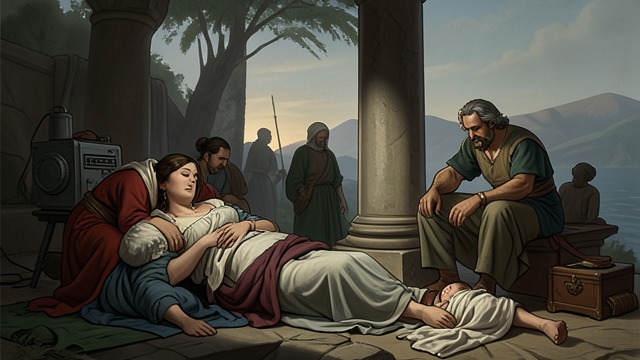
Sold into Egypt and bought by Potiphar, an officer of Pharaoh, Joseph rises to authority in his master’s household before Potiphar’s wife’s advances turn his integrity into the occasion for a false accusation and imprisonment. The episode reverses his circumstances without ending his progress: in prison, as in the household, Joseph receives responsibility and favor, while the narrative repeatedly attributes his success to the LORD’s presence.
Service in Potiphar’s Household
The Ishmaelites brought Joseph to Egypt, where Potiphar, an Egyptian officer of Pharaoh and captain of the guard, bought him. The LORD was with Joseph, and his work prospered in Potiphar’s house. Potiphar recognized this and entrusted Joseph with the household, placing everything he owned in Joseph’s hand.
The blessing extended beyond Joseph’s own advancement: from the time Potiphar appointed him overseer, the LORD blessed the Egyptian’s house and fields for Joseph’s sake. Potiphar left all his affairs to Joseph and concerned himself with nothing except the food he ate. The account also describes Joseph as handsome in form and appearance, a detail that immediately precedes the change in his master’s wife’s attention.
The Refusal and the Accusation
Potiphar’s wife repeatedly urged Joseph to lie with her. He refused, reasoning that Potiphar had trusted him with everything in the house and withheld only his wife; to accept her proposal, he said, would be a great wickedness and a sin against God. Her advances continued day after day, but Joseph would neither lie with her nor remain with her.
On a day when Joseph entered the house to do his work and no other household men were inside, Potiphar’s wife caught him by his garment and again demanded that he lie with her. Joseph fled, leaving the garment in her hand. She used the abandoned clothing to support her account: she called the men of the household, claimed Joseph had come to mock and assault her, and said that he had fled when she cried out. She kept the garment until Potiphar returned, then repeated the accusation to him.
Imprisonment and Continued Favor
Potiphar became angry at his wife’s report and put Joseph in the prison where the king’s prisoners were confined. The text does not recount a hearing or give Joseph a chance to answer the charge; it moves directly from the accusation to his confinement.
The reversal does not erase the pattern established in Potiphar’s house. The LORD remained with Joseph, showed him kindness, and gave him favor in the prison keeper’s eyes. The keeper entrusted all the prisoners and the work of the prison to Joseph, taking no responsibility for what was placed in his hand, because the LORD was with him and made his work prosper.
Narrative Significance
The episode turns a sign of Joseph’s authority—the garment he leaves behind while escaping—into the instrument of the accusation that strips him of his position. His refusal is framed as fidelity both to Potiphar’s trust and to God; the resulting punishment does not bring an immediate vindication, but it carries Joseph into another institution where he again gains trust and responsibility.
The repeated statement that the LORD is with Joseph links prosperity in an Egyptian household to favor in a prison. The change in setting is stark, but the narrative pattern persists: Joseph serves faithfully, those overseeing him entrust him with authority, and his work prospers.
Joseph Interprets Pharaoh's Dreams
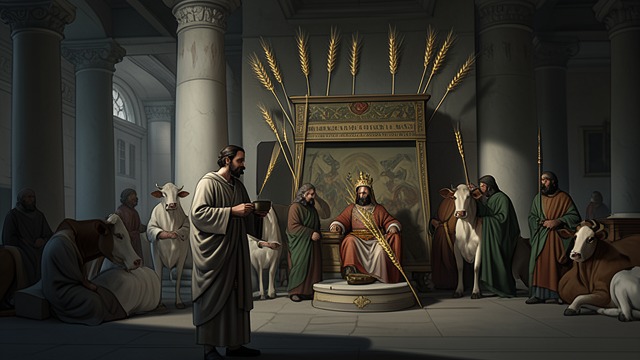
After two years in prison, Joseph is summoned to interpret Pharaoh’s troubling dreams: seven healthy cows and seven full ears of grain are consumed by seven lean cows and seven blighted ears. Joseph identifies the images as one prediction—seven years of abundance followed by seven years of severe famine—and proposes a policy of storing a fifth of Egypt’s harvest during the plentiful years. Pharaoh appoints him to oversee the land, turning interpretation into state policy and preparing Egypt for scarcity.
The Dreams and Their Interpretation
Pharaoh dreams first that seven fat, well-favoured cows emerge from the river, followed by seven lean cows that consume them without becoming any better nourished. In a second dream, seven full ears of grain are swallowed by seven thin ears blasted by the east wind. The repeated pattern troubles Pharaoh; neither Egypt’s magicians nor its wise men can interpret the dreams.
The chief butler recalls the Hebrew prisoner who interpreted his and the chief baker’s dreams accurately. Joseph is brought hastily from the dungeon, shaves, changes his clothes, and comes before Pharaoh. He does not claim the ability as his own: he says that God will provide Pharaoh with an answer. He explains that the two dreams have one meaning: the seven good cows and ears represent seven years of plenty, and the seven lean cows and empty ears represent seven years of famine. Their repetition signals that the matter is established and will soon come to pass.
A Plan for Scarcity
Joseph moves from explaining the warning to prescribing a response. He advises Pharaoh to appoint a capable and wise administrator, set overseers throughout the land, and collect one fifth of Egypt’s produce during the seven abundant years. Grain is to be gathered and stored in the cities so that the country will have reserves when famine follows and the land would otherwise perish.
Pharaoh and his servants accept the proposal. Pharaoh recognizes Joseph as a man in whom the spirit of God is, and declares that Joseph’s discernment and wisdom qualify him to govern. Joseph’s interpretation therefore becomes the basis for a concrete system of preparation: a share of the harvest is collected under royal authority and conserved against the coming shortage.
Appointment and Administration
Pharaoh places Joseph over his household and all Egypt, reserving only the throne above him. He gives Joseph his signet ring, dresses him in fine linen, places a gold chain around his neck, and has him ride in the second chariot. Pharaoh gives him the Egyptian name Zaphenath-paneah and Asenath, daughter of Poti-phera, priest of On, as his wife. Joseph is thirty years old when he enters Pharaoh’s service and travels throughout the land.
During the seven years of plenty, Joseph gathers food in the cities, storing so much grain that it becomes beyond counting. Before the famine begins, Asenath bears him two sons: Manasseh, whose name Joseph connects with the relief of his toil and his father’s household, and Ephraim, whose name marks his fruitfulness in the land of his affliction. When abundance ends and famine begins, Egypt still has bread. Joseph opens the storehouses and sells grain to the Egyptians; people from other countries also come to Egypt to buy it.
Consequences and Narrative Significance
The famine reaches Canaan, where Jacob sends ten of Joseph’s brothers to Egypt to buy food, keeping Benjamin at home. Joseph is now governor and sells grain to those who come. His brothers bow before him without recognizing him, while he recognizes them and remembers his earlier dreams. The economic crisis thus brings the family back into Joseph’s presence and begins the brothers’ first journey to Egypt.
Joseph’s rise links a private gift for interpreting dreams to the survival of a kingdom and the movement of his family across borders. The narrative presents foresight as both divine disclosure and practical administration: Joseph interprets the warning, organizes storage, and directs the sale of grain when scarcity arrives. The reserves preserve food in Egypt while making its ruler the point of access for people from the surrounding lands.
Joseph's Brothers' First Visit to Egypt
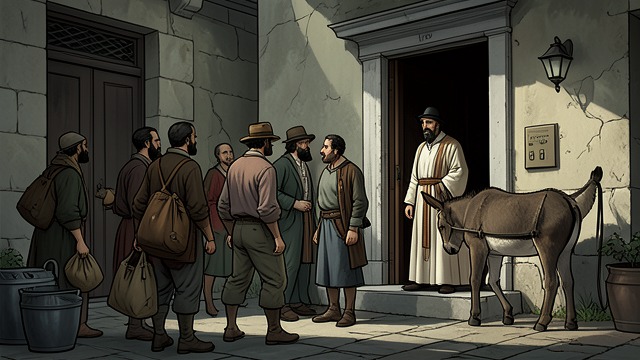
Joseph's Brothers' First Visit to Egypt turns famine relief into a reckoning within the family: Joseph recognizes the brothers who do not recognize him, tests their account of themselves, and makes Benjamin's return the condition for their release. The visit ends with Simeon detained and Jacob refusing, for the moment, to risk his youngest son.
Famine and the Journey to Egypt
After seven years of plenty, the predicted famine began. Joseph had stored grain in Egypt, and when scarcity spread across the region he opened the storehouses and sold food. The famine reached Canaan, so Jacob sent Joseph's ten brothers to buy grain in Egypt; he kept Benjamin at home, fearing harm might befall him.
Joseph was governor and personally sold grain to those who came. His brothers appeared before him and bowed with their faces to the earth. He knew them, but they did not recognize him. Their bowing recalled the dreams Joseph had once dreamed about them, turning a desperate commercial journey into a private test shaped by their shared past.
Joseph's Test and Simeon's Detention
Joseph treated his brothers as strangers and spoke roughly, accusing them of coming to spy out the land. They denied it and explained that they were sons of one man: twelve brothers in all, with the youngest at home and one brother gone. Joseph pressed the accusation and said their truthfulness would be tested by bringing Benjamin to Egypt.
He confined all ten brothers for three days. On the third day he offered terms: one brother would remain imprisoned while the others carried grain home, but they must bring their youngest brother back. They agreed. Joseph then took Simeon and bound him before the others, while ordering that their sacks be filled with grain, their money returned in them, and provisions given for the journey.
Recognition, Guilt, and Return to Jacob
The brothers spoke among themselves, connecting their present distress with what they had done to Joseph: they recalled seeing his anguish when he pleaded with them and refusing to listen. They did not know Joseph understood them through an interpreter. He turned away and wept, then returned and carried out the detention of Simeon.
On the journey home, one brother discovered his money in the mouth of his sack. When the brothers found that each man's money had been returned, they were afraid and wondered what God had done to them. They reported the Egyptian governor's demand to Jacob, including the requirement that Benjamin accompany them if they were to return and secure Simeon's release.
Jacob Refuses to Send Benjamin
When the sacks were emptied, the brothers and Jacob saw that every bundle of money had been returned, deepening their fear. Jacob mourned the losses as he understood them: Joseph was gone, Simeon was being held, and now Benjamin was being demanded. Reuben offered his own two sons as a guarantee if he failed to bring Benjamin back, but Jacob refused to send him, saying that harm to the boy would bring him down to the grave in sorrow.
The famine persisted, and the grain brought from Egypt was eventually consumed. Judah later argued that the brothers could not return without Benjamin because the governor had forbidden them to appear without him. This first visit therefore left the family caught between the need for food and Jacob's fear of losing Benjamin, while Simeon remained in Egypt.
Joseph Tests His Brothers
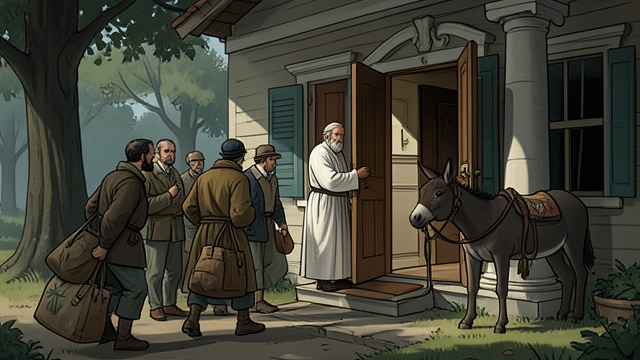
Joseph Tests His Brothers is the turning point in Joseph’s second encounter with his brothers in Egypt: a staged accusation over Joseph’s silver goblet brings Judah to offer himself in Benjamin’s place, and Joseph can no longer conceal his identity. The test transforms the brothers’ earlier betrayal into a moment of responsibility and sacrifice, while preparing the family’s reunion amid the continuing famine.
The Return to Egypt
The famine forced Jacob’s family to seek food again after their first supply from Egypt was exhausted. Joseph’s demand that they return with Benjamin put Jacob’s attachment to his youngest son in direct conflict with the family’s need to survive. Judah pledged himself as surety for Benjamin, promising to bear the blame if he failed to bring him back; Jacob finally consented, sending a present of balm, honey, spices, ladanum, nuts, and almonds, along with double money and the money returned in the brothers’ sacks.
Joseph received the brothers at his house and ordered a meal. They feared that the money found in their sacks would be used against them, but Joseph’s steward reassured them, brought Simeon out to them, and provided water and feed for their donkeys. When Joseph arrived, the brothers bowed and presented their gifts. He asked after their father and blessed Benjamin, his full brother; overcome by emotion, Joseph withdrew to weep before returning to the meal.
The Goblet and the Accusation
The meal briefly gives way to apparent ease: the brothers are seated in birth order, marvel at the arrangement, and Benjamin receives five times the portion given to each of the others. Joseph then directs his steward to fill their sacks with food, return their money, and place Joseph’s silver goblet in Benjamin’s sack. The next morning the brothers leave, unaware of the planted object.
Joseph sends his steward after them with an accusation that they have repaid good with evil by taking the goblet. The brothers deny stealing it and point out that they had returned the money previously found in their sacks. They declare that whoever has the goblet should die and that the rest will become their master’s bondmen; the steward instead says that only the person found with it will be held, and the others may go free. He searches from the eldest brother to the youngest, and the goblet is found in Benjamin’s sack. The brothers tear their clothes, load their donkeys, and return together to Joseph’s house.
Judah’s Plea
Joseph says that Benjamin will remain as his bondman and that the other brothers may return in peace to their father. Judah steps forward to plead for Benjamin, recounting how Jacob had already lost one beloved son and feared that harm to the youngest would bring him down to the grave in sorrow. Judah repeats his pledge to his father and offers to stay in Benjamin’s place, asking that the boy be allowed to return with his brothers.
The offer reverses the earlier pattern of the family’s history: the brothers once sold Joseph into Egypt, but now Judah is prepared to surrender his own freedom rather than bring further grief upon Jacob. The test has made the brothers’ treatment of Benjamin—not merely their words—the measure of whether they will abandon another favored son.
Joseph Reveals Himself
After Judah’s plea, Joseph can no longer restrain himself. He sends the Egyptians out, weeps aloud, and tells his brothers who he is. They are too frightened to answer. Joseph asks them to come near and identifies himself as the brother they sold into Egypt, but tells them not to grieve or blame themselves: he interprets his arrival in Egypt as God’s means of preserving life.
Joseph explains that two years of famine have passed and five remain, and that his position as ruler over Egypt will allow him to sustain the family. He urges his brothers to bring Jacob and the household to Goshen, where they can remain near him and be provided for during the famine. The test thus ends not in Benjamin’s enslavement or the brothers’ separation, but in Joseph’s disclosure, an offer of protection, and the possibility of family reunion.
Joseph Reveals Himself to His Brothers
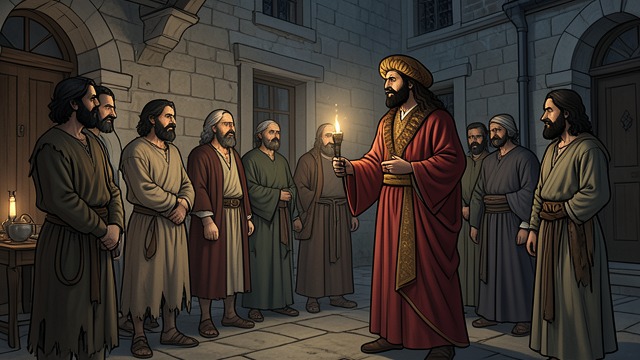
Joseph Reveals Himself to His Brothers is the turning point in which a test of the brothers’ loyalty becomes a reunion. After Judah offers himself in Benjamin’s place, Joseph discloses his identity, reframes his sale and rise in Egypt as a means of preserving life, and summons Jacob’s household to join him before the famine ends.
Judah’s Appeal and Joseph’s Disclosure
The disclosure follows Judah’s plea on behalf of Benjamin. Judah recalls that Jacob’s beloved younger son is the only surviving child of his mother and that their father, already grieving the son he believes lost, would die if Benjamin did not return. Because Judah had guaranteed the boy’s safety, he asks to remain Joseph’s bondman in Benjamin’s place. His offer makes the danger to Jacob, rather than the brothers’ own freedom, the immediate stake.
Joseph can no longer restrain himself before those present. He orders everyone else to leave, then weeps so loudly that the Egyptians and Pharaoh’s household hear him. He identifies himself as Joseph, the brother his family sold into Egypt, and asks whether their father is still alive. The brothers are too frightened to answer; Joseph invites them closer and tells them not to be distressed or angry with themselves over what they did.
A Reversal Interpreted as Preservation
Joseph does not deny the brothers’ responsibility for selling him, but he places that act within a larger account of events: God sent him ahead of them to preserve life. Two years of famine have passed, and five more years remain without plowing or harvest. Joseph says his position in Egypt will provide the family a remnant and save them alive through this severe famine.
He describes his elevation as the work of God, who has made him a father to Pharaoh, lord over Pharaoh’s household, and ruler throughout Egypt. The interpretation turns the brothers’ earlier act of betrayal into the beginning of a rescue, without erasing the deed itself. Joseph’s explanation connects his authority directly to the practical offer that follows: his family can survive because he is able to sustain them.
Reunion and the Invitation to Goshen
Joseph embraces Benjamin and weeps on his neck; Benjamin weeps in return. He kisses each of his brothers and weeps over them, after which they are able to speak with him. The report reaches Pharaoh’s household, where the news pleases Pharaoh and his servants.
Joseph tells his brothers to bring Jacob and their households to Egypt. He offers them residence in Goshen, near him, and promises to sustain them through the five famine years still to come, so that they and their possessions will not be reduced to poverty. Pharaoh endorses the move, offering the family the good of Egypt and ordering wagons for the children and wives. Joseph supplies provisions for the journey and changes of raiment for each brother; Benjamin receives three hundred shekels of silver and five changes. Jacob is also sent ten asses laden with Egyptian goods and ten she-asses carrying corn, bread, and other provisions.
Jacob’s Response and the Family’s Migration
As the brothers depart, Joseph warns them not to fall out on the way. They return to Canaan and tell Jacob that Joseph is alive and rules Egypt. At first Jacob cannot believe the report. Hearing Joseph’s words and seeing the wagons sent to carry him restores his spirit, and he resolves to go see his son before he dies.
Jacob sets out with his household and possessions, stopping at Beer-sheba to offer sacrifices to the God of his father Isaac. In a night vision, God tells him not to fear going down to Egypt: there he will become a great nation, God will go down with him, and Joseph will be present at his death. The family then travels in Pharaoh’s wagons with their children, wives, cattle, and goods. The reunion thus becomes a migration of Jacob’s entire household, not simply the return of the brothers to Egypt.
From Family Reunion to Covenant Memory
The episode’s claim that Joseph was sent ahead to preserve life resonates with the later recollection of Israel’s descent into Egypt and deliverance from bondage. In the first-fruits declaration, the worshipper recounts how a small family went down to Egypt and became a great and populous nation, before the Egyptians afflicted them and God brought them out. That later public memory gives the family’s migration a longer historical horizon: the move that secures survival in famine becomes part of the account of how Israel came to be in Egypt.
The reunion also belongs to a wider covenant narrative in which God’s commitment to the family extends beyond one generation. In Egypt, God promises Jacob that he will become a great nation and that God will accompany him. Later, the covenant is described as embracing those present and those not yet born, while Moses’ final charge appoints Joshua to lead Israel into the land. Joseph’s revelation therefore closes the immediate crisis of Benjamin’s threatened loss while carrying the family toward a future that the story presents as both providentially sustained and historically consequential.
Jacob's Migration to Egypt
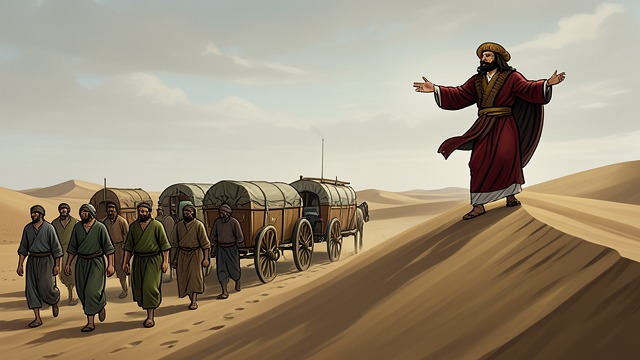
Jacob’s migration to Egypt is both a family reunion and a turning point in the family’s history: famine drives the household from Canaan, but the move brings Jacob back to Joseph and establishes the family in Goshen. The narrative frames the journey with divine reassurance and closes on the family’s provision in Egypt, even as Joseph’s famine policy transforms Egyptian landholding and royal power.
Famine and the Decision to Migrate
After Joseph’s interpretation of Pharaoh’s dreams, Egypt stores grain through seven years of abundance. When the famine begins, Joseph opens the storehouses and sells grain; scarcity reaches Canaan as well as Egypt. Jacob therefore sends his sons to Egypt to buy food, and their encounters with Joseph lead to the revelation that he is alive and holds authority there.
Jacob initially doubts the report, but the wagons Joseph sends from Egypt revive his spirits. Convinced that Joseph lives, Jacob resolves to see him before his death. At Beer-sheba he offers sacrifices to the God of his father Isaac, and God reassures him in a night vision: Jacob is not to fear going down to Egypt, where his descendants will become a great nation; God will accompany him, and Joseph will be with him at the end of his life.
The Household’s Journey and Reunion
Jacob travels with his descendants, their wives, children, cattle, and possessions. The account names the branches of the household and records its scale: sixty-six members of Jacob’s immediate family came into Egypt, and the total household numbered seventy when Joseph and the sons born to him there are included. Judah goes ahead to show the way to Goshen.
Joseph rides out in his chariot to meet his father there. He embraces Jacob and weeps for a long while; Jacob, seeing Joseph alive, says that he can now die. The reunion resolves the separation caused by Joseph’s earlier disappearance and anchors the migration in a restored father-son relationship.
Settlement in Goshen
Joseph prepares his family to meet Pharaoh, explaining that they are shepherds and keepers of livestock. Pharaoh receives five of Joseph’s brothers, approves their request to live in Goshen, and offers the best of the land for Jacob’s household. Jacob is brought before Pharaoh, blesses him, and describes his 130 years as few and difficult in comparison with the years of his ancestors.
Joseph settles his father and brothers in the land of Rameses, in Goshen, and provides bread for the household according to the needs of its children. The family’s move is thus not simply a flight from hunger: it creates a new home under Pharaoh’s protection, with Joseph responsible for sustaining his relatives.
Famine Administration and Narrative Significance
The family’s security unfolds alongside the wider famine’s severe consequences. Joseph gathers the Egyptians’ money in exchange for grain; when their money is spent, he takes their livestock for food. In the following year, the Egyptians offer their land and themselves in exchange for bread and seed. Joseph acquires the land for Pharaoh and relocates the people by city, while the priests’ land remains outside the transfer because they receive a portion from Pharaoh. He then gives the people seed and establishes a fifth of future harvests for Pharaoh, leaving four parts for cultivation and household needs.
Against this national transformation, the migration preserves Jacob’s household and carries forward the promise that his descendants will become a great nation in Egypt. The journey also reverses the famine’s immediate threat: the family that left Canaan seeking food settles in the land where Joseph has stored and controls the grain.
Joseph's Famine Administration in Egypt
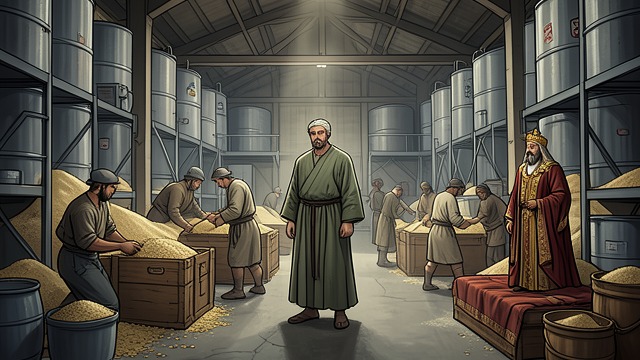
Joseph's famine administration in Egypt is both a vast provisioning operation and a transfer of economic power to Pharaoh: grain stored during seven years of plenty sustains the population through famine, while the terms of continued access to food make the crown owner of Egyptian land and establish a recurring one-fifth levy. The account contrasts this transformation of Egyptian households with Joseph's provision for his own family, which settles and multiplies in Goshen.
Preparation and the onset of famine
The administration begins with Joseph's interpretation of Pharaoh's doubled dream: seven years of abundance will be followed by seven years of severe famine. Joseph advises appointing a capable overseer, collecting a fifth of the produce during the abundant years, and storing the food in the cities. Pharaoh accepts the plan, places Joseph over the land, gives him his signet ring, fine linen and a gold chain, and grants him authority second only to the throne.
Joseph gathers grain in such abundance that it becomes beyond counting. When the years of famine arrive, scarcity extends across the region, but Egypt has bread. Joseph opens the storehouses and sells grain to Egyptians; people from other countries also come to Egypt to buy, and Jacob sends Joseph's brothers there for food.
Exchange, land, and royal revenue
As the famine persists, Egyptians first spend their money buying grain. When their money is exhausted, Joseph supplies bread in exchange for their livestock: horses, flocks, herds, and donkeys. The next year, with both money and livestock gone, they offer their bodies and land in return for food and seed, asking that they and their land become Pharaoh's dependents rather than die or leave the land desolate.
Joseph buys all the land of Egypt for Pharaoh, as Egyptians sell their fields under the pressure of famine, and moves the population city by city. The priests' land is excepted because they receive an allowance from Pharaoh. Joseph then gives the people seed and sets the terms for cultivation: at harvest, one fifth goes to Pharaoh, while four parts remain for seed, food, and household needs. The people acknowledge that he has saved their lives and accept the arrangement. The narrative says the fifth became a statute for the land, with the priests' land remaining outside Pharaoh's ownership.
Israel's provision and settlement
The account distinguishes Joseph's household from the Egyptian population's loss of land. He sustains his father, brothers, and their dependents with bread according to their needs, and places them in the best of the land, in Goshen. There they acquire possessions and multiply greatly even as Egypt and Canaan languish under the continuing famine.
This contrast gives the episode its double shape: stored food averts starvation and supports the migration and settlement of Joseph's family, while the same crisis converts Egyptian money and livestock into royal resources, fields into Pharaoh's property, and harvests into a permanent share for the crown.
Jacob blesses Ephraim and Manasseh

Jacob blesses Ephraim and Manasseh during his final illness in Egypt, adopting Joseph’s sons into his own family and deliberately placing the younger Ephraim ahead of the firstborn Manasseh. The reversal carries forward the Genesis narrative’s recurring challenge to birth order, while securing both grandsons a place among Israel’s heirs.
Setting and Adoption
After Jacob had lived in Egypt for seventeen years, Joseph was told that his father was ill. He brought his two sons, Manasseh and Ephraim, to visit. Jacob strengthened himself and sat up in bed when he heard Joseph had arrived.
Jacob recalled that God Almighty had appeared to him at Luz in Canaan and promised to make him fruitful, form him into a company of peoples, and give the land to his descendants as an everlasting possession. He then declared Joseph’s two sons to be his own: Ephraim and Manasseh would count as Reuben and Simeon did. Joseph’s later children, by contrast, would remain Joseph’s and be reckoned under their brothers’ names in the inheritance.
Jacob also recalled Rachel’s death on the journey from Paddan toward Ephrath, where he buried her; the passage identifies Ephrath with Bethlehem. The recollection places the blessing within a family history marked by loss and migration, as Jacob prepares to give Joseph’s sons a recognized inheritance.
The Crossed Hands
Jacob’s eyes were dim with age, and at first he asked who the young men were. Joseph identified them as the sons God had given him in Egypt. Jacob asked that they be brought near, kissed and embraced them, and said he had not expected to see Joseph’s face again, much less his descendants.
Joseph arranged the boys according to birth order: Ephraim, the younger, stood at Jacob’s left hand, and Manasseh, the firstborn, at his right. Jacob crossed the expected order by laying his right hand on Ephraim’s head and his left on Manasseh’s, guiding his hands knowingly. Joseph tried to move his father’s right hand to Manasseh, but Jacob refused.
Blessing and Inheritance
Jacob invoked the God before whom Abraham and Isaac had walked, and the God who had shepherded him throughout his life. He also invoked the angel who had redeemed him from evil, asking that the boys be blessed, bear the names of Jacob and his fathers, and grow into a multitude in the earth.
Jacob acknowledged that Manasseh too would become a people and be great, but declared that his younger brother would be greater and that Ephraim’s descendants would become a multitude of nations. He blessed both boys and established Ephraim before Manasseh in the family’s order. The words became a formula for Israel’s blessing: people would ask God to make them as Ephraim and Manasseh.
Turning to Joseph, Jacob said that he was about to die, but that God would be with Joseph’s family and bring them back to the land of their fathers. He also granted Joseph one portion above his brothers, which he said he had taken from the Amorite with sword and bow. The blessing thus joins the grandsons’ status and future to the larger promises of family, land, and return.
Narrative Significance
The episode makes the act of blessing an act of family ordering: Jacob formally incorporates Joseph’s sons, gives them standing alongside his own sons, and distinguishes their futures without excluding either one. The crossed hands make the reversal visible, while Jacob’s insistence that he knows the birth order makes clear that the younger son’s precedence is deliberate.
The scene resonates with the book’s repeated disruptions of ordinary primogeniture, but here the reversal does not arise from deception. It is spoken openly by a dying patriarch who recognizes both sons, promises greatness to both, and assigns the greater future to Ephraim.
Jacob's final blessings
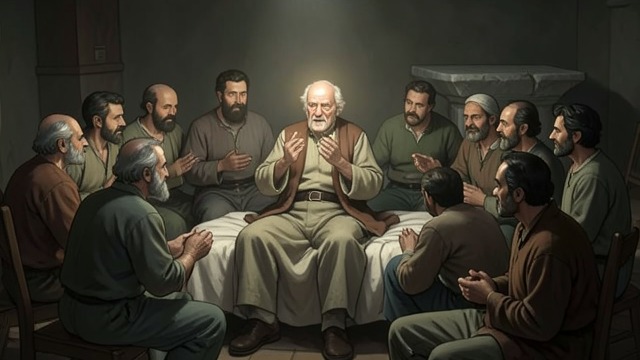
Jacob’s final blessings are a deathbed address in which he interprets his sons’ pasts and declares their differing futures, turning a family’s last gathering with its patriarch into a portrait of Israel’s twelve tribes. His words combine judgment, imagery, and promise: Reuben loses preeminence because of his conduct, Simeon and Levi face dispersion, Judah receives a ruler’s staff, and Joseph is sustained and blessed by God.
The Gathering and Its Purpose
Jacob summons his sons to assemble and hear what will befall them in the end of days. Calling them both the sons of Jacob and the sons of Israel, he presents the speech as a family address with a future-facing reach: the words concern not only the men before him but the tribes that descend from them.
The blessings are not uniform praise. Jacob addresses each son according to a distinct assessment, joining remembered conduct to images of future standing, work, danger, or abundance. The sequence makes the family’s shared descent compatible with sharply differentiated tribal destinies.
Judgment, Authority, and Tribal Roles
Reuben is acknowledged as Jacob’s firstborn and the first-fruits of his strength, but his instability disqualifies him from preeminence. Jacob connects that loss to Reuben’s violation of his father’s bed, making remembered family conduct the reason for a diminished future standing.
Simeon and Levi are treated together as brothers whose kinship is associated with violence. Jacob rejects their council and assembly, condemns their fierce anger and cruel wrath, and declares that they will be divided and scattered among Israel. The blessing thus becomes a judgment on their shared conduct as well as a prediction of their dispersion.
Judah receives the most explicit language of rule. His brothers will praise him and bow before him; he is pictured as a lion at rest, while the sceptre and ruler’s staff remain with him and the peoples obey him. The imagery of vine, wine, and milk adds abundance to this vision of authority.
The remaining sons receive compact but distinct portraits. Zebulun is associated with the sea, ships, and Zidon; Issachar with a pleasant resting place and the burden of task-work; Dan with judging and a serpent’s sudden attack; Gad with repelling those who attack him; Asher with rich food and royal delicacies; Naphtali with a freed hind and gracious words; and Benjamin with a wolf that takes prey and divides spoil.
Joseph and the Blessing of Divine Help
Joseph is described as a fruitful vine whose branches reach beyond a wall, yet his prosperity is not presented as effortless: archers have attacked and hated him. His bow remains firm and his arms are made supple through the help of the Mighty One of Jacob, identified also as the Shepherd and Stone of Israel, and the God of his father.
The blessing that follows gathers images of abundance from every realm: heaven above, the deep below, and the breasts and womb. Jacob declares these blessings mighty and places them on Joseph’s head, calling him the prince among his brothers. Joseph’s prominence therefore rests both on fruitfulness and on divine aid amid hostility.
The Twelve Tribes and the Meaning of the Blessings
The speech closes by identifying its recipients as the twelve tribes of Israel and stating that Jacob blessed each according to his blessing. The formulation gathers the separate sayings into a collective account of tribal identity without erasing their contrasts: rule, labor, conflict, abundance, judgment, and dispersal all appear within the same family future.
Jacob’s pronouncements link inherited status to conduct and circumstance, but they also place Israel’s prospects under divine authority. The promise of Judah’s rule and the blessings upon Joseph stand beside judgments on Reuben, Simeon, and Levi; the result is not a simple ranking of sons but a differentiated vision of the people who will bear their names.
Jacob's death and burial
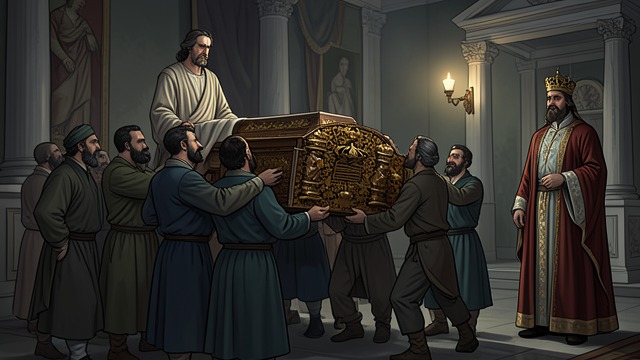
Jacob’s death and burial bring his family’s history in Canaan to a close while affirming the ancestral burial place as their enduring point of belonging. His sons carry out his specific request to be laid in the Cave of Machpelah, and Joseph’s return to Egypt afterward sets the burial alongside the continuing life of the family there.
Jacob’s Final Request
Before his death, Jacob charges his sons to bury him in the cave in the field of Machpelah, before Mamre in the land of Canaan. He identifies it as the property Abraham bought from Ephron the Hittite for a burial place, and names those already interred there: Abraham and Sarah, Isaac and Rebekah, and Leah. The request places Jacob’s own burial within a family lineage anchored in Canaan.
Jacob dies after completing his charge to his sons: he gathers his feet onto the bed, expires, and is gathered to his people. Joseph weeps over him and kisses him, then orders the physicians in his service to embalm him. The Egyptians mourn for seventy days; the embalming period itself lasts forty days.
The Funeral Procession
When the mourning period ends, Joseph seeks permission from Pharaoh to fulfill the oath Jacob had made him swear: to carry his father to Canaan for burial and then return. Pharaoh grants the request. Joseph travels with Pharaoh’s servants and household elders, the elders of Egypt, his brothers, and the rest of his father’s household; the young children, flocks, and herds remain in Goshen. Chariots and horsemen accompany the very great company.
At the threshing-floor of Atad, beyond the Jordan, the company mourns with a great lament, and Joseph observes seven days of mourning for his father. The Canaanites who see it call it a grievous mourning by the Egyptians; the place is consequently named Abel-mizraim.
Burial and Aftermath
Jacob’s sons carry out his instructions and bury him in the Cave of Machpelah, in the field Abraham bought from Ephron, in front of Mamre. The burial brings Jacob back to the family burial place in Canaan, while the rest of his household’s life remains centered in Egypt: after the burial, Joseph and his brothers return there with the others who had accompanied them.
The funeral also forms a hinge in the family story. After their father’s death, Joseph’s brothers fear he may repay them for the harm they did him, and they ask his forgiveness. The narrative thus follows the burial not with the end of the family’s conflict, but with its renewed confrontation and Joseph’s reassurance.
Joseph forgives his brothers
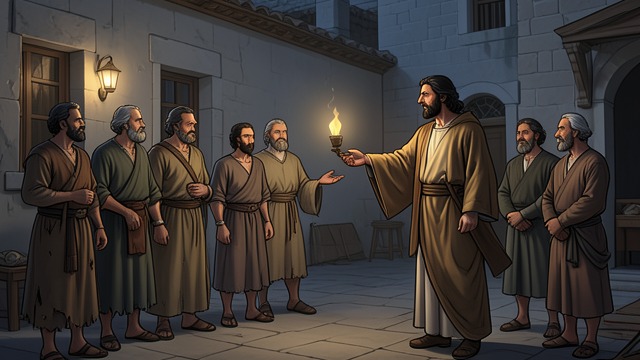
Joseph forgives his brothers after Jacob’s death, turning their fear of retribution into a final reconciliation. He does not deny the harm they intended, but answers it with reassurance and care, interpreting the family’s history as part of God’s purpose to preserve life.
The brothers’ fear and appeal
After Jacob was buried in the Cave of Machpelah, Joseph returned to Egypt with his brothers and the others who had gone up for the burial. The brothers then feared that, with their father gone, Joseph might hate them and repay them for the evil they had done to him.
They sent Joseph a message asking him to forgive their transgression and sin. The message appealed to the God of their father, and represented Jacob as having urged forgiveness before his death. The brothers then came before Joseph themselves and offered to become his servants.
Joseph’s response
Joseph wept when he heard their appeal. He rejected the posture of ultimate judgment, asking whether he occupied God’s place, and distinguished the brothers’ intention from the outcome: they had meant evil against him, but God had meant the events for good, bringing about the preservation of many lives.
His answer was not merely a declaration that the past no longer mattered. He told them not to fear, promised to sustain them and their little ones, comforted them, and spoke kindly to them. Their offer of submission was met with a commitment to provide for the family.
Reconciliation and the family’s future
The scene completes the brothers’ movement from fear of Joseph’s retaliation to renewed dependence on his protection. Joseph’s response acknowledges their wrongdoing without treating vengeance as his own prerogative; its emphasis falls on preserving the family and sustaining the next generation.
The episode also closes the book’s account of Joseph’s reconciliation with his brothers while pointing beyond Egypt. Joseph later tells them that God will remember them and bring them to the land sworn to Abraham, Isaac, and Jacob, and makes them swear to carry his bones from Egypt. Thus the forgiveness scene joins family survival to the continuing promise of return.
Joseph's death and burial in Egypt
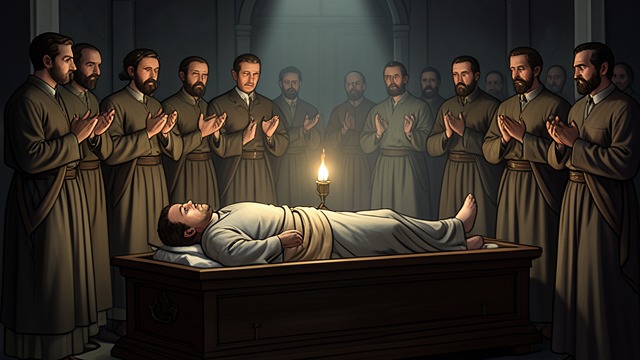
Joseph's death and burial in Egypt close Genesis with a promise still awaiting fulfillment: though embalmed and placed in a coffin in Egypt, Joseph makes the Israelites swear to carry his bones with them when God brings them to the land promised to Abraham, Isaac, and Jacob. His final words turn his death into a forward-looking charge, and his coffin remains a material reminder of the family's unresolved journey.
Joseph’s Final Years
Joseph lives in Egypt with his father's household and reaches the age of 110. He sees Ephraim's descendants to the third generation, and children of Machir, Manasseh's son, are born upon his knees, placing his death amid several generations of the family’s growth.
Before he dies, Joseph tells his brothers that God will surely remember them and bring them up out of Egypt to the land sworn to Abraham, Isaac, and Jacob. His words connect the family's present life in Egypt to the ancestral promise of land.
The Oath and Burial
Joseph makes the children of Israel swear that when God remembers them, they will carry his bones from Egypt. The request gives the family a specific obligation to preserve and transport his remains, and the oath makes the anticipated departure a shared commitment extending beyond his lifetime.
Joseph dies at 110, is embalmed, and is placed in a coffin in Egypt. The account records no immediate transfer to Canaan: his burial remains in Egypt, while his oath points toward a future return.
Narrative Significance
The ending holds death and expectation together. Joseph’s coffin marks the family’s continued presence in Egypt, but his confidence that God will bring them to the promised land prevents that presence from becoming the story’s final destination.
The promise reaches beyond Joseph’s lifetime and his immediate household to the children of Israel as a people. His remains become a lasting sign of the ancestral promise, preparing for the later story of departure from Egypt without depicting that departure here.
Israelites' enslavement in Egypt
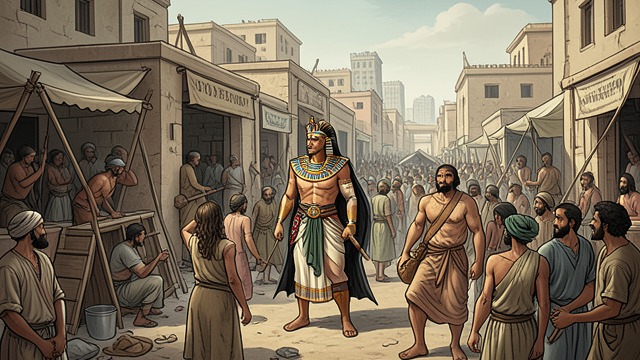
Israel’s enslavement in Egypt is the story of a rapidly growing people transformed into a labor force by a new Pharaoh who fears their numbers. The oppression intensifies from compulsory work on royal store-cities to a policy targeting Hebrew boys, while the narrative makes Israel’s multiplication, survival, and eventual deliverance central to its covenantal memory.
Growth and Royal Fear
The account opens with the names of Jacob’s sons who came to Egypt with their households: Reuben, Simeon, Levi, Judah, Issachar, Zebulun, Benjamin, Dan, Naphtali, Gad, and Asher. The descendants of Jacob numbered seventy, with Joseph already in Egypt. After Joseph, his brothers, and their generation died, the Israelites continued to multiply until the land was filled with them.
A new king arose who did not know Joseph. He saw the Israelites as too numerous and powerful, and feared that in a war they might join Egypt’s enemies and leave the country. His response was not to welcome their growth but to organize their subjection.
Forced Labor and Escalating Oppression
Pharaoh appointed taskmasters over the Israelites and imposed burdensome labor, including the construction of the store-cities Pithom and Raamses. The pressure did not produce the decline the king sought: the more the people were afflicted, the more they multiplied and spread, increasing Egyptian fear.
The Egyptians then compelled the Israelites to serve with rigor. Their work included mortar and brick, field labor, and other forms of service; the text emphasizes the bitterness and severity of this imposed labor. Their increasing numbers and their oppression unfold together, so that royal policy repeatedly meets the very growth it is meant to contain.
The Threat to Hebrew Boys
Pharaoh next ordered the Hebrew midwives, Shiphrah and Puah, to kill Hebrew boys at birth while allowing girls to live. The midwives feared God and did not carry out the command; they preserved the boys. When Pharaoh demanded an explanation, they answered that Hebrew women gave birth before a midwife could reach them.
God dealt well with the midwives, and the Israelites continued to grow in number and strength. Pharaoh then extended the order to all his people: every Hebrew son was to be cast into the river, while every daughter was to be spared. The policy thus moved from secret instructions to midwives to a public command directed at the population as a whole.
Deliverance Remembered as Covenant History
The oppression provides the history recalled in later covenant speeches. In Moses’ account of the covenant at Horeb, Israel is reminded that God brought the people out of Egypt, the house of bondage, and that the Sabbath command is grounded in their former servitude and deliverance. The memory of forced labor therefore becomes an ethical reason for rest, extending Sabbath rest even to servants and resident strangers.
In the covenant at Moab, the assembled people are told to remember their experience in Egypt and their passage among other nations. The covenant reaches beyond those physically present to those absent and to future generations, binding collective memory to a continuing obligation. The text also warns that abandoning the covenant for other gods will bring curse and expulsion from the land, while return to God can lead to compassion and gathering from dispersion.
The narrative’s later warnings sharpen the contrast between the people’s beginnings and their possible future: a people rescued from bondage may again be scattered and subjected to servitude if they break covenant. Conversely, fidelity brings blessing and life in the land. Enslavement is thus not only the origin of Israel’s deliverance story but a recurring measure of the dangers of forgetting that history.
Moses' birth and rescue
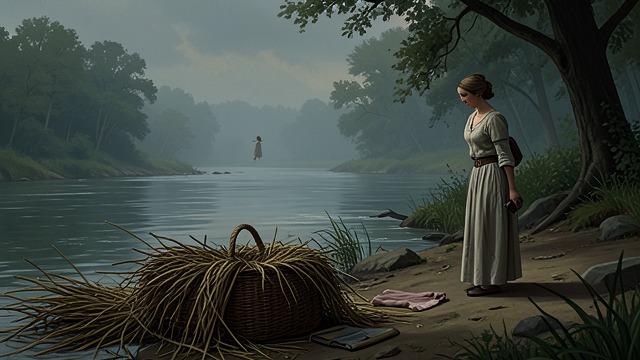
Moses' birth and rescue is the opening turn in the life of the future leader of the Israelites: amid Pharaoh’s attempt to destroy Hebrew boys, his family protects him, and Pharaoh’s Daughter raises him within the very household that issued the order.
Threat and concealment
The episode follows Pharaoh’s command that every Hebrew son be cast into the river while daughters were to be allowed to live. A man and woman of the house of Levi had a son, and his mother hid him for three months. When she could no longer conceal him, she made a small ark of bulrushes, sealed it with slime and pitch, placed the child inside, and set it among the river’s reeds. His sister remained at a distance to see what would happen.
Discovery and adoption
Pharaoh’s Daughter came down to bathe by the river, and her attendants walked along its bank. Seeing the basket among the reeds, she sent a maid to retrieve it. When she opened it, she found a crying boy and recognized him as one of the Hebrew children; she felt compassion for him.
The child’s sister approached and asked whether she should find a Hebrew woman to nurse him. Pharaoh’s Daughter agreed, and the girl brought the child’s mother. She was instructed to nurse him for Pharaoh’s Daughter and was promised wages. Once the child had grown, his mother brought him to Pharaoh’s Daughter, and he became her son. She named him Moses, explaining that she had drawn him out of the water.
Significance in the narrative
The rescue reverses the purpose of Pharaoh’s decree: the river meant to threaten Hebrew boys becomes the setting in which this child is saved. His mother’s concealment, his sister’s intervention, and Pharaoh’s Daughter’s compassion together secure his survival; the arrangement also allows his own mother to nurse him before he enters the royal household.
Moses’ adoption establishes a connection between his Hebrew birth and his upbringing as Pharaoh’s Daughter’s son. The narrative presents his survival as dependent on a chain of decisions by women in both households, setting the conditions for the account that follows.
Moses kills an Egyptian and flees to Midian
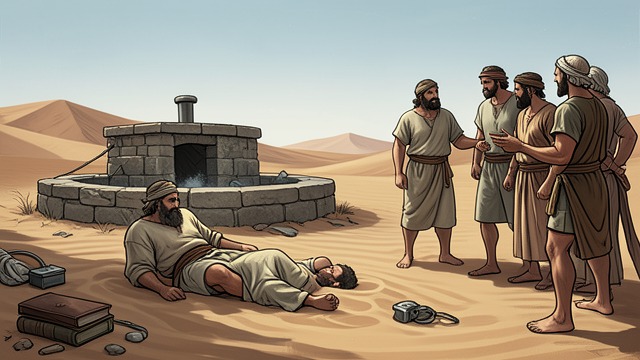
Moses kills an Egyptian he sees striking a Hebrew, then flees Pharaoh’s reach when the act is exposed. His flight to Midian turns a brief intervention on behalf of his fellow Hebrews into a lasting break with Egypt and the beginning of a new household.
The killing and its discovery
As an adult, Moses went out to his Hebrew kinspeople and observed their burdens. Seeing an Egyptian beating one of them, he looked around, struck the Egyptian, and hid the body in the sand.
The next day, Moses tried to intervene in a dispute between two Hebrews, challenging the one he judged to be in the wrong. The man answered by invoking the killing and questioning Moses’ authority to act as a ruler or judge. Moses understood that the deed was known and became afraid.
Flight to Midian
When Pharaoh heard of the killing, he sought to put Moses to death. Moses fled from Pharaoh and settled in Midian, where he sat beside a well. The episode therefore moves from violence within Egypt’s system of oppression to exile beyond Pharaoh’s immediate reach.
Intervention at the well and a new household
At the well, the seven daughters of a Midianite priest came to draw water for their father’s flock, but shepherds drove them away. Moses stood up for them and helped water the flock. When they returned sooner than expected, they told their father that an Egyptian had delivered them from the shepherds and had also drawn water for them.
Their father asked why they had left the man behind and invited Moses to eat. Moses was content to stay with him, and the priest gave him his daughter Zipporah as a wife. She bore a son, Gershom; Moses named him with reference to being a stranger in a strange land.
Narrative significance
The episode establishes a pattern in Moses’ conduct: he responds when he sees others being mistreated, first among the Hebrews in Egypt and then at the well in Midian. The consequences differ sharply. His intervention against the Egyptian leads to exposure and flight, while his defense of the priest’s daughters brings welcome, marriage, and a home in exile.
Moses’ departure also precedes the account of the Israelites’ continuing bondage and their cry to God. The story thus places his personal displacement beside the people’s oppression, before he encounters the Burning Bush at Horeb and receives his call.
The burning bush and Moses' call
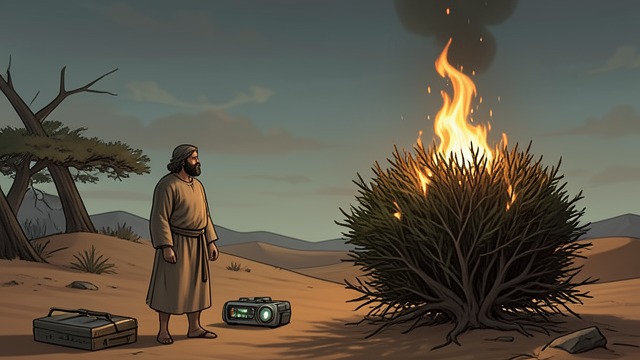
The burning bush and Moses’ call is the commissioning encounter at Horeb in which the Angel of the LORD appears in fire within a bush that is not consumed, and God sends Moses to bring the Children of Israel out of Egypt. The scene turns Moses’ life in Midian toward Israel’s deliverance, grounding his mission in divine remembrance of the covenant and providing both signs and a speaking partner to meet his doubts.
Setting and Encounter
After the Children of Israel cry out under Egyptian bondage, God hears them and remembers the covenant with Abraham, Isaac, and Jacob. Moses, meanwhile, is keeping the flock of his father-in-law, Jethro, the priest of Midian. He leads it to the farthest end of the wilderness and reaches Horeb, the mountain of God.
The Angel of the LORD appears to Moses in a flame of fire from the midst of a bush. Moses turns aside to examine the sight because the bush burns without being consumed. God calls him by name from within it; Moses answers, and is told not to approach and to remove his shoes because the ground is holy. Identifying himself as the God of Moses’ father and of Abraham, Isaac, and Jacob, God prompts Moses to hide his face.
The Commission and Its Promise
God declares that he has seen the affliction of his people in Egypt, heard their cry under their taskmasters, and knows their suffering. He says he will deliver them from the Egyptians and bring them to a good and spacious land, described as flowing with milk and honey. Moses is sent to Pharaoh to bring the Children of Israel out of Egypt.
Moses questions his ability to carry out the task. God promises to be with him and gives a future sign: after Moses has brought the people out, they will serve God on this mountain. When Moses asks what name he should give if the people ask who sent him, God answers, "I AM THAT I AM" and instructs him to identify the sender as the God of their ancestors, whose name and remembrance endure through the generations.
A Public Mission and Resistance Foretold
Moses is instructed to gather the Elders of Israel and tell them that God has remembered them and will bring them out of Egypt to the promised land. He and the elders are then to approach the king of Egypt and request a three-day journey into the wilderness to sacrifice to God. The message is presented as one the elders will heed.
The commission anticipates resistance: God tells Moses that Pharaoh will not permit the people to leave except under a mighty hand. God will strike Egypt with wonders, after which Pharaoh will let them go. The departure is also to include silver and gold jewelry and clothing requested from Egyptian neighbors and householders, so the people will not leave empty-handed.
Moses’ Doubts and the Means of His Mission
Moses doubts that the people will believe or listen to him, so God gives him signs. His rod becomes a serpent when cast down and returns to a rod when he takes hold of it. His hand becomes leprous when placed in his bosom, then is restored when he puts it back. God also names a further sign: water from the river poured on dry land will become blood.
Moses then protests that he is slow of speech. God answers that he made the human mouth and promises to be with Moses’ mouth and teach him what to say. When Moses asks that someone else be sent, God becomes angry but appoints his brother Aaron, who can speak well. Moses is to give Aaron the words; Aaron will serve as his spokesman, while Moses carries the rod used for the signs.
Narrative Significance
The encounter binds Israel’s immediate cry for help to the earlier covenant with the patriarchs: deliverance is presented not as an isolated response but as the fulfillment of remembered promises. The revelation of the divine name and the assurance of divine presence answer Moses’ questions about the identity and authority behind his mission.
The scene also makes reluctance part of the commission’s structure. Moses raises doubts about belief and speech, and the response is practical as well as declarative: signs address the first concern, while Aaron addresses the second. The call at Horeb thus establishes both the purpose of the confrontation with Pharaoh and the means by which Moses is to undertake it.
Moses and Aaron's first confrontation with Pharaoh
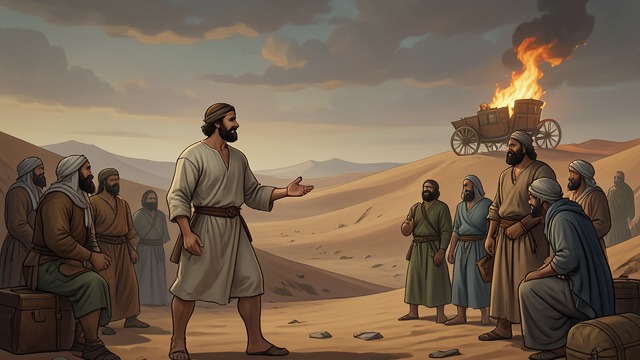
Moses and Aaron’s first confrontation with Pharaoh begins with a demand that the enslaved Israelites be allowed to worship the LORD, but ends with Pharaoh increasing their workload and the people blaming their would-be leaders. The episode makes liberation’s first step a collision between competing claims of authority: Pharaoh refuses the demand, and his refusal is felt at once in the daily burden of brickmaking.
The Demand and Pharaoh’s Refusal
After the Israelites believed Aaron’s signs and worshipped when they heard that the LORD had remembered their affliction, Moses and Aaron went before Pharaoh. They asked him, in the name of the LORD, the God of Israel, to let the people go and hold a feast in the wilderness. When Pharaoh rejected the request, they specified a three days’ journey to sacrifice to the LORD, warning that otherwise the people might face pestilence or the sword.
Pharaoh challenged the authority behind the demand: he said he did not know the LORD and would not let Israel go. He treated the request not as a negotiation over worship but as an attempt to interrupt labor, asking why Moses and Aaron were causing the people to leave their work. He argued that the population was already numerous and should not be given rest.
The Increased Burden
That same day Pharaoh ordered the taskmasters and Israelite officers to stop supplying straw for brickmaking while keeping the required brick quota unchanged. The Israelites were sent throughout Egypt to gather stubble themselves, and the taskmasters pressed them to meet the daily target as before. When the quota went unmet, the Israelite officers were beaten and challenged over their failure to produce the required bricks.
The officers appealed directly to Pharaoh. They pointed out that they had been given no straw but were still ordered to make bricks and held responsible for the shortfall. Pharaoh dismissed their complaint, called them idle, and repeated his refusal to provide straw or reduce the quota. The officers recognized that the unchanged demand under these new conditions placed them in jeopardy.
Blame, Complaint, and the Promise of Deliverance
Leaving Pharaoh, the officers met Moses and Aaron and accused them of making the Israelites abhorrent to Pharaoh and his servants, giving the Egyptians grounds to harm them. The confrontation therefore turned the people’s initial belief into immediate distrust: the promised appeal to Pharaoh had not brought relief but a worsening of their labor.
Moses returned to the LORD and asked why the people had been treated badly and why he had been sent. Since he had spoken to Pharaoh in the LORD’s name, he protested, Pharaoh had dealt harshly with the people, and no deliverance had come. The LORD answered that Moses would now see what would be done to Pharaoh: by a strong hand Pharaoh would let the people go and drive them from his land. The first confrontation thus ends not with release, but with the announcement that the refusal will be answered by divine action.
The Episode in the Covenant Narrative
The demand is framed as an obligation to the LORD, while Pharaoh asserts control through the labor system and refuses to recognize the LORD’s authority. The clash is immediately material: the request for a brief journey to worship is answered by withholding straw while preserving the brick quota. Moses and Aaron’s public role as messengers is consequently placed under pressure from both sides—the ruler rejects their demand, and the officers hold them responsible for its cost.
The confrontation also sets the Exodus promise against the reality of bondage. The LORD recalls the covenant with Abraham, Isaac, and Jacob and promises to bring the Israelites out from under Egyptian burdens, redeem them, and bring them to the land promised to their ancestors. At this first encounter, however, the people cannot take comfort from that assurance: their cruel bondage leaves them unwilling to listen to Moses, and the deliverance promised by the LORD remains ahead.
The first Passover and death of the firstborn
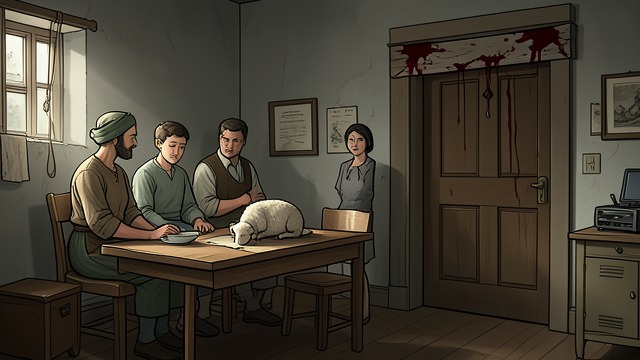
The first Passover and death of the firstborn are the decisive final plague in the Israelites’ departure from Egypt: the LORD distinguishes Israelite households by the blood-marked entrances, strikes Egypt’s firstborn at midnight, and compels Pharaoh to let the people go. The account also establishes Passover and Unleavened Bread as perpetual observances that preserve the memory of deliverance across generations.
The Passover Preparation
The LORD tells Moses and Aaron that the month will become the beginning of Israel’s year. On its tenth day, each household is to select a year-old, unblemished male lamb, from either the sheep or the goats. A small household may share one with its nearest neighbor, with the number of participants determining the portion.
The lamb is kept until the fourteenth day, when the whole assembly of the Israelites kills it at dusk. The household marks its doorway with the lamb’s blood, using hyssop to apply it to the lintel and the two side-posts. The meal is eaten that night: the meat roasted over fire, with unleavened bread and bitter herbs. Nothing is to remain until morning, and any remainder must be burned.
The meal is eaten in readiness for departure, with belts fastened, shoes on, and staffs in hand. The Israelites are also told to remain inside until morning. The blood on the entrance is the sign by which the LORD passes over the house and prevents the destroyer from entering.
The Plague and Release
At midnight, the LORD strikes every firstborn in Egypt, from Pharaoh’s firstborn to the firstborn of the captive in the dungeon, as well as the firstborn of the cattle. A great cry rises throughout Egypt; there is no house without a death. The narrative presents this judgment as the decisive contrast between Egypt and Israel, whose houses are spared.
Pharaoh summons Moses and Aaron during the night and tells them to leave with the Israelites and serve the LORD, taking their flocks and herds; he also asks them to bless him. The Egyptians press the people to depart quickly, fearing that they will all die. The Israelites carry away their dough before it can rise, along with silver, gold, and clothing obtained from the Egyptians. Their hurried departure makes the unleavened bread a lasting material reminder of the circumstances of the exodus.
A Feast of Memory
The account turns the night’s deliverance into an enduring ordinance. Passover is to be kept throughout the generations, and the Feast of Unleavened Bread lasts seven days: leaven is removed from the houses, and eating leavened bread during the period carries the penalty of exclusion from Israel. The first and seventh days are holy convocations, when ordinary work is prohibited apart from preparing food.
The observance is designed to teach as well as commemorate. When children ask what the service means, their parents are to explain that the sacrifice recalls how the LORD passed over Israelite houses while striking Egypt and delivered their households. The people bow and worship, then carry out the instructions given to Moses and Aaron.
The same deliverance becomes a framework for Israel’s later covenant identity. Moses recalls that the LORD brought Israel out of the house of bondage, and the command to keep the Sabbath is grounded in the people’s memory of having been servants in Egypt. The Passover thus links household ritual and inherited memory to the wider obligation to live as a people delivered by the LORD.
Crossing of the Red Sea
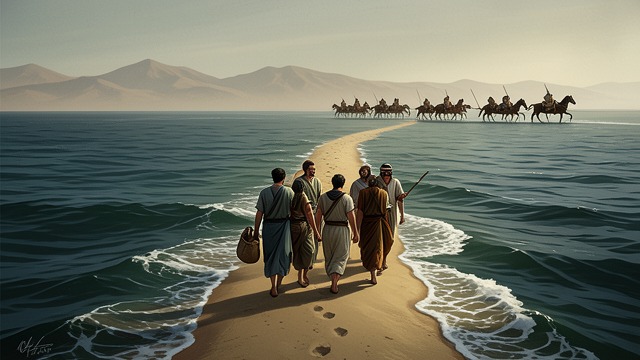
The Crossing of the Red Sea transforms the Israelites’ escape from Egypt into an unmistakable deliverance: pursued by Pharaoh’s chariots and army, they pass through the divided sea on dry ground, and the waters return upon their pursuers. The sequence moves from fear and apparent entrapment to rescue, the destruction of the Egyptian force, and the people’s renewed belief in the LORD and Moses.
Causes and Encirclement
After Pharaoh had let the people go, the LORD directed Moses to turn the Israelites back and encamp by the sea, before Baal-zephon and between Migdol and the sea. The route was deliberate: Pharaoh would conclude that the people were trapped, pursue them, and come to recognize the LORD’s power. Pharaoh, whose heart the LORD hardened, mobilized six hundred chosen chariots along with the other chariots of Egypt and their captains.
The Egyptian force overtook the Israelites at their camp beside the sea. Seeing the pursuit, the people were terrified and cried to the LORD. They reproached Moses for leading them into the wilderness, saying that slavery in Egypt had seemed preferable to dying there. Moses answered with a promise of deliverance and told the people that the LORD would fight for them.
The Sea Opens and the Pursuit Ends
The LORD told Moses to raise his rod and stretch out his hand over the sea. The Angel of God and the pillar of cloud moved from before the Israelite camp to its rear, standing between the two camps: darkness lay on the Egyptian side, while the cloud gave light to the Israelites through the night. The separation held until morning.
Moses stretched out his hand, and the LORD drove the sea back with a strong east wind throughout the night, turning the seabed into dry ground and dividing the waters. The Israelites went into the sea with water like a wall on either side. Pharaoh’s horses, chariots, and horsemen followed them into the passage.
During the morning watch, the LORD threw the Egyptian force into confusion and made its chariot wheels come off, so that the chariots became difficult to drive. The Egyptians recognized that the LORD was fighting for Israel and tried to flee. At the LORD’s command, Moses again stretched out his hand; as morning appeared, the sea returned to its strength. It covered the pursuing chariots and horsemen, and none of the Egyptian force that had entered the sea remained.
Deliverance and Its Public Meaning
The Israelites, by contrast, crossed on dry ground with the waters still standing on either side. The LORD saved them from the Egyptians, and they saw the Egyptian dead along the seashore. The account presents the crossing not simply as an escape but as the reversal of a pursuit: the sea that had seemed to block the Israelites’ way became the means of their deliverance and the end of Pharaoh’s force.
Having witnessed what the LORD did to the Egyptians, the people feared the LORD and believed in the LORD and in Moses, his servant. Moses and the Israelites then sang to the LORD, celebrating the defeat of Pharaoh’s chariots and their riders in the sea. The song carries the event’s significance beyond the immediate rescue, proclaiming the LORD’s power and the guidance of the redeemed people toward a holy habitation.
Covenant Memory
The crossing becomes a defining memory in later covenant teaching. In the covenant made with Israel in Moab, Moses recalls that the people had seen the LORD’s acts in Egypt, including great signs and wonders, and connects their wilderness journey with the land and obligations set before them.
Later, the account of the covenant’s consequences recalls the deliverance from Egypt as the history from which Israel’s covenant relationship began. The crossing thus stands within the book as both a concrete rescue from the army that pursued Israel and a lasting ground for the people’s identity and covenant allegiance.
Manna and quail in the wilderness
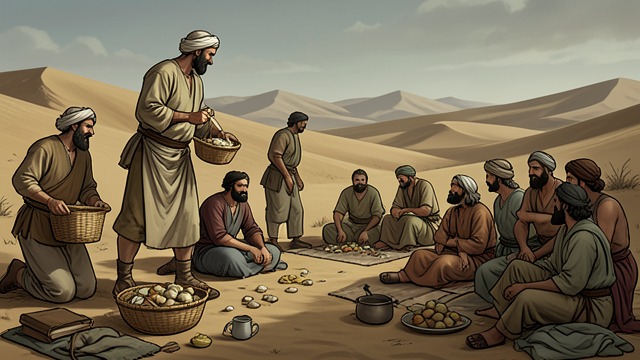
Manna and quail in the wilderness are a sustained provision for the Israelites after hunger prompts them to complain in the wilderness of Sin. The episode answers an immediate crisis with evening meat and morning bread, but also makes gathering and resting part of a daily test: the food is sufficient for each person, while the Sabbath portion is doubled and kept without spoiling.
Need and Provision
On the fifteenth day of the second month after leaving Egypt, the Israelites arrive in the wilderness of Sin, between Elim and Sinai. The whole congregation complains to Moses and Aaron that they have been brought into the wilderness to die of hunger, recalling the food they had eaten in Egypt.
God tells Moses that bread will rain from heaven and that the people are to gather a day’s portion daily, with twice as much on the sixth day. Moses and Aaron explain that the evening’s meat and the morning’s bread will show that God has heard the people’s complaints. As Aaron addresses the congregation, the glory of the LORD appears in the cloud; at dusk, quail cover the camp, and in the morning dew leaves a fine, frost-like substance on the wilderness ground. Moses identifies it as the bread God has given them.
Daily Gathering and the Sabbath
The people gather according to their need, an omer for each person. Some gather more and some less, but when they measure it, no one has a surplus and no one lacks. Moses tells them not to leave any until morning; some do, and it spoils and breeds worms. The people gather it each morning, and it melts as the sun grows hot.
On the sixth day they gather two omers per person. Moses instructs them to prepare what they will eat and keep the rest for the next morning, the Sabbath. This time the food does not spoil. Some go out to gather on the seventh day and find none; the people are told that God has given them the Sabbath and its provision in advance, and they rest.
A Sustained Provision
The Israelites call the food manna. It is white, like coriander seed, and tastes like wafers made with honey. Moses directs that an omer be preserved for future generations as a reminder of the bread provided during the journey from Egypt; Aaron places it before the Testimony as commanded.
The account closes by extending the provision beyond this first episode: the Israelites eat manna for forty years, until they reach the borders of Canaan. Food in the wilderness is therefore both immediate sustenance and a recurring sign of dependence, ordered by a rhythm of gathering for six days and resting on the seventh.
Water from the rock at Rephidim
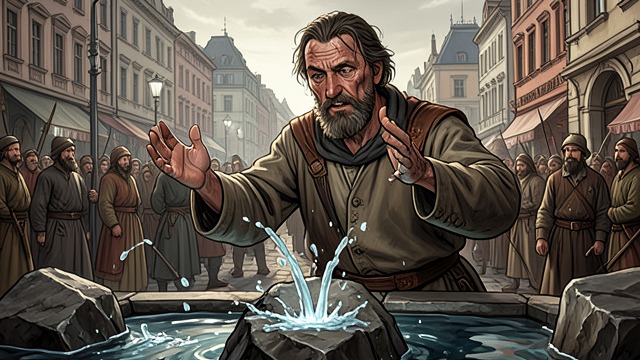
Water from the rock at Rephidim is an episode in which physical thirst becomes a test of Israel’s trust in the LORD and of Moses’ leadership. At the LORD’s command, Moses strikes a rock at Horeb in the presence of Israel’s elders, water comes out for the people to drink, and the place receives the names Massah and Meribah, memorializing the people’s quarrel and their test of whether the LORD was among them.
Background and Crisis
The Israelites arrive at Rephidim during their journey through the wilderness, and there is no water for the people. The shortage quickly becomes a confrontation: they contend with Moses and demand water, then complain that he has brought them, their children, and their cattle out of Egypt to die of thirst.
Moses answers by asking why they contend with him and test the LORD. Faced with the people’s anger and the possibility that they may stone him, he cries to the LORD, making the crisis both a question of survival and a challenge to his authority.
Water from the Rock
The LORD instructs Moses to pass before the people with some of Israel’s elders, carrying the rod with which he struck the river. The LORD says that He will stand before Moses upon the rock at Horeb and tells him to strike it so that water may come out for the people.
Moses follows the instruction in the elders’ sight, and water flows from the rock. The provision answers the immediate need without erasing the conflict that brought it about: the people receive water, while the episode preserves the memory of their challenge.
Names and Significance
The place is called Massah and Meribah because of Israel’s striving and because the people tested the LORD by asking whether He was among them. The paired names bind the material emergency to its religious meaning: scarcity gives rise to a question about divine presence, and the water supplied in response stands against that doubt.
The episode places the wilderness journey’s dependence on basic necessities alongside a recurring pattern of complaint and divine provision. Moses’ appeal, the elders’ presence, and the water from Horeb’s rock turn the shortage into a remembered test of trust and leadership.
Battle of Rephidim
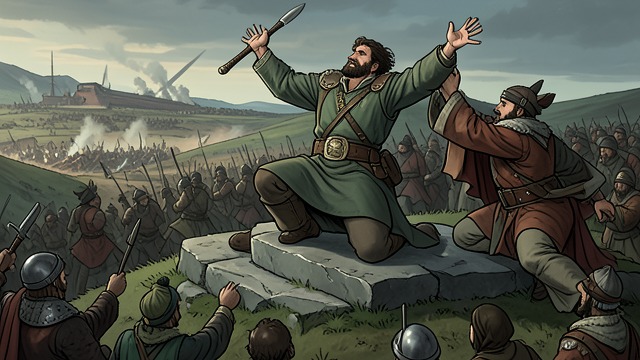
At Rephidim, Amalek fought Israel, and the Israelites prevailed when Moses held up his hands on a hill while Joshua led the fighters below. The account makes the outcome depend on coordinated action: Aaron and Hur support Moses when his hands grow heavy, and Joshua’s victory is then preserved in writing and marked by an altar.
Setting and Combatants
The encounter follows the Israelites’ arrival at Rephidim, where the people had already faced a shortage of water. Amalek then came and fought Israel, turning the encampment into the setting for an armed conflict.
Moses assigns Joshua to choose men and fight Amalek. He tells Joshua that he will stand on the hill with the rod of God, establishing two linked positions in the battle: Joshua and the fighters in the conflict, Moses above them.
The Battle and Its Turning Point
The narrative describes a direct correspondence between Moses’ posture and the course of the fighting: when he holds up his hand, Israel prevails; when he lowers it, Amalek prevails. The battle is therefore presented not as Joshua’s effort alone, but as an outcome bound to Moses’ sustained act on the hill.
As Moses’ hands grow heavy, Aaron and Hur place a stone beneath him and hold up his hands, one on each side. They keep them steady until sunset. The support of the two men enables Moses to continue, while Joshua defeats Amalek and his people with the sword.
Memorial and Continuing Conflict
After the victory, the LORD tells Moses to write an account as a memorial and to repeat it to Joshua. The command makes the battle more than a concluded encounter: it is to be remembered and passed on to the next leader.
Moses builds an altar named Adonai-nissi. The episode ends with a declaration that the LORD will have war with Amalek from generation to generation, giving the victory a lasting significance within the narrative rather than treating it as an isolated campaign.
Narrative Significance
The account combines military leadership, physical assistance, and divine authority without reducing the victory to any one of them. Joshua directs the fighting; Moses’ hands mark the battle’s changing fortunes; Aaron and Hur make his continued role possible.
Later covenant instruction recalls the exodus from Egypt and Israel’s passage through surrounding nations, while Moses’ charge to Joshua promises that the LORD will go before Israel into the land. Against that wider arc, the Rephidim victory functions as an early precedent for Joshua’s leadership and as a remembered conflict whose meaning extends beyond the battlefield.
Jethro's advice to Moses
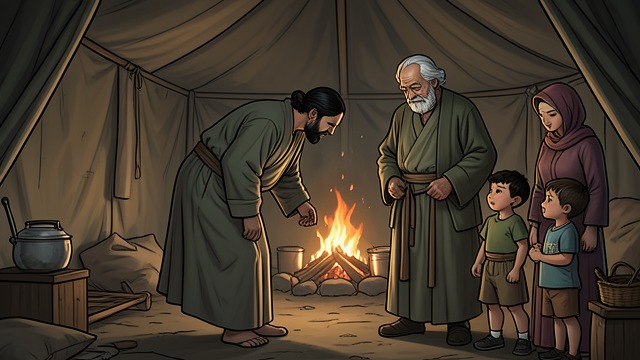
Jethro's advice to Moses is both a family reunion and a practical reorganization of leadership: after seeing Moses judge the people alone from morning until evening, Jethro proposes a hierarchy of judges that Moses adopts, reserving difficult cases for himself and assigning smaller matters to others.
Arrival and Reunion
Jethro, priest of Midian and Moses’ father-in-law, hears how God brought Moses and Israel out of Egypt. He comes to Moses in the wilderness at the mountain of God, bringing Zipporah, Moses’ wife, and their two sons, Gershom and Eliezer, whom Jethro had taken with him after Moses sent them away. Moses goes out to meet Jethro, bows and kisses him, and the two ask after one another’s welfare before entering the tent.
Moses recounts what the LORD did to Pharaoh and the Egyptians for Israel’s sake, the hardships along the way, and the deliverance. Jethro rejoices, blesses the LORD for rescuing the people, and declares that the LORD is greater than all gods. He then offers a burnt-offering and sacrifices; Aaron and all the elders of Israel join Moses and Jethro for a meal before God.
The Strain of Solo Judgment
The next day, Jethro watches Moses sit in judgment while the people stand around him from morning until evening. Moses explains that people come to inquire of God; when disputes arise, he judges between neighbors and makes known God’s statutes and laws. The account thus presents Moses’ work as both adjudication and instruction, but concentrated entirely in one leader.
Jethro warns that this arrangement is not good: the burden is too heavy for Moses to carry alone, and it will wear down both him and the people. His intervention follows from what he has observed, and his counsel aims not to remove Moses from leadership but to make that leadership sustainable.
A Delegated System
Jethro advises Moses to continue representing the people before God, bringing their causes to God, and teaching them the statutes, laws, way of life, and work required of them. Alongside this central role, Moses is to appoint capable, God-fearing, truthful men who reject unjust gain as rulers over thousands, hundreds, fifties, and tens.
Under the proposed arrangement, these leaders judge the people at all times. They decide ordinary cases themselves and bring every difficult matter to Moses. Jethro links this division of responsibility to the welfare of both leader and community: Moses will be able to endure, and the people will reach their destination in peace, provided the plan accords with God’s command.
Implementation and Significance
Moses listens to his father-in-law and does what he recommends. He selects capable men from all Israel and appoints them as heads over the people in the same graded structure; they handle routine matters, while the hard cases come to Moses. Once the arrangement is in place, Moses lets Jethro depart, and Jethro returns to his own land.
The episode depicts delegated judgment as a way to distribute responsibility without displacing Moses’ distinctive roles as mediator and teacher. It also places counsel and institutional order alongside the account of deliverance: the visiting father-in-law first hears and affirms what the LORD has done, then helps Moses organize the community that has been brought out of Egypt.
The covenant and revelation at Mount Sinai
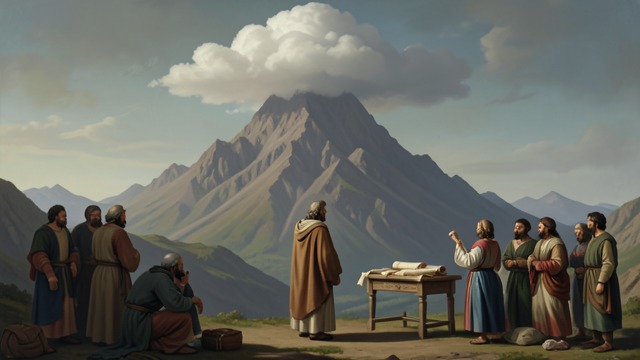
The covenant and revelation at Mount Sinai make Israel’s departure from Egypt the foundation of a binding relationship with the LORD. At the mountain, the people hear the covenant’s terms, receive commandments governing worship and communal life, and affirm their willingness to obey; the agreement is then ratified through sacrifice and blood. The scene joins divine authority to collective obligation, setting Sinai’s revelation within a continuing covenantal history that is recalled again in later instruction.
Revelation and the Covenant Terms
The encounter begins in the third month after the Israelites leave Egypt, when they camp in the wilderness before Mount Sinai. The LORD recalls their deliverance and offers a distinctive communal status on condition that they heed His voice and keep His covenant: they are to be His treasured people, a kingdom of priests, and a holy nation. Moses conveys this offer to the elders, and the people answer together that they will do what the LORD has spoken. The covenant thus binds a remembered act of rescue to a present commitment and a future identity.
The Mountain, Its Boundaries, and the Commandments
Before the encounter, Moses is instructed to consecrate the people and have them wash their garments. A boundary is set around the mountain: neither the people nor the priests may cross it to approach the LORD without permission. On the third day, thunder, lightning, a thick cloud, and a loud horn accompany the LORD’s descent in fire; the mountain smokes and quakes. The people tremble, and Moses brings them from the camp to the foot of the mountain. The repeated warnings against crossing its limits make access to the revelation carefully ordered: the people remain below, while Moses is summoned upward, with Aaron permitted to accompany him under specified terms.
From the mountain, God gives the commandments, beginning with the claim that the LORD brought Israel out of Egypt, the house of bondage. The people are forbidden to worship other gods or make images for worship, and are warned against taking the LORD’s name in vain. The Sabbath is to be kept holy, with rest extending beyond the household head to children, servants, resident strangers, and cattle; the commandment is grounded in the LORD’s rest after creating heaven and earth. The remaining prohibitions address dishonoring parents, murder, adultery, theft, false testimony, and coveting a neighbor’s household and possessions. Together, these terms connect exclusive worship with family and community conduct.
Ratification and Continuing Memory
After the commandments, the people recoil from the thunder, lightning, horn, and smoking mountain, asking Moses to speak to them rather than have God address them directly. Moses tells them not to fear, explaining that the encounter tests them and is meant to keep them from sin; while they stand at a distance, he approaches the thick darkness where God is. The LORD then gives further instructions: Israel is not to make silver or gold gods, and worship is to be marked by an altar of earth or unhewn stone, without steps leading up to it.
The covenant is formally ratified when Moses recounts the LORD’s words and ordinances, writes them down, and builds an altar beneath the mountain alongside twelve pillars representing Israel’s twelve tribes. Young Israelites offer burnt offerings and oxen as peace offerings. Moses places half the blood in basins and casts half against the altar; after reading the Book of the Covenant aloud, he sprinkles the remaining blood on the people and identifies it as the blood of the covenant. The public assent and the ritual together bind the people to the written terms.
Moses, Aaron, Nadab, Abihu, and seventy elders then ascend and behold the God of Israel; they are not harmed, and they eat and drink. Moses is subsequently summoned higher to receive stone tablets, the law, and commandments for teaching. Joshua accompanies him partway, while the elders remain with Aaron and Hur to handle disputes. A cloud covers Mount Sinai for six days; on the seventh, the LORD calls Moses, whose stay in the mountain lasts forty days and forty nights. The revelation therefore extends beyond the initial commandments into instruction meant to be transmitted and preserved.
Later accounts recall Sinai as a covenant made not only with an earlier generation but with the Israelites addressed in the present: Moses says the LORD spoke with them face to face from the fire, while he stood between the LORD and the people to convey the words because they feared the fire. This retelling restates the commandments and emphasizes Sabbath rest for servants and resident strangers as well as the household, grounding it in Israel’s memory of bondage and deliverance. The covenant’s force is also framed through consequences: obedience is associated with blessing, while turning to other gods brings covenant curses and exile. In the account of the covenant at Moab, the written law is placed beside the Ark of the Covenant, publicly read at the end of every seven years, and joined to a song and heaven and earth as witnesses. Sinai thus becomes both a foundational revelation and a continuing standard by which Israel’s later conduct is remembered and judged.
The golden calf and renewal of the covenant
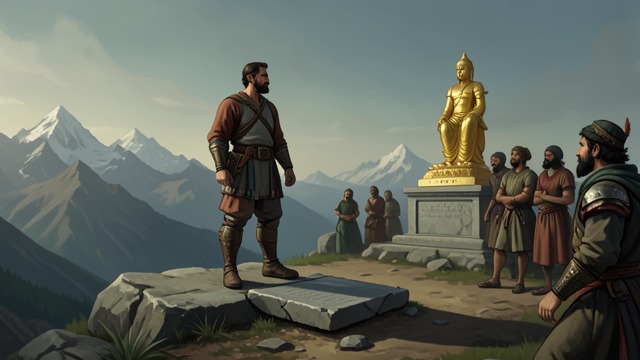
The golden calf and renewal of the covenant is a foundational crisis in the relationship between the LORD and Israel: while Moses remains on Mount Sinai, the people make an image and worship it, threatening the covenant just given to them. Moses destroys the calf and the first stone tablets, intercedes for the people, and receives a renewed covenant; the episode also makes clear that forgiveness does not erase the consequences of disobedience.
Moses’ intercession turns the crisis toward covenant renewal without concealing its cost. When the LORD threatens to consume the people and make a great nation of Moses, he appeals to the exodus, the patriarchal promise to Abraham, Isaac, and Israel, and the danger that Egypt would misread Israel’s destruction. The LORD relents from the threatened disaster. Moses then descends carrying the two stone tablets, but, on seeing the calf and the dancing, breaks them beneath the mountain. He burns and grinds the calf, scatters its powder on water, and makes the Israelites drink it. Aaron explains that the people demanded a god to lead them and claims that the calf simply emerged from the fire; Moses instead confronts him with the sin he has brought upon the people.
Punishment and the people’s separation from God
At the camp gate, Moses called for those on the LORD’s side, and the Levites gathered to him. Acting on his command, they carried out a purge in which about three thousand people died. The next day Moses returned to the LORD to seek atonement, even offering to be blotted from God’s book if the people could not be forgiven. God refused to erase the guilty from the book, ordered Moses to lead the people onward under the guidance of an angel, and said that their sin would still be visited upon them; the LORD then struck the people because they had made the calf. The journey to the promised land would continue, but divine presence among the people was no longer assured: the LORD said that he would send an angel ahead and drive out the inhabitants, yet would not go among Israel lest their stubbornness bring their destruction. Hearing this, the people mourned and removed their ornaments.
The renewed covenant and its terms
The crisis leads not to an unqualified restoration but to a renewed covenant mediated through Moses. After the people mourn and remove their ornaments, Moses pitches the tent of meeting outside the camp; the cloud descends at its entrance, and the LORD speaks with Moses. Moses insists that the people are the LORD’s own and that the divine presence must accompany them, since this presence distinguishes them from other peoples. The LORD grants this request and allows Moses a guarded glimpse of divine glory: hidden in a cleft of rock and covered by the LORD’s hand, he sees only what the LORD permits.
Moses hews two replacement stone tablets and ascends Mount Sinai alone. The LORD proclaims a character marked by mercy, patience, and abundant goodness and truth, while also declaring that guilt will not simply be cleared. Moses bows in worship and asks that the LORD remain among the people, pardon their sin, and take them as an inheritance. The LORD makes a covenant with Moses and Israel, promising marvelous acts and the displacement of the peoples before them, while warning Israel against treaties with the inhabitants and worship of their gods.
The renewed covenant is set out through concrete obligations. Israel must make no molten gods, keep the Feast of Unleavened Bread in Abib, consecrate firstborn males and redeem firstborn sons, rest on the seventh day even during plowing and harvest, and observe the Feast of Weeks and Feast of Ingathering. The people are to appear before the LORD three times each year, bring the choicest firstfruits, and observe rules governing Passover offerings. After forty days and nights without food or water, Moses comes down with the covenant’s ten words on the tablets. His face shines from speaking with the LORD; the people fear approaching him, so Moses gives them the commands and wears a veil, removing it when he returns to speak with the LORD.
The episode’s aftermath extends beyond the mountain. Moses later recalls the golden calf as an instance of Israel’s corruption and warns that making and serving images will bring destruction and exile, even as he promises that a scattered people who seek the LORD may find mercy and renewal. In the covenant at Moab, the account of Israel’s past serves as a warning against turning to other gods, and the law is deposited beside the Ark of the Covenant as a witness. The golden calf thus becomes a lasting counter-memory to the exodus: the people delivered from Egypt must repeatedly choose fidelity, while covenant renewal preserves their future without pretending that rebellion carried no cost.
Construction of the Tabernacle
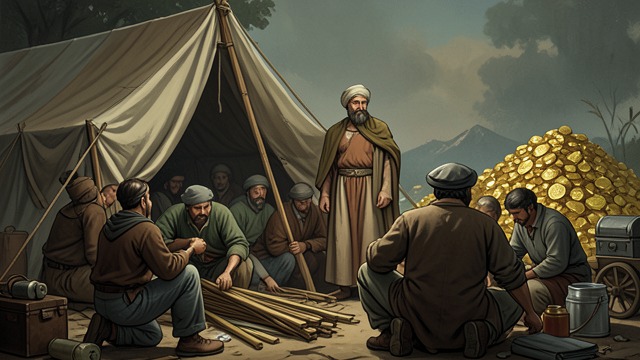
Construction of the Tabernacle is the collective realization of a sanctuary commanded by the LORD. Its making joins willing gifts, specialized craftsmanship, precise material accounting, and the work of the community; when the completed objects are brought to Moses, he confirms that the work follows the command and blesses the people.
A Command and a Willing Offering
Moses announces that the undertaking requires both contributions and skilled work. The people are invited to bring an offering from a willing heart: gold, silver, brass, colored yarns and fine linen, goats’ hair, animal skins, acacia wood, oil, spices, and gemstones. These resources are assigned to a detailed program that includes the tent and its fittings, the ark and its cover, the table and showbread, the lampstand, altars, laver, court, and priestly garments.
The response encompasses both wealth and labor. Men and women bring gold jewelry; others contribute textiles, skins, metal, or acacia wood. Women who are skilled in spinning make the colored linen and goats’ hair cloth, while the rulers bring onyx and setting stones, together with spices and oil. The gifts are described as freewill offerings: the construction begins not with a single donor but with contributions from people moved to give.
Craft Leadership and Abundant Materials
Bezalel of the tribe of Judah is named as the principal craft leader, endowed with wisdom, understanding, knowledge, and workmanship in gold, silver, brass, stone, and wood. Oholiab of the tribe of Dan is appointed alongside him, and both are charged with teaching. Other wise-hearted workers join them, making the sanctuary a coordinated enterprise in which skill is both practiced and passed on.
The offerings arrive every morning, until the craftsmen report that the supply exceeds what the work requires. Moses then orders that no further offerings be made, and the people are restrained from bringing more. The abundance is not left as an unspecified impression: the later account records twenty-nine talents and seven hundred and thirty sanctuary shekels of gold, one hundred talents and 1,775 shekels of silver, and seventy talents and 2,400 shekels of brass. The silver includes a half-shekel contribution from each of 603,550 men aged twenty and upward; the hundred talents are cast into the sanctuary and veil sockets.
The Sanctuary’s Structure and Furnishings
The tent is made from ten linen curtains, each twenty-eight cubits long and four cubits wide, joined in two sets with fifty gold clasps so that the tabernacle forms one unit. Eleven goats’ hair curtains make an outer tent, coupled with brass clasps; coverings of red-dyed rams’ skins and sealskins lie above. Acacia boards, ten cubits high, stand on silver sockets, with bars joining the sides and a central bar running through the boards. A richly colored veil embroidered with cherubim and a separate entrance screen complete the inner structure.
Bezalel makes the ark from acacia wood, overlays it inside and outside with pure gold, and fits it with rings and carrying staves. Its gold cover bears two hammered cherubim, one at either end, with wings spread over the cover and faces turned toward it. The table, also made of gold-overlaid acacia, has carrying staves and vessels of pure gold.
The lampstand is made as one beaten work of pure gold, with a central shaft, six branches, almond-blossom-shaped cups, and seven lamps; it and its vessels use a talent of gold. The incense altar is a gold-overlaid square of acacia wood, with horns and rings for its carrying staves. The burnt-offering altar is larger, five cubits square and three cubits high, overlaid with brass and furnished with a brass grating, utensils, and carrying staves. The laver and its base are made from the mirrors of the women serving at the entrance to the tent of meeting.
The court is enclosed by fine linen hangings: one hundred cubits along each long side and fifty cubits at each end. Its pillars stand in brass sockets, with silver hooks and fittings; the colored gate screen measures twenty cubits long and five high. The account’s measurements and materials make the sanctuary not merely a collection of sacred objects but a portable, assembled structure whose parts are designed to be joined, carried, and set apart.
Priestly Garments and Israel’s Names
The work includes garments for Aaron and his sons, made from colored yarns and fine linen for their service in the holy place. The ephod combines gold, blue, purple, scarlet, and linen; gold is beaten into threads and woven into its fabric. Two onyx stones, engraved with the names of the children of Israel, are mounted on its shoulder pieces as memorial stones.
The square breastplate is doubled and set with twelve stones in four rows, each corresponding to one of the tribes and engraved with a name. Gold chains and rings fasten it securely to the ephod. Aaron’s blue robe has a reinforced neck opening and a hem alternating gold bells with colored pomegranates. Linen tunics, headgear, breeches, and a colored sash complete the garments; a plate of pure gold on the high priest’s headgear bears the inscription “HOLY TO THE LORD.” In this way, Israel’s names are carried on the priest’s shoulders and breast, while holiness is made visible in the clothing of priestly service.
Completion, Accounting, and Communal Recognition
The Levites render an account of the sanctuary’s materials under Moses’ command, with Ithamar, son of Aaron, overseeing the accounts. Bezalel and Oholiab are identified again as the makers, and the completed inventory is brought to Moses: the tent and its furnishings, coverings, ark, table and showbread, lampstand, altars, laver, court, service implements, and garments for Aaron and his sons.
The conclusion emphasizes that the people have done all the work as the LORD commanded Moses. Moses inspects it, sees that it has been completed accordingly, and blesses them. The episode thus closes the distance between command and execution: a plan becomes a material sanctuary through collective giving, specialized labor, documented resources, and a final act of communal acknowledgment.
Dedication of the Tabernacle
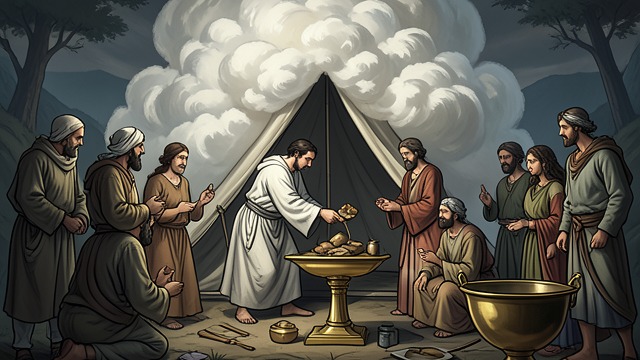
The Dedication of the Tabernacle completes the sanctuary’s construction by turning its carefully arranged furnishings and spaces into a consecrated dwelling for the LORD. On the first day of the first month of the second year after the exodus, Moses establishes the sanctuary, anoints its objects and priests, and finishes the surrounding court; the cloud and divine glory then fill it, becoming the visible sign that guides Israel’s journeys.
Date and Consecration
The LORD commands Moses to rear up the Tabernacle on the first day of the first month. The sequence is both architectural and ritual: Moses is to place the Ark of the Testimony behind the veil, arrange the bread on the table, set and light the lamps, position the golden incense altar, the burnt-offering altar and the laver, and enclose the sanctuary with its court.
Consecration extends beyond setting the objects in place. Moses anoints the Tabernacle and everything within it, then anoints the burnt-offering altar and its vessels, making that altar most holy; he also anoints the laver and its base. The sanctuary’s parts are thus ordered for service and marked as holy.
The Priests and the Completed Sanctuary
Moses brings Aaron and his sons to the entrance of the tent of meeting and washes them with water. He clothes Aaron in the holy garments and anoints him for priestly service; his sons receive tunics and anointing as well. Their anointing establishes their priestly service across their generations.
The narrative dates the actual raising of the Tabernacle to the first day of the first month in the second year. Moses erects its sockets, boards, bars and pillars, spreads the tent coverings, places the testimony inside the Ark and screens it with the veil. He then arranges the table and bread to the north, the lampstand to the south, and the incense altar before the veil, repeatedly noting that each task follows the LORD’s command.
Worship and Sacred Access
Moses lights the lamps before the LORD and burns sweet incense on the golden altar. At the entrance he sets the altar of burnt-offering and offers a burnt-offering and a meal-offering. The laver stands between the tent of meeting and the altar, supplied with water so that Moses, Aaron and Aaron’s sons can wash their hands and feet when entering the tent or approaching the altar.
After Moses raises the court around the Tabernacle and altar and hangs the court gate screen, the work is finished. The arrangement defines a sequence of approach and service: the court surrounds the sanctuary, the altar stands at its entrance, and washing accompanies entry and altar service.
Divine Presence and Israel’s Journeys
The cloud covers the tent of meeting, and the glory of the LORD fills the Tabernacle. The presence is so complete that Moses cannot enter while the cloud remains over it. The dedication therefore culminates not in human access to the sanctuary but in the divine presence taking possession of it.
The cloud also becomes Israel’s signal for movement: whenever it lifts from above the Tabernacle, the people set out; while it remains, they do not journey. By day the cloud of the LORD rests over the sanctuary, and by night fire is within it, visible to all Israel throughout their journeys. The completed Tabernacle is both a consecrated center of worship and the enduring sign by which the people travel.
Census of Israel in the wilderness of Sinai
The Census of Israel in the wilderness of Sinai is a military and communal reckoning that gives numerical form to Israel’s organization in the wilderness. Conducted by Moses and Aaron under the LORD’s command, it counts 603,550 men eligible for war, while assigning the Levites a distinct responsibility for the Tabernacle rather than including them in the total.
Order and Participants
The census takes place in the wilderness of Sinai, in the tent of meeting, on the first day of the second month in the second year after the people left Egypt. The LORD directs Moses to count the congregation by families and fathers’ houses, recording by name every male aged twenty and above who can go forth to war. Aaron joins Moses, and a named leader from each tribe assists them.
The assembly gathers on the appointed day, and the people declare their pedigrees according to family and fathers’ house. The count therefore records more than a general population: it connects military eligibility to lineage and organizes the people through their ancestral households.
The Total and the Levites’ Separate Charge
The tribal tallies produce a total of 603,550 men eligible for war. Reuben, Israel’s firstborn, numbers 46,500; the census also records 59,300 for Simeon and 45,650 for Gad. These figures locate the census within a wider enumeration of Israel’s tribes and present the people as a body counted for organized service.
The Levites are explicitly excluded from this total. Instead, they are appointed over the Tabernacle of the Testimony and its furnishings: they are to carry and serve it, take it down when the camp moves, and set it up when the camp settles. They encamp around the sanctuary, keeping its charge and preventing an unauthorized person from approaching on pain of death. Their distinct status is thus defined by sacred service and the protection of the congregation, not by inclusion in the military count.
Census, Covenant, and Collective Identity
The census belongs to a larger pattern in which households and descent shape Israel’s collective identity. At the beginning of Exodus, the people entering Egypt with Jacob are reckoned as seventy, and the account then emphasizes their multiplication. In the wilderness, the count is recast around tribal families and men able to fight, while the Levites receive a separate institutional role.
Later, Moses recalls the covenant made at Horeb and the people’s experience of hearing the LORD speak from the fire. The commandments are framed as obligations for the gathered community, to be taught across generations and kept in the land. The census’s combination of named tribes, ancestral households, military capacity, and differentiated sanctuary service gives that community an ordered form.
In the same covenant teaching, obedience is associated with blessing, multiplication, and life in the land, while turning aside is associated with curse and loss. The census itself announces no such outcome; its significance lies in establishing who is counted, how the tribes are represented, and why the Levites stand apart as guardians and servants of the Tabernacle.
Levites Replace Israel’s Firstborn and Redemption Payment Registration
The registration of the Levites in place of Israel’s firstborn establishes a quantified exchange between sacred service and redemption payment. In the wilderness of Sinai, the LORD claimed the Levites as His own, assigned them to replace Israel’s firstborn, and required a payment for the 273 firstborn who remained beyond their number.
Claim and Substitution
The LORD explained the substitution by recalling the night the firstborn of Egypt were struck: every firstborn in Israel, human and animal, had then been consecrated to Him. The Levites were now taken from among the Israelites in place of those firstborn, and the Levites themselves were declared the LORD’s.
The exchange was not merely a census arrangement. The Levites were assigned to sacred service, including duties at the tent of meeting, while the firstborn represented a prior claim arising from Israel’s deliverance in Egypt. The registration made that claim administratively visible and specified how it would be discharged.
The Census and the Surplus
Moses and Aaron counted the Levites by their families, including every male from one month old and upward. The total was 22,000. In a separate count using the same age threshold, Israel’s firstborn males numbered 22,273.
The difference was exactly 273. The Levites could therefore serve as substitutes for the same number of firstborn, but not for all of them. The text treats that numerical surplus as a specific obligation to be redeemed rather than leaving the discrepancy unresolved.
Redemption Payment
The LORD prescribed five sanctuary shekels for each of the 273 firstborn not matched by a Levite, with the sanctuary shekel defined as twenty gerahs. Moses collected the payment from those counted as surplus; the total was 1,365 sanctuary shekels.
Moses then transferred the redemption money to Aaron and his sons, following the LORD’s command. The procedure linked the census directly to priestly provision: the Levites were assigned in place of most of the firstborn, while silver accounted for the remaining difference.
The Levites’ Share and Continuing Duties
The later rules for Levite support extend the logic of assigned service. The Levites received Israel’s tithe as their inheritance in return for their work at the tent of meeting, since they had no territorial inheritance among the Israelites. They, in turn, were to set apart a tenth of that tithe as a gift to the LORD and give it to Aaron the priest.
These arrangements distinguish the Levites’ support from an unrestricted claim on sacred contributions: they were to offer the best portion, and what remained could be eaten by them and their households as their reward for service. The initial substitution and the continuing tithe system thus place Levite livelihood within the same structure of religious duty and communal allocation.
A Pattern of Counted Obligations
The episode presents sacred status through exact numbers, categories, and transfers: 22,000 Levites, 22,273 firstborn, five shekels for each unmatched person, and a recorded payment delivered to the priests. Its precision turns the memory of deliverance into an ongoing institutional arrangement, binding the Levites’ service, the firstborn’s redemption, and priestly support together.
First Tabernacle Sacrifices and the LORD's Fire Appears
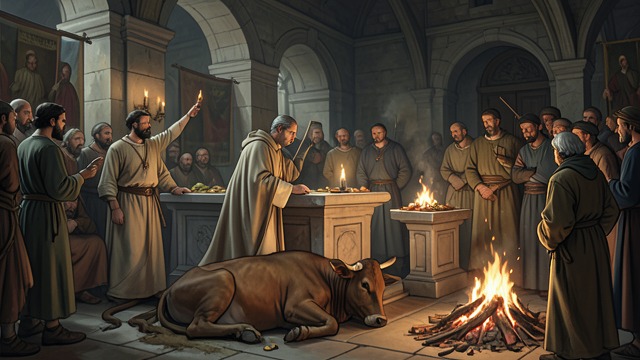
The First Tabernacle Sacrifices and the LORD's Fire Appears mark the first public sacrificial service after Aaron and his sons’ seven-day consecration. Aaron offers sacrifices for himself and the people before the assembled congregation; the LORD’s glory appears, and fire consumes the offerings on the altar, confirming the day’s promised manifestation.
Setting and Participants
The ceremony takes place on the eighth day, when Moses summons Aaron, Aaron’s sons, and the elders of Israel. The whole congregation gathers before the tent of meeting. Moses explains that they are to carry out the LORD’s command so that the LORD’s glory may appear to them.
The offerings are prescribed for both priest and people. Aaron is to bring an unblemished bull-calf as a sin-offering and a ram as a burnt-offering. The Israelites are instructed to bring a he-goat for a sin-offering, a yearling calf and lamb for burnt-offerings, an ox and a ram for peace-offerings, and a meal-offering mixed with oil.
The Sacrificial Sequence
Moses directs Aaron to approach the altar, make atonement first for himself and the people, and then present the people’s offerings. Aaron slaughters his own sin-offering; his sons bring him its blood, which he applies to the altar’s horns and pours at its base. He burns the fat, kidneys, and liver lobe on the altar, while the flesh and skin are burned outside the camp.
Aaron then offers the burnt-offering, placing its blood around the altar and burning the pieces after washing the entrails and legs. He presents the people’s goat as a sin-offering, performs the burnt-offering according to the prescribed ordinance, and burns a portion of the meal-offering in addition to the regular morning burnt-offering.
For the people’s peace-offerings, Aaron slaughters the ox and ram. His sons deliver the blood, which he dashes around the altar; the fat and specified internal portions are set apart, and Aaron burns the fat. He waves the breasts and right thigh before the LORD, completing the sequence of offerings.
Appearance of the LORD’s Glory
After the sacrifices, Aaron raises his hands toward the people and blesses them, then comes down from the altar. Moses and Aaron enter the tent of meeting and come out to bless the congregation together. At this point the LORD’s glory appears to all the people.
Fire comes forth from before the LORD and consumes the burnt-offering and the fat on the altar. The gathered people see the sign, shout, and fall on their faces. The sequence thus moves from commanded offerings and priestly blessing to a public manifestation that the text presents as the fulfillment of Moses’ announcement.
Ritual and Communal Significance
The offerings distinguish the priests’ atonement from the people’s while placing both within a single public service. The repeated actions—handling blood, burning designated portions, presenting the peace-offerings, and blessing the congregation—make the inauguration of the altar an ordered communal rite rather than a private act.
The fire’s arrival gives the ceremony a decisive ending: the LORD’s presence is made visible to the whole congregation, and the people respond together in awe. The event also stands immediately before the account of Nadab and Abihu, whose unauthorized offering is followed by fire from before the LORD; the juxtaposition sets the welcome of commanded worship against the danger of departing from it.
Death of Nadab and Abihu
Nadab and Abihu’s deaths mark a sudden reversal in the inauguration of the priesthood: after the LORD’s fire accepts the offerings before all Israel, the brothers are killed by fire for presenting an offering that had not been commanded. The episode makes sacred service a matter of exact responsibility, and its aftermath keeps Aaron and his surviving sons at their posts even as the wider community mourns.
Priestly Duties and Significance
The LORD then commands Aaron and his sons not to drink wine or strong drink when entering the tent of meeting. The stated purpose is that they distinguish the holy from the common and the unclean from the clean, and teach Israel the statutes given through Moses. The instruction follows the deaths directly, linking disciplined priestly conduct with the work of discernment and teaching.
The episode sets the brothers’ unauthorized offering against the prescribed offerings that have just been accepted, and contrasts their deaths with Aaron’s silence and the continuing obligations of Eleazar and Ithamar. It makes the inauguration’s divine approval inseparable from a warning: those who approach the sanctuary bear a particular responsibility, while mourning must be carried out without abandoning the duties assigned to the priesthood.
Altar Dedication Ceremony
The Altar Dedication Ceremony is a twelve-day offering by Israel’s tribal princes that provides transport for the Tabernacle’s service and dedicates its altar. Its careful distribution of gifts and repeated daily offerings turns a single consecration into a shared act of service by the tribes.
Distribution of the Gifts
The princes first brought six covered wagons and twelve oxen to the Tabernacle. Moses assigned them according to the Levites’ work: the Gershonites received two wagons and four oxen, while the Merarites received four wagons and eight oxen under Ithamar’s supervision. The Kohathites received no wagons or oxen, because they carried the holy objects on their shoulders. The gifts thus supported distinct forms of sanctuary service rather than being distributed equally.
Twelve Days of Offerings
After the altar was anointed, the LORD instructed Moses that one prince should present an offering each day. Nahshon son of Amminadab, representing the Tribe of Judah, offered first. His gifts included silver vessels filled with fine flour mixed with oil, a golden pan of incense, and animals for burnt, sin, and peace offerings.
The same offering was repeated by each prince on his appointed day. The account names Nethanel of Issachar on the second day and Eliab of Zebulun on the third, then records the remaining princes in turn through Ahira of Naphtali on the twelfth. This repetition gives each tribe a distinct place in the dedication while making the offerings alike in substance.
Completion and Significance
The final accounting gathers the twelve days into a single dedication: twelve silver dishes and twelve silver basins, together weighing 2,400 sanctuary shekels, and twelve gold incense pans weighing 120 shekels altogether. The offerings also comprised twelve animals each for burnt and sin offerings, alongside twenty-four oxen and sixty each of rams, he-goats, and yearling lambs for peace offerings. This inventory makes the princes’ repeated gifts a collective act while preserving their day-by-day participation. Afterward, when Moses entered the Tent of Meeting, he heard the Voice speaking from above the Ark Cover, between the two cherubim, linking the completed dedication with the sanctuary as a place of divine address.
Cleansing and Consecration of the Levites
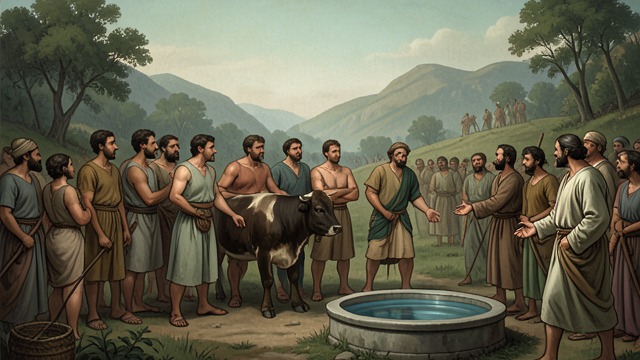
The cleansing and consecration of the Levites established them as a set-apart group for service at the tent of meeting, given in place of Israel’s firstborn. Through purification, offerings, and the congregation’s public participation, the rite connected their service to atonement and protected the community from the danger of unauthorized approach to the sanctuary.
Age and Service
The rite also set limits and stages for Levitical work. Men entered service in the work of the tent of meeting at twenty-five; at fifty they withdrew from its active labor, though they continued to assist their fellow Levites in keeping its charge. The arrangement joined consecrated status to defined duties rather than treating service as unbounded.
Consecration and Entry into Service
The ceremony began with purification: the Levites were sprinkled with purification water, shaved, and required to wash their clothes. They then brought a young bull with a grain offering of fine flour mixed with oil, along with another young bull for a sin offering. Moses presented them before the tent of meeting and assembled the congregation of Israel, whose members laid hands upon the Levites. Aaron presented them before the LORD as a wave offering on behalf of the people; the Levites in turn laid hands on the bulls, one offered as a sin offering and the other as a burnt offering to make atonement for them.
After this offering, Moses set the Levites apart from the rest of Israel and presented them before Aaron and his sons. The LORD declared them wholly given for service, in place of Israel’s firstborn, whom He had claimed after striking Egypt’s firstborn. The Levites were entrusted to Aaron and his sons to serve Israel at the tent of meeting and to make atonement for the people, so that no plague would come through an unauthorized approach to the sanctuary. Moses, Aaron, and the congregation carried out the instructions; the Levites purified themselves and washed their clothes, and Aaron presented them as a sacred gift and made atonement for them. Only then did they enter the tent of meeting to perform their service before Aaron and his sons.
Establishment of the Second Passover
The Establishment of the Second Passover turns a practical conflict between ritual impurity and the festival calendar into a defined provision: those unable to observe Passover at its appointed time because of contact with a dead body or travel far away may keep it one month later, while those with no such impediment remain accountable for observing the festival.
The First Passover in the Wilderness
In the first month of the second year after the Israelites left Egypt, the LORD commanded them to keep Passover at its appointed season. The observance was set for dusk on the fourteenth day of the month, and the people kept it in the Wilderness of Sinai according to the command given through Moses.
The provision arose when certain men, made unclean through contact with a dead body, could not participate on that day. They came before Moses and Aaron and asked why their condition should prevent them from presenting the LORD’s offering at its appointed time among the Israelites. Moses did not decide the matter on his own; he told them to wait while he sought the LORD’s direction.
A Second Date and Its Conditions
The ruling allowed a person who was unclean because of a dead body, or away on a distant journey, to keep Passover on the fourteenth day of the second month at dusk. The meal was to be eaten with unleavened bread and bitter herbs; none was to remain until morning, and no bone was to be broken. The later observance was therefore a regulated alternative, not an exemption from the festival’s prescribed form.
The rule also distinguishes unavoidable absence from refusal. A person who was clean, not on a journey, and nevertheless failed to keep Passover was to be cut off from the people and bear the consequence of not bringing the LORD’s offering at its appointed season. A resident stranger who wished to observe Passover was to follow the same statute as one born in the land.
Ritual Access and Communal Obligation
The episode makes room for a real impediment without treating the festival as optional: the men’s question prompts a ruling that restores their opportunity to participate, while the penalty for an eligible person’s refusal preserves the force of the appointed observance. The same law applies to native-born Israelites and resident strangers, extending a shared ritual standard across the community.
In the book’s wider covenantal account, Israel is summoned to stand before the LORD as a people bound by an oath, including present members and those not present. The Passover provision gives that obligation a concrete calendar and procedure: ritual status or distance may alter the date, but not erase the duty to observe.
Israelites Depart from the Wilderness of Sinai
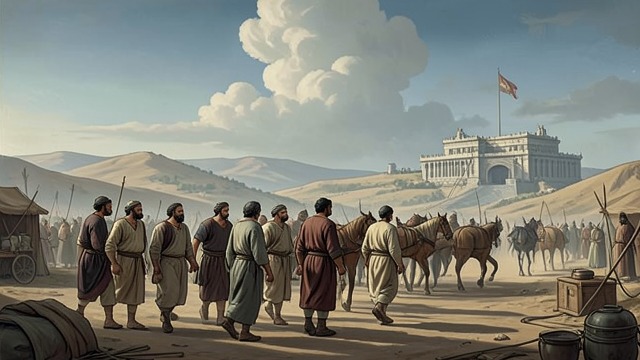
Israelites Depart from the Wilderness of Sinai is the first organized departure of the Israelite camps from Sinai, turning the promised journey toward the land into movement. Set in the second year, on the twentieth day of the second month, the departure is marked by the cloud lifting from the Tabernacle and by a carefully ordered procession in which the tribes and those carrying the sanctuary each have a place.
The Signal and the Order of Departure
The cloud was taken up from over the Tabernacle of the Testimony, and the Israelites set out by stages from the Wilderness of Sinai. Their first journey followed the command of the LORD through Moses, making the departure both a physical relocation and an act of obedience to divine direction. The cloud then rested in the Wilderness of Paran.
The camp moved in a prescribed sequence. The standard of Judah led, with Issachar and Zebulun following; the Tabernacle was taken down, and the Gershonites and Merarites, who carried it, set forward. Reuben, Simeon, and Gad came next. The Kohathites carried the sanctuary so that the Tabernacle could be set up when they arrived. Ephraim, Manasseh, and Benjamin followed, while Dan brought up the rear, with Asher and Naphtali completing the order. The departure is thus narrated not as a scattered migration but as a coordinated procession of tribes, carriers, and sacred objects.
Hobab and the Route Through the Wilderness
Before the journey continued, Moses asked Hobab, the son of Reuel the Midianite and Moses’ father-in-law, to travel with the Israelites toward the place the LORD had promised them. Hobab initially said he would return to his own land and kindred. Moses urged him not to leave, explaining that his knowledge of where to camp in the wilderness could make him a guide to the people; he also promised that Hobab would share in the good the LORD would do for Israel. The account records the appeal but does not state Hobab’s final answer.
The Israelites then traveled three days from the mountain of the LORD. The Ark of the Covenant went ahead of them during those three days to seek a resting place, while the cloud of the LORD remained over them by day as they moved from camp. The narrative places sacred guidance and the practical search for a place to rest within the same account of the journey.
Moses’ Words as the Ark Moves and Rests
The movement of the Ark and the pauses of the camp are marked by paired declarations from Moses. As the Ark set forward, he called for the LORD to rise, scatter His enemies, and drive away those who hated Him. When it rested, he called for the LORD to return to the tens of thousands of Israel’s families. These words give the procession a repeated pattern: departure is joined to a plea for protection, and rest to a plea for the LORD’s presence among the people.
From Departure to Wilderness Testing
The ordered march does not end the difficulties of the wilderness. Immediately after the departure account, the narrative reports that the people complained, and fire from the LORD burned at the edge of the camp. The people cried out to Moses; he prayed to the LORD, and the fire abated. The place was named Taberah because the fire had burned there. This next episode sharply contrasts the disciplined order of the procession with the instability and distress that arise during the journey.
Taberah Incident
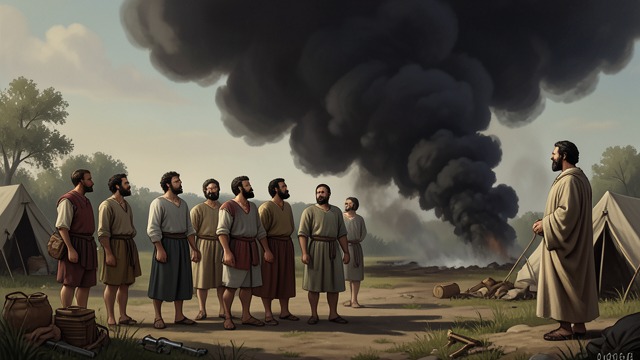
The Taberah Incident is the first crisis narrated after the Israelites depart from Sinai: their complaint provokes a fire from the LORD at the camp’s edge, and Moses’s prayer causes it to abate. Its brief account turns a journey into a test of the community’s conduct and establishes a pattern of crisis, intercession, and reprieve.
Setting and Cause
The incident follows the departure from the mountain of the LORD, with the Ark of the Covenant going ahead to seek a resting place and the cloud of the LORD over the camp by day. Against this ordered movement, the people are described as murmuring and speaking evil in the LORD’s hearing. The account does not specify the content of their complaint.
The Fire and Moses’s Intercession
The LORD hears the people, becomes angry, and sends fire that burns at the far edge of the camp. The people cry out to Moses; he prays to the LORD, and the fire abates. The narrative gives no further account of the damage, naming no individual victims or describing the fire’s effects beyond its reach into the camp’s outermost part.
Name and Narrative Significance
The place is called Taberah because the LORD’s fire burned there. The episode’s sequence is compact but consequential: communal complaint is followed by divine anger, then by the people’s appeal to Moses and the cessation of the fire. Moses’s intervention places him between the aggrieved community and the divine response, while the camp’s journey continues into a sequence of further complaints and tests.
The Spirit Comes Upon the Seventy Elders
The Spirit Comes Upon the Seventy Elders is the account of the LORD responding to Moses’ inability to carry Israel’s complaints alone by empowering seventy elders to share the leadership burden. Its central movement is from an overburdened leader’s plea to a wider distribution of responsibility, culminating in Moses’ wish that all the LORD’s people might receive the spirit and prophesy.
Causes and Background
The episode follows the people’s complaints about their food. They recall the fish, cucumbers, melons, leeks, onions, and garlic they ate in Egypt, while describing the manna as their only provision. Moses hears families weeping at the entrances of their tents and tells the LORD that he cannot carry the people alone; the burden is too heavy for him.
Moses also asks how he could provide meat for a people numbering six hundred thousand men on foot. The LORD answers by asking whether His hand has become short, then gives Moses a practical instruction: gather seventy elders and bring them to the tent of meeting.
The Elders Receive the Spirit
The LORD says that He will come down and speak with Moses at the tent, take some of the spirit resting upon Moses, and place it upon the elders so they can bear the people’s burden with him. Moses gathers the seventy and stations them around the tent.
When the LORD comes down in the cloud and speaks to Moses, the spirit rests upon the elders and they prophesy. The account presents this gift as the means by which leadership becomes shared rather than left to Moses alone.
Eldad, Medad, and Moses’ Response
Two of the registered elders, Eldad and Medad, remain in the camp rather than going out to the tent. The spirit rests upon them there as well, and they prophesy in the camp. A young man reports this to Moses, and Joshua urges Moses to stop them.
Moses rejects the implication that their prophesying threatens his standing. He asks whether Joshua is jealous on his behalf and expresses the wish that all the LORD’s people were prophets and that the LORD would put His spirit upon them. He then returns to the camp with the elders.
Consequences and Significance
The narrative answers Moses’ crisis on two connected levels: the elders are appointed to share the burden, and the spirit’s presence is not confined to those gathered at the tent. Eldad and Medad’s activity in the camp extends the episode beyond its designated gathering place, while Moses’ response frames that extension as something to welcome rather than suppress.
The event thus links spiritual empowerment with shared responsibility. Moses’ authority remains intact, but his response resists treating prophetic activity as an exclusive possession and voices a hope for the wider participation of the people.
Eldad and Medad Prophesy in the Camp
Eldad and Medad Prophesy in the Camp is a brief episode in which two men receive the spirit given to Israel’s seventy elders and prophesy away from the Tent of Meeting. When Joshua urges Moses to stop them, Moses instead welcomes the possibility that the LORD might give the spirit to all the people, making the episode a statement about prophetic authority that does not depend on presence at the central gathering.
Appointment of the Elders
The episode follows a crisis over the people’s demand for meat. The LORD tells Moses to gather seventy elders and officers at the Tent of Meeting so they can share the burden of leadership; the LORD will take of the spirit resting upon Moses and place it upon them. Moses gathers the elders around the Tent, and the LORD descends in the cloud and gives them the spirit. When it rests upon them, they prophesy, though the account says this does not continue.
Eldad and Medad are named as two of those recorded among the elders, but they have not gone out to the Tent. The spirit rests upon them nonetheless, and they prophesy in the camp. Their location distinguishes them from the assembled elders without excluding them from the same spiritual gift.
Joshua and Moses
A young man reports the two men’s prophesying to Moses. Joshua, identified as Moses’ attendant from his youth, urges his master to restrain them. The report therefore turns an unexpected manifestation into a question of authority: whether prophetic activity outside the gathered group should be stopped.
Moses answers by asking whether Joshua is jealous on his behalf, then expresses the wish that all the LORD’s people might be prophets and receive the LORD’s spirit. Rather than treating the two men’s activity as a challenge to his position, Moses presents the gift as something he would welcome more widely. He then returns to the camp with the elders.
Narrative Context and Significance
The episode is set within the wider response to the people’s craving for meat. The LORD promises that they will eat meat for a month, rebukes Moses’ doubt about providing for six hundred thousand men on foot, and declares that the LORD’s hand is not too short. After the elders’ appointment and the prophesying, a wind brings quail from the sea; the people gather them in great quantities, but a severe plague follows while the meat is still being eaten. The place is named Kibroth-hattaavah, and the people journey onward to Hazeroth.
Within this sequence, the account places shared leadership and shared prophetic inspiration beside the peril of the people’s demand. Eldad and Medad’s prophesying in the camp shows that the spirit is not limited to the Tent’s gathering, while Moses’ response frames that wider distribution as desirable rather than threatening.
Quail and Plague at Kibroth-hattaavah
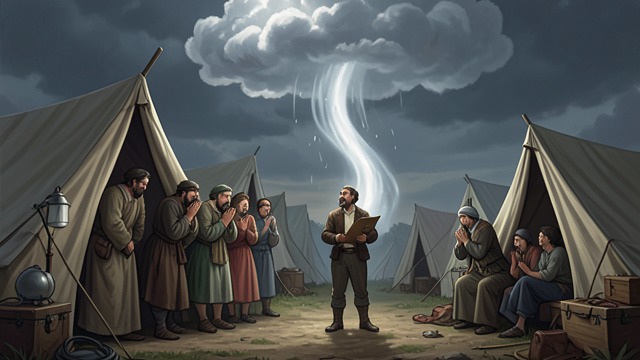
At Kibroth-hattaavah, Israel’s demand for meat turns a provision of food into a crisis of leadership and judgment. The LORD answers both Moses’ plea for help and the people’s complaint: seventy elders share the burden of leadership, quail arrive in abundance, and a severe plague strikes while the people are eating. The place is named for the burial of those who lusted.
Complaint and the burden of leadership
The episode follows an earlier outbreak of fire at Taberah, which abates after Moses prays. Then the mixed multitude and the Children of Israel weep for meat, recalling the fish, cucumbers, melons, leeks, onions, and garlic they ate in Egypt. They describe their present diet as nothing but manna. The account specifies how manna was gathered and prepared: it fell with the dew, was ground or pounded, cooked in pots, and made into cakes.
The complaint reaches Moses as families weep at the doors of their tents. Displeased and overwhelmed, he tells the LORD that he cannot carry the people alone and asks why this burden has been placed on him. His crisis is not simply a lack of food to distribute: it is the strain of bearing responsibility for the whole community.
Shared authority and promised meat
The LORD directs Moses to gather seventy elders and officers at the tent of meeting. The spirit resting on Moses is shared with them so that they can bear the people’s burden with him. The arrangement directly answers Moses’ plea by extending leadership beyond one person.
The promise of meat comes with a rebuke: the people are told they will eat it for a whole month because they have rejected the LORD among them and complained about leaving Egypt. Moses questions how such provision could meet the needs of a people numbering six hundred thousand men on foot, even if their flocks and herds were slaughtered or all the fish of the sea were gathered. The LORD’s answer challenges that doubt and affirms that the promise will come to pass.
The spirit in the camp
Moses gathers the elders around the Tent, and the LORD comes down in the cloud, shares the spirit resting on Moses, and the elders prophesy. Two of the appointed men, Eldad and Medad, remain in the camp rather than going to the Tent, yet the spirit rests on them too and they prophesy there.
When Joshua urges Moses to stop them, Moses refuses to treat their activity as a threat to his own position. He wishes that all the LORD’s people might be prophets with the LORD’s spirit upon them. The episode thus presents the distribution of the spirit not as a privilege Moses guards, but as a widening of participation in the community’s leadership and religious life.
Quail, plague, and the place-name
A wind from the LORD brings quail from the sea and drops them around the camp, extending about a day’s journey in each direction and lying about two cubits above the ground. The people gather them through a day and a night and into the following day; even the least successful gatherer collects ten heaps. The abundance is unmistakable, but the provision does not end the crisis.
While the meat is still being eaten, the LORD’s anger kindles and a severe plague strikes the people. The place is called Kibroth-hattaavah, explained by the burial there of those who lusted. The episode’s sequence sets hunger, abundant supply, and death beside one another: the requested food arrives, but its arrival is bound to judgment rather than uncomplicated relief.
Miriam Punished with Leprosy
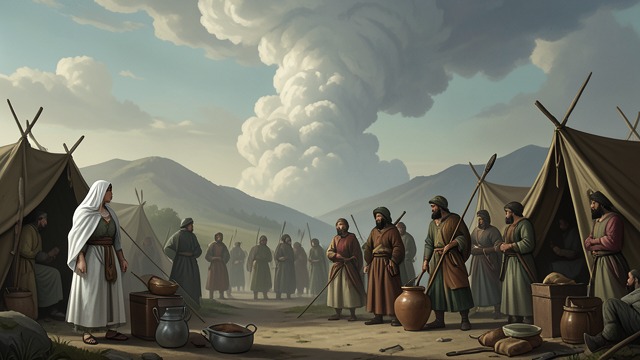
Miriam Punished with Leprosy is the episode in which Miriam and Aaron oppose Moses’ authority and God answers their challenge by distinguishing Moses’ exceptional prophetic standing. Miriam is afflicted with leprosy, Aaron acknowledges their sin, and Moses pleads for her healing; after seven days outside the camp, she is brought back and the people resume their journey.
Challenge to Moses
Miriam and Aaron speak against Moses because he has married a Cushite woman. They also question whether the LORD has spoken only through Moses, noting that He has spoken through them as well. The account identifies Moses as exceptionally meek, while the challenge places both the marriage and the distribution of prophetic authority at issue.
God’s Judgment and Moses’ Intercession
The LORD summons Moses, Aaron, and Miriam to the tent of meeting, then appears in a pillar of cloud and calls Aaron and Miriam forward. He distinguishes ordinary prophecy, made known through visions and dreams, from His relation with Moses: Moses is trusted throughout God’s house, and the LORD speaks with him directly and openly. The rebuke establishes that the siblings’ claim to prophetic speech does not make their standing equivalent to Moses’.
After the LORD departs, Miriam is found afflicted with leprosy. Aaron appeals to Moses, confessing that they have acted foolishly and sinned, and asks that Miriam not be left in that condition. Moses cries to the LORD to heal her. The narrative thus moves from a dispute over authority to a plea for mercy, with Aaron acknowledging the offense and Moses intervening for his sister.
Seven Days Outside the Camp
The LORD decrees that Miriam must remain outside the camp for seven days before being brought back. She is shut out for that period, and the people do not travel until she returns. Only afterward do they leave Hazeroth and camp in the wilderness of Paran. Her punishment therefore interrupts the community’s movement as well as marking the consequences of the challenge to Moses.
The Twelve Spies Explore Canaan
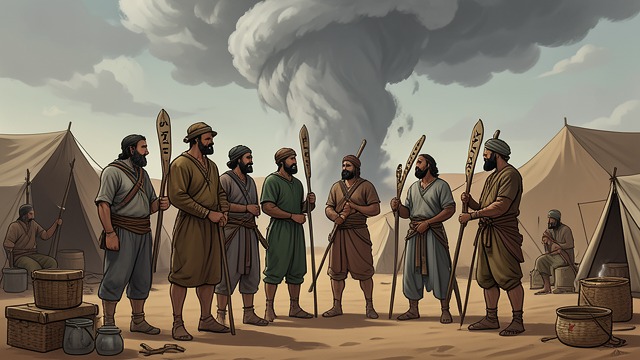
The Twelve Spies Explore Canaan turns a mission to assess the promised land into a crisis of confidence: the explorers bring back tangible proof of its fertility, but their account of its formidable inhabitants divides the people between fear and trust. The episode’s central tension lies in the difference between seeing the same land as a gift to possess and as a danger too great to face.
Commission and Mission
At the LORD’s command, Moses sent one leading man from each tribe to spy out Canaan. The mission began in the wilderness of Paran, and its instructions were practical: assess the population’s strength and numbers, the quality of the land, the character of its settlements, and whether it had trees. The spies were also to bring back some of the land’s produce.
The twelve included Caleb, from the tribe of Judah, and Hoshea, from the tribe of Ephraim. Moses renamed Hoshea Joshua before sending the group out. Their route extended from the wilderness of Zin to Rehob near Hamath, then through the South and into the hill country. At Hebron they encountered Ahiman, Sheshai, and Talmai, descendants of Anak.
The Land and Its Report
The reconnaissance took place at the time of the first-ripe grapes. In the Valley of Eshcol, the spies cut a cluster of grapes so large that two men carried it on a pole; they also gathered pomegranates and figs. The place was named for that cluster. After forty days, the spies returned to Moses, Aaron, and the whole congregation at Kadesh, in the wilderness of Paran, and displayed the produce.
Their report held together promise and threat. They described a land flowing with milk and honey and showed its fruit, but also reported fierce inhabitants, very large fortified cities, and descendants of Anak. They identified Amalek in the South, Hittites, Jebusites, and Amorites in the hill country, and Canaanites by the sea and along the Jordan.
Caleb called for the people to go up at once and take possession, insisting that they could overcome the inhabitants. The other spies disputed him: they said the people of the land were stronger, and turned their account into what the narrative calls an evil report. They portrayed the land as one that devoured its inhabitants, described its people as exceptionally tall, and said they had seen the Nephilim, the sons of Anak. In their own eyes, they were like grasshoppers—and they believed they appeared so to the inhabitants as well.
Fear and Rebellion
The report transformed the congregation’s response to the land. The people wept through the night, murmured against Moses and Aaron, and wished they had died in Egypt or in the wilderness rather than risk being killed in Canaan. They feared that their wives and children would become prey and proposed choosing a captain to lead them back to Egypt.
Moses and Aaron fell facedown before the assembly. Joshua and Caleb, the two spies who opposed the fearful assessment, tore their clothes and insisted that the land was exceedingly good. They urged the people not to rebel against the LORD or fear the inhabitants: if the LORD delighted in them, he would bring them into the land; its people, they said, were bread for Israel, and the LORD was with them. The congregation answered by threatening to stone Joshua and Caleb. The LORD’s glory then appeared in the tent of meeting before all Israel.
Covenant Memory and Consequence
The account makes the spies’ dispute part of a larger question of whether Israel will trust the LORD’s promise and presence. In Moses’ later teaching, the Exodus is recalled as the LORD bringing a people out of Egypt with signs, wonders, a mighty hand, and an outstretched arm, so that he might bring them into the land sworn to their ancestors. The mission’s crisis thus concerns not only the military assessment of Canaan but the people’s response to the history and promise that frame their journey.
The subsequent covenant teaching sets obedience and rebellion within a pattern of blessing and curse, and warns that turning to other gods can lead to expulsion and scattering; it also promises compassion and gathering if the people return to the LORD. These later teachings give the failed response at the land’s threshold a lasting place in Israel’s story: the question raised by the spies’ report is whether fear will displace trust in the covenant.
The episode also anticipates the transition in leadership. Moses later tells Israel that he will not cross the Jordan, while the LORD will go before the people and Joshua will lead them into the land. The reconnaissance therefore stands at the threshold between wilderness and inheritance, with Joshua already among the explorers and later appointed to carry the mission forward.
Israel Rebels After the Spies’ Report
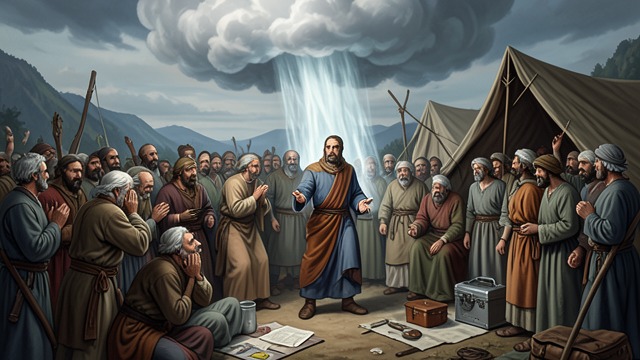
Israel Rebels After the Spies’ Report is the turning point at which the journey toward Canaan becomes a sentence of prolonged wandering. After the spies returned with fruit from a land described as flowing with milk and honey, the people focused on its fortified cities and formidable inhabitants, rejected the exhortations of Caleb and Joshua, and proposed returning to Egypt. The LORD spared the people after Moses interceded, but barred the adult generation from the land; later, Moses recalled the episode to a new generation as a warning against distrust and as an explanation for why they, rather than their parents, would inherit the promise.
The Report and the Rebellion
The spies’ account held two truths in tension. They brought fruit from the land and affirmed its abundance, but emphasized fierce inhabitants, fortified cities, and the presence of the Anakim. Caleb urged the people to go up and take possession, confident they could overcome; the other spies answered that the inhabitants were stronger. Their report magnified the danger until the people saw themselves as grasshoppers and the land as one that consumed its inhabitants.
The congregation wept through the night, complained against Moses and Aaron, and wished they had died in Egypt or the wilderness. They feared that their wives and children would become prey, questioned why the LORD had brought them toward Canaan, and proposed choosing a leader to take them back to Egypt. Moses and Aaron fell facedown before the assembly. Joshua and Caleb tore their clothes and urged the people not to rebel or fear: the land was good, its defenders’ protection had left them, and the LORD was with Israel. The congregation answered by threatening to stone them; the LORD’s glory then appeared at the tent of meeting.
Moses’ Intercession and the Sentence
The LORD declared that the people had repeatedly tested him despite the signs they had witnessed, and threatened to destroy them and make Moses into a greater nation. Moses appealed to the consequences such an act would have for the LORD’s reputation among the nations, who knew that he was present with Israel and guided them by cloud and fire. He also appealed to the LORD’s patience and abundant lovingkindness, asking that the people be pardoned as they had been forgiven since leaving Egypt. The LORD granted pardon in response to Moses’ plea.
Pardon did not mean that the rebellion carried no consequence. The generation that had seen the signs but refused to heed the LORD would not see the land sworn to their ancestors. The LORD singled out Caleb for having followed him fully, promising that Caleb and his descendants would possess the land he had explored; the sentence also named Joshua among the exceptions. Those aged twenty and above who had murmured against the LORD were condemned to die in the wilderness, while the children whom the people had feared would be taken captive were promised entry into the land they had rejected.
The Reversal and Its Cost
In Moses’ later retelling, the people’s response to the sentence forms a second, failed reversal. They admitted they had sinned and armed themselves to go up, but Moses warned them not to fight because the LORD was no longer with them in that attempt. Their earlier refusal to enter at the LORD’s command was followed by an effort to enter after the command had changed; remorse did not erase the consequences of the first decision.
The account’s central contrast is not between a safe land and a dangerous one: the spies’ report acknowledges both the land’s abundance and the strength of its inhabitants. It is between fear that interprets danger as proof of abandonment and the trust urged by Caleb, Joshua, and Moses. In the narrative, this refusal transforms the promised land from the immediate destination of the people who left Egypt into an inheritance for their children.
Recollection and Covenant Memory
The route list later places Israel’s departure from the wilderness of Sinai, its passage through many encampments, and its arrival in the plains of Moab within a recorded sequence of journeys. It also records that the people went from Kadesh to Mount Hor, where Aaron died in the fortieth year after the exodus. The itinerary makes the passage of time tangible, while the rebellion narrative supplies its cause: entry into Canaan had been deferred because the adult generation would not trust the promise.
In his address beyond the Jordan, Moses retells the episode in the first person. He recalls that the people themselves requested scouts, that twelve men explored the land and returned with its fruit, and that the people nevertheless rebelled, claiming the LORD had brought them out of Egypt to deliver them to the Amorites. Moses answers that the LORD had gone before them, fought for them, and carried them through the wilderness, yet they did not believe. His recollection again distinguishes the condemned generation from Caleb, Joshua, and the children who would enter.
The later covenant address broadens this memory into a warning about Israel’s dependence on the LORD’s promise rather than its own merit. Moses insists that Israel does not possess the land because of its righteousness and recalls the people’s rebellion from the exodus onward, including the golden calf and the refusal to go up from Kadesh-barnea. The report episode therefore stands not only as a past failure but as a precedent: possession of the land depends on the sworn promise, while the people remain accountable for whether they heed the LORD.
Israel’s Rebellion at Kadesh
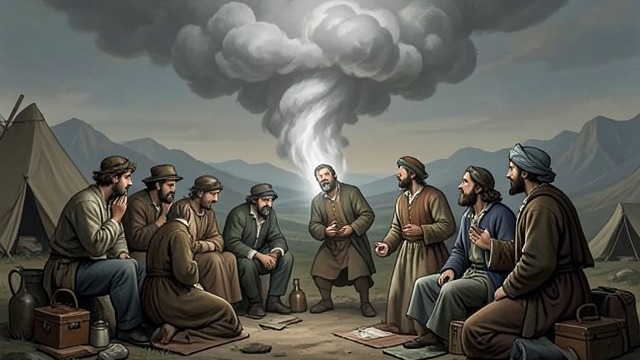
Israel’s Rebellion at Kadesh turns a fearful response to the spies’ report into a decisive refusal of the promised land, followed by an unauthorized attack and defeat at Hormah. The episode establishes the cost of the people’s distrust: the adult generation is condemned to die in the wilderness, while their children, with Joshua and Caleb, are designated to enter Canaan.
The Spies’ Report and the People’s Rebellion
After forty days exploring Canaan, the spies returned to Kadesh with evidence of its fertility, including a cluster of grapes carried on a pole between two men, as well as pomegranates and figs. They affirmed that the land flowed with milk and honey, but emphasized its fortified cities and formidable inhabitants, among them the descendants of Anak. Caleb urged the assembly to go up and take possession; the other spies insisted that Israel could not overcome the people and spread a report portraying the land as one that consumed its inhabitants.
The report turned apprehension into collective revolt. The people wept through the night, complained against Moses and Aaron, feared that their families would fall by the sword, and proposed choosing a captain to lead them back to Egypt. Moses and Aaron fell facedown before the assembly. Joshua and Caleb tore their clothes and urged the people not to rebel against the LORD or fear the inhabitants, insisting that the land was good and that the LORD was with Israel. The assembly instead threatened to stone them; the LORD’s glory then appeared at the tent of meeting.
Intercession and the Sentence
The LORD declared that the people’s repeated testing and refusal to heed him merited destruction, with Moses’ descendants made into a greater nation. Moses pleaded for pardon, reasoning that the surrounding nations would interpret Israel’s destruction as proof that the LORD had been unable to bring the people into the land. He appealed to the LORD’s patience and abundant lovingkindness, and the LORD granted pardon in response to his plea.
Pardon did not mean that the rebellion would have no consequence. The adults numbered from twenty years old and upward who had murmured against the LORD would die in the wilderness rather than see the land. Caleb, who had followed the LORD fully, and Joshua were excepted; the children whom the people had feared would become prey would enter and possess the land they had rejected. The ten spies who had spread the evil report died by plague before the LORD, while Joshua and Caleb survived.
The sentence made the spies’ forty-day journey the measure of Israel’s punishment: each day would count as a year, producing forty years of wilderness wandering. The children would bear the consequences of their parents’ infidelity until the condemned generation had been consumed. In Moses’ later account, the same reversal is recalled as a consequence of Israel’s refusal to go up when commanded: the generation that feared its children would become prey was told that those children, not their parents, would possess the land.
The Presumptuous Attack at Hormah
When Moses reported the sentence, the people mourned and rose early the next morning, declaring that they had sinned and would now go up to the promised place. Moses warned them that this would again transgress the LORD’s command: the LORD was not with them, and the Amalekites and Canaanites stood in their path. They went up presumptuously despite the warning; the ark of the covenant and Moses remained in the camp. The Amalekites and Canaanites struck them down and pursued them as far as Hormah.
The reversal is central to the episode’s sequence. Israel first refused the land when urged to trust the LORD, then tried to enter only after the judgment had been pronounced, without the LORD’s presence. Their belated willingness could not undo the earlier refusal, and the attempted conquest ended not in possession but in defeat.
Retelling and Covenant Significance
In Moses’ retrospective account in Deuteronomy, the people’s request to send scouts is presented as their own proposal, though Moses approved it and appointed twelve men, one from each tribe. The account recalls the fruit brought back from the Valley of Eshcol, the people’s fear of the Anakim and fortified cities, and their claim that the LORD had brought them out of Egypt in order to deliver them to the Amorites. It also recalls that the Amorites pursued them as far as Hormah and that the LORD did not heed their later weeping. This retelling places the episode within Moses’ broader appeal to remember the exodus and wilderness journey as grounds for obedience.
The rebellion also anticipates the covenant framework later articulated on the plains of Moab. Israel is called to heed the LORD’s commands and is warned that disobedience brings the covenant’s curses, including expulsion from the land; return to the LORD, in turn, opens the prospect of compassion and restoration. The Kadesh episode gives that framework a defining narrative example: the land is promised, but possession is tied to the people’s response to the LORD, and the failed invasion shows that remorse without obedience cannot reverse the sentence.
Aaron’s Staff Buds
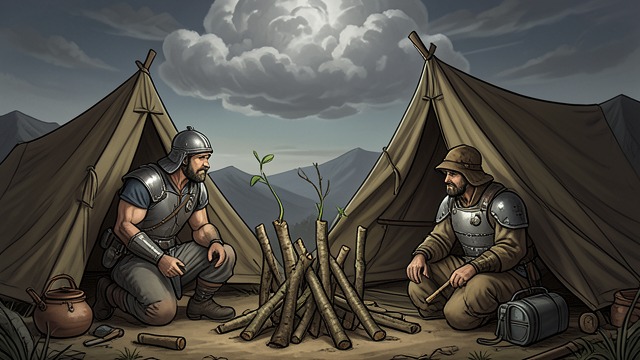
Aaron’s Staff Buds is a public sign establishing Aaron’s priestly authority amid a crisis of rebellion. After a deadly plague and renewed fear about approaching the sanctuary, God orders twelve tribal rods placed before the testimony; the next day Aaron’s alone has budded, flowered, and borne ripe almonds, and it is kept there as a lasting token against further murmurings.
Background and Purpose
The sign follows a revolt that has left the community fearful of its leaders and of the sanctuary. After a plague killed fourteen thousand seven hundred people, apart from those who died in connection with Korah’s affair, God instructed Moses to gather one rod from each ancestral house, with the name of each prince written on it. Aaron’s name was to be written on Levi’s rod, representing that tribe’s house.
The rods were not merely displayed before the people: Moses was to lay them in the tent of meeting before the testimony, where God met with the leaders. God specified the test in advance: the rod of the man chosen would bud, and the sign was intended to bring the people’s complaints against Moses and Aaron to an end.
The Sign and Its Preservation
The princes supplied twelve rods, and Moses placed them before the LORD in the tent of the testimony. When Moses entered the tent the following day, Aaron’s rod, representing the house of Levi, had put forth buds, bloomed blossoms, and borne ripe almonds. Moses brought all the rods out before the Israelites, and each man took back his own; the difference was visible in the single rod that had produced growth and fruit.
The LORD then ordered Moses to return Aaron’s rod before the testimony and keep it there as a token against rebellious people, so that their murmurings would cease and they would not die. Moses carried out the instruction. The rod’s transformation thus served both as evidence of Aaron’s selection and as a continuing warning preserved at the sanctuary.
Aftermath and Significance
The episode leads directly into instructions defining the responsibilities of Aaron’s household and the Levites. Aaron and his sons are charged with the sanctuary and priesthood, while the Levites are assigned service at the tent but barred from approaching its holy furnishings and altar. The division of duties is presented as a safeguard against further wrath among the Israelites.
The sign answers a dispute over leadership not through a contest among the claimants but through a divinely specified test and a sign kept for future reference. Its movement from rod to blossom, flower, and ripe almond makes Aaron’s election unmistakable within the narrative; its permanent placement turns that moment into an institutional reminder of the boundaries surrounding sanctuary service.
The Sabbath Wood Gatherer Is Put to Death
The Sabbath Wood Gatherer Is Put to Death is a brief wilderness episode in which an unidentified man gathering sticks on the Sabbath is brought before Moses, Aaron, and the congregation, held while the proper judgment is sought, and then stoned outside the camp at the LORD’s command. Its stark sequence turns the Sabbath command from a general obligation into a communal judgment with a lethal consequence.
Setting and Immediate Circumstances
The account places the incident during the wilderness period, without identifying the man or specifying his circumstances beyond his gathering sticks on the Sabbath. Those who find him bring him to Moses and Aaron and before the whole congregation, making the matter a public question rather than one settled by the discoverers alone.
The man is held in custody because the congregation has not yet been told what should be done to him. This pause is central to the episode: the narrative records uncertainty about the penalty before reporting a direct ruling.
Ruling and Execution
The LORD tells Moses that the man must be put to death and that the entire congregation must stone him outside the camp. The people then take him outside and stone him, and he dies as commanded. The reported sequence is spare: discovery, detention, divine judgment, removal from the camp, and execution.
The sentence is carried out by the congregation, not by Moses or Aaron acting alone. The account therefore presents the punishment as a collective act following the LORD’s instruction, while offering no further account of the man’s identity, intent, or response.
Place in the Legal and Narrative Context
The episode follows rules for sins committed inadvertently and for acts done defiantly. The surrounding passage provides offerings and atonement for inadvertent wrongdoing, while describing deliberate contempt for the LORD’s command as grounds for being cut off from the people. The Sabbath case follows those distinctions, but the narrative does not explicitly classify the man’s act or explain his intent; it records the specific ruling and its execution.
Immediately afterward, the LORD commands the Israelites to wear fringes with a blue thread on their garments, so that seeing them will remind them of the commandments and keep them from straying after their own desires. Against that next instruction, the Sabbath episode stands as a severe narrative instance of the stakes attached to remembering and doing the commandments.
Israel Defeats the Canaanites of Arad
Israel Defeats the Canaanites of Arad is a brief battle narrative in which an initial Israelite defeat is reversed after the people make a vow to the LORD. The victory leads to the destruction of the Canaanite cities and gives the place the name Hormah.
Attack and Vow
As Israel approached by the way of Atharim, the Canaanite king of Arad, who lived in the South, heard of their arrival and fought them. He took some Israelites captive, making the encounter an immediate setback for the traveling people.
Israel then vowed to the LORD that, if delivered, they would utterly destroy the Canaanite cities. The vow links the requested deliverance to a stated outcome for the towns; the account gives no further description of the fighting.
Victory and Aftermath
The LORD hearkened to Israel and delivered the Canaanites into their hands. Israel fulfilled its vow by utterly destroying them and their cities, and the place was called Hormah.
Place in the Narrative
The episode is narrated as a compact reversal: the campaign begins with captives taken by Arad, then turns to Israel’s appeal and victory. Its outcome is recorded through the changed fortunes of the battle, the destruction of the cities, and the place-name Hormah.
The Conquest of King Sihon
The Conquest of King Sihon begins as a request for passage and ends with Israel taking the Amorite cities and territory east of the Jordan. The accounts in Numbers and Deuteronomy present the refusal, battle, and victory as a turning point in Israel’s approach to the land: a route is denied, a kingdom is defeated, and its territory becomes both an inheritance and a subject of covenant memory.
A Request for Passage
Numbers describes Israel sending messengers to Sihon, king of the Amorites, asking to travel through his land by the king’s highway. They promise not to turn aside into fields or vineyards or drink from the wells, but to continue along the route until they have crossed the border. Sihon refuses permission, gathers his people, and meets Israel in battle at Jahaz.
Deuteronomy supplies a fuller version of the appeal. Moses recalls that Israel offered to keep to the highway and to buy food and water, asking only to pass through on foot. The request is framed as limited and peaceful; Sihon’s refusal is then explained as part of the LORD’s purpose to deliver him and his land into Israel’s hands.
Battle and Territorial Outcome
Israel defeats Sihon at Jahaz and takes his territory from the Arnon River to the Jabbok, stopping at the strong border of the Ammonites. The account names Heshbon, Sihon’s royal city, and says Israel settled in the Amorite cities and towns. It also recalls that Sihon had earlier taken this land from the former king of Moab, placing Israel’s conquest within a succession of territorial changes.
Deuteronomy emphasizes the scope and severity of the campaign: Israel takes Sihon’s cities, destroys their inhabitants, and keeps the livestock and the spoil. The narrative also marks a limit to the advance: Israel does not approach the land of the Ammonites or the places the LORD had forbidden. The conquered territory is not described as an undifferentiated expanse; its borders and exclusions define the victory.
The Conquest in Covenant Memory
In Moses’ later address, the conquest is recalled alongside the defeat of Og, king of Bashan. The two victories explain how land east of the Jordan came to be assigned as an inheritance to the Reubenites, the Gadites, and half the tribe of Manasseh. Sihon’s defeat thus becomes part of the history that underwrites the settlement of these tribes.
The retelling also places the campaign within the covenant made with Israel in Moab, alongside the earlier covenant at Horeb. Moses calls the assembled people, including their families and the resident stranger, to enter the covenant and its oath; he warns that turning to other gods will bring the covenant’s curses. The memory of victory therefore carries an obligation: possession of land is connected to hearing and keeping the covenant.
The episode’s geography gives that memory a clear shape. A denied passage at the king’s highway leads to battle at Jahaz; the result is possession from the Arnon toward the Jabbok, with Ammonite territory left untouched. Later, Moses uses the victory to encourage Joshua and Israel before they cross the Jordan, presenting Sihon’s defeat as precedent for the challenges ahead.
The Conquest of Og, King of Bashan
The Conquest of Og, King of Bashan, is the second major victory in Israel’s campaign east of the Jordan, following the defeat of Sihon. Og marched out to fight Israel at Edrei; the LORD assured Moses of victory, and Israel took Og’s land, including sixty fortified cities. The conquest expanded Israelite territory and provided a precedent for the people’s approaching entry into the Promised Land.
Background and Battle
After Israel had taken territory from Sihon, the people turned north toward Bashan. Og, its king, came out with his forces to meet them in battle at Edrei. The LORD told Moses not to fear Og, declaring that Og, his people, and his land had been delivered into Israel’s hand; Moses was instructed to deal with him as he had dealt with Sihon.
Israel defeated Og and his forces, leaving no survivors among the king’s people. The account thus frames the victory both as a military encounter and as the fulfilment of the assurance Moses received before the battle.
Conquest and Territorial Gains
Israel captured all of Og’s cities: sixty fortified settlements in the region of Argob, with high walls, gates, and bars, as well as many unwalled towns. The territory taken extended through Bashan and Gilead, from the Arnon valley toward Mount Hermon. The narrative emphasizes the scale of the prize by describing the cities’ defenses and the breadth of the conquered region.
The account also singles out Og as the last surviving remnant of the Rephaim and notes that his iron bedstead, kept at Rabbah among the Ammonites, measured nine cubits long and four cubits wide. This detail gives the defeated king a striking physical presence within a story otherwise focused on the extent of his lost kingdom.
Allocation and Later Remembrance
The conquered land was distributed among the eastern Israelite tribes. The Reubenites and Gadites received land from Aroer and part of Gilead, while the half-tribe of Manasseh received the rest of Gilead and Bashan. The conquest therefore changed not only the military balance but also the territorial inheritance of these groups.
Moses later recalled the defeat of Og alongside the defeat of Sihon, presenting both victories as evidence that the LORD would act similarly against the kingdoms Israel would encounter beyond the Jordan. In this retelling, the campaign becomes a model of reassurance for Joshua and the people as they prepare to enter the land.
Balak Summons Balaam to Curse Israel
Balak’s attempt to secure a curse against Israel becomes a contest over who controls the word spoken about the people: though the king repeatedly changes the location and offers honor, Balaam can only deliver the message God gives him, and his three declarations bless Israel.
Fear and the summons
After Israel defeated Sihon and Og and camped on the plains of Moab, Balak saw the victories and feared the people’s numbers. Moab’s elders described Israel as a force that might consume the land like an ox grazing a field. Balak therefore sent messengers to Balaam at Pethor, asking him to curse Israel so that Moab might prevail in battle and drive the people away.
The messengers carried rewards for divination. Balaam asked them to stay overnight while he sought God’s word; God told him not to go with them or curse Israel, because the people were blessed. Balaam sent the first delegation back, explaining that the LORD would not permit him to go.
A renewed offer and a constrained mission
Balak responded by sending a larger, more distinguished delegation and promising Balaam great honor and whatever he requested. Balaam replied that even a house full of silver and gold could not authorize him to go beyond the word of the LORD. After God told him to go with the men but speak only what God commanded, Balaam set out with Moab’s princes.
When Balak met him near the border of the Arnon, Balaam made clear that he had no independent power to speak: he could utter only the word God put in his mouth. Balak nevertheless took him to successive vantage points, hoping that a different view of Israel might yield a curse. At each site the king arranged seven altars and offerings of seven bulls and seven rams, while Balaam waited for a message and returned to speak it.
Three blessings instead of a curse
From the first height, Balaam declared that he could not curse a people God had not cursed. He described Israel as set apart from the nations and too numerous to count, and expressed the wish that his own end might resemble the end of the righteous. Balak protested that he had hired Balaam to curse his enemies, but Balaam insisted that he had to speak what the LORD placed in his mouth.
At the field of Zophim on Pisgah, the second oracle stressed that God does not lie or reverse what he has spoken: Balaam had been commanded to bless, and could not take the blessing back. It presented the LORD as present among Israel, recalled God’s bringing the people out of Egypt, and declared that neither enchantment nor divination could prevail against them. Balak’s response was to ask Balaam at least to refrain from blessing as well as cursing, but Balaam again said he must do what the LORD spoke.
Balak then took Balaam to the top of Peor. Seeing Israel arranged tribe by tribe, Balaam did not seek enchantments as before; the spirit of God came upon him. His third oracle praised Israel’s encampments and pictured flourishing abundance, an exalted kingdom, and a people rising like a lion. Balak struck his hands together in anger and ordered Balaam to return home, saying that the LORD had prevented the honor he had promised.
The final oracles and the episode’s close
Before departing, Balaam reminded Balak that no payment could make him speak beyond the LORD’s word. He then announced what Israel would do to Moab in the end of days, foretelling a star from Jacob and a scepter from Israel, alongside the subjugation of Moab and other peoples. Further pronouncements named the eventual destruction of Amalek and the troubles awaiting other nations. Balaam returned to his people, and Balak went his way.
The episode reverses the purpose of the royal summons at every turn: Balak seeks a weapon against Israel, but the repeated ritual preparations yield words that affirm Israel’s blessing and future strength. Its conclusion also distinguishes the intended curse from the later conflict with Moab: after Balaam and Balak part, Israel’s subsequent disloyalty at Shittim and the ensuing plague are narrated separately.
Balaam’s Donkey Speaks
Balaam’s Donkey Speaks is the turning point in Balaam’s journey to meet Balak: the donkey perceives the Angel of the LORD before Balaam does, and her speech makes visible the threat behind their confrontation. The episode checks Balaam’s progress and establishes that he may go only to speak the words God gives him.
The Journey and the Unseen Obstacle
Balak, king of Moab, had summoned Balaam to curse Israel. After God first forbade him to go, Balak sent more numerous and distinguished messengers, offering great honor. Balaam replied that even a house full of silver and gold could not authorize him to go beyond the word of the LORD. God then permitted him to travel with the men, but only to speak what God commanded.
Balaam set out riding his donkey, accompanied by two servants. The Angel of the LORD stood in the road with a drawn sword, but Balaam did not see him. The donkey did: she turned aside into a field, and Balaam struck her to bring her back onto the road.
Three Encounters on the Road
The Angel appeared again in a narrow way between vineyard walls. Seeing him, the donkey pressed against one wall and crushed Balaam’s foot; Balaam struck her again. At a third, even narrower place, where she could turn neither right nor left, the donkey lay down beneath him. Balaam struck her with his staff.
The repeated pattern reverses the apparent order of understanding: the animal responds to the danger while the human seer misreads her actions as obstruction. The third refusal brings the journey to a halt and precedes the revelation of what Balaam could not see.
Speech, Recognition, and Warning
The LORD opened the donkey’s mouth, and she asked why Balaam had struck her three times. He answered that she had mocked him and said that, had he possessed a sword, he would have killed her. The donkey reminded him that she was the animal he had ridden throughout his life and asked whether she had ever behaved this way before; Balaam admitted that she had not.
The LORD then opened Balaam’s eyes. He saw the Angel of the LORD standing in the road with a drawn sword, bowed his head, and fell on his face. The Angel explained that he had come as an adversary because Balaam’s way was contrary to him, and that the donkey’s three turnings had spared Balaam’s life. Balaam acknowledged that he had sinned because he had not known the Angel was there, and offered to turn back if the journey displeased him.
The Journey Resumes Under Constraint
The Angel told Balaam to continue with the men but repeated the restriction that he speak only the words given to him. Balaam therefore proceeded to Balak, who went out to meet him at Ir-moab, on the border of the Arnon. When Balak challenged his delay and again invoked the honor he could offer, Balaam answered that he had no power to speak beyond the word God put in his mouth.
The episode does not cancel the mission, but defines its limits. Balak seeks a curse against Israel; Balaam’s journey instead demonstrates that neither the king’s reward nor Balaam’s own intentions can override the divine word. The donkey’s perception and speech expose that limit before Balaam reaches Balak.
The Israelite Census on the Plains of Moab
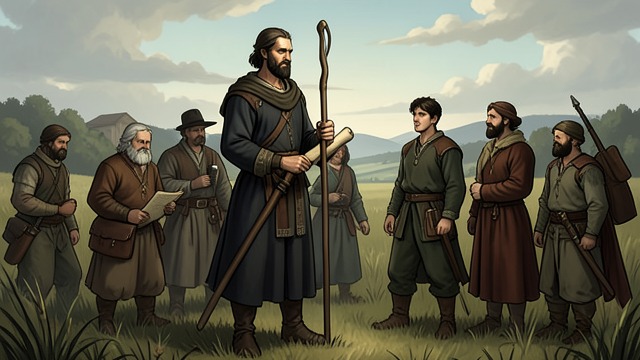
The Israelite Census on the Plains of Moab was both a count of the generation poised to enter the land and the basis for assigning its inheritance. Conducted by Moses and Eleazar after the plague, it recorded 601,730 Israelites aged twenty and older who could serve in war, while its contrast with the earlier census underscored the passing of the wilderness generation.
Setting and Purpose
The census was ordered after the plague, as Israel stood in the plains of Moab by the Jordan at Jericho. The LORD instructed Moses and Eleazar, son of Aaron, to count the congregation by ancestral houses, including those aged twenty and older who were able to go to war. The count thus presented the assembled people not only as families but as a community preparing to possess the land.
Families and the New Total
The register proceeds tribe by tribe, naming family groupings and recording their numbers. Among the totals it gives are 43,730 Reubenites, 22,200 Simeonites, and 76,500 from Judah. It also records the descendants of Dathan and Abiram within Reuben’s genealogy, recalling their rebellion with Korah: the earth swallowed them, fire consumed 250 men, and the account adds that Korah’s sons did not die.
The census totals 601,730 Israelites. Its genealogies also preserve particular family details, including that Er and Onan died in Canaan and that Serah was Asher’s daughter. The Levites were counted separately: 23,000 males from one month old and upward, because they received no inheritance among the Israelites.
Inheritance and Allocation
The count directly informs the division of the land. Larger groups are to receive a larger inheritance and smaller groups a smaller one, in proportion to their numbers; nevertheless, the land is to be assigned by lot, according to the names of the ancestral tribes. Population determines relative share, while the lot determines the allocation.
A Generation Replaced
The census is explicitly compared with the earlier count made by Moses and Aaron in the wilderness of Sinai. Not one man from that earlier generation remains among those now counted, except Caleb and Joshua, in keeping with the LORD’s declaration that the others would die in the wilderness. The new total therefore records a demographic transition as well as military readiness: the people about to inherit the land are not the generation that left Egypt.
The wider covenant teaching on the plains of Moab connects possession of the land with Israel’s obligations and future. Moses recalls the exodus and the years in the wilderness, while the covenant’s blessings and curses set out the consequences of loyalty or apostasy. Against that larger frame, the census identifies the community to whom the inheritance is apportioned and whose future is bound to its conduct.
Event 1
Event 2
Event 3
Event 4
Event 5
Event 6
Event 7
Event 8
Event 9
Event 10
Event 11
Event 12
Event 13
Event 14
Event 15
Event 16
Event 17
Event 18
Event 19
Event 20
Event 21
Event 22
Event 23
Event 24
Event 25
Event 26
Event 27
Event 28
Event 29
Event 30
Event 31
Event 32
Event 33
Event 34
Event 35
Event 36
Event 37
Event 38
Event 39
Event 40
Event 41
Event 42
Event 43
Event 44
Event 45
Event 46
Event 47
Event 48
Event 49
Event 50
Event 51
Event 52
Event 53
Event 54
Event 55
Event 56
Event 57
Event 58
Event 59
Event 60
Event 61
Event 62
Event 63
Event 64
Event 65
Event 66
Event 67
Event 68
Event 69
