“Fly the fangs of Belisarius!”
Uncle Silas“Fly the fangs of Belisarius!” is the warning Maud Ruthyn believes she hears after writing down a Latin reference to Belisarius, a moment that turns an act of private sympathy into an unsettling possible premonition. The voice is never confirmed as supernatural: Mary Quince denies speaking, Maud recognizes the experience as a trick of imagination, and yet its unexplained force lingers in the changed encounter with Silas Ruthyn the next morning.
The phrase and its immediate context
Maud has been looking at a print of a girl fleeing wolves. The image’s towering, interlaced trees remind her of Windmill Wood, where she and Millicent Ruthyn had often walked; the girl’s flight and the pursuing pack lead her thoughts to a print of Vandyke’s Belisarius. On an envelope, she idly writes the beginning of the Latin inscription associated with the image, “Date obolum Belisario!” Her father had translated it for her, and the note serves both as a memory exercise and as an expression of the compassion she invariably feels for Silas Ruthyn in his fallen and miserable state.
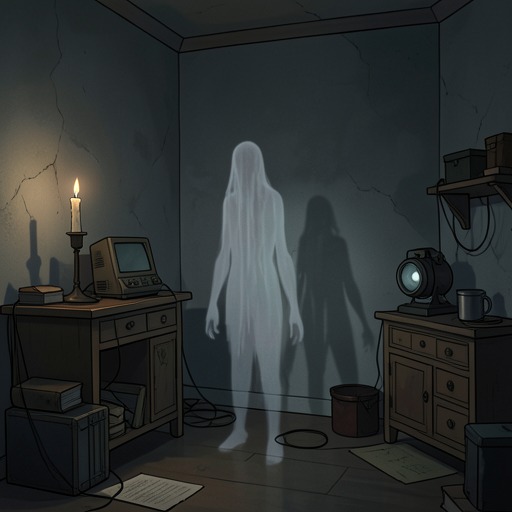
The printed scene supplies a chain of associations rather than an explanation. The hunted girl, the wolves, and the remembered Belisarius converge in Maud’s mind; then, as she looks again at the fleeing figure and the pursuing pack, she thinks she hears a stern whisper near the hearthstone: “Fly the fangs of Belisarius!” The warning transforms the earlier Latin note into something that sounds like an answer to her thoughts, while leaving its speaker uncertain.
A voice without a witness
Maud turns sharply to Mary Quince and asks whether she spoke. Mary rises from her work by the fireside, staring with a mixture of fear and curiosity, but plainly denies having uttered the words. There is therefore no corroborating witness to the voice. Maud herself concludes that it must have been a trick of the imagination, yet says that she could recognize its clear, stern sound among a thousand if it spoke again.
That coexistence of rational explanation and enduring certainty gives the expression its particular tension. The scene does not establish a ghost, an external warning, or any other supernatural cause. Instead, it preserves Maud’s sensory conviction alongside her judgment that her mind deceived her, allowing the phrase to remain suspended between inward experience and possible omen.
Silas’s altered manner
The morning after a night of broken sleep and agitation, Maud is summoned to Silas’s room. He is gentle, kind, smiling, and submissive as usual, but she senses a new discomfort between them. His manner suggests to her that he now feels toward her the same half-superstitious repulsion she has long felt toward him. When he thinks she is not watching, he fixes his eyes grimly on her; when she looks back, he turns them to the book before him and speaks as if reading aloud.
Maud cannot identify a tangible cause for this withdrawal. She knows that Silas remains kind and understands that she longs to serve him, so she wonders whether his expression signals shame or even horror rather than dislike. The narrative places his changed looks immediately after the voice, but does not prove that he heard it or that the imagined words caused his reaction. That unresolved sequence lets the phrase function as an interpretive hinge: the warning may be only Maud’s own mental event, yet the next encounter makes its significance feel difficult to dismiss.
Compassion turned toward danger
The Latin inscription recalls Belisarius as a figure of fallen misery and links Maud’s sympathy for Silas to the plight of the hunted girl in the print. Against that compassion, the imagined command to flee introduces a sharper possibility: pity may not protect Maud from the person she wishes to help. The phrase does not settle whether Silas is dangerous, nor does the evidence identify Belisarius as a literal person or force within the scene. Its importance lies in the contrast it creates between Maud’s impulse to aid her uncle and a voice that sounds like a warning to escape.
The episode also makes uncertainty part of the novel’s method. A remembered classical allusion, an image of pursuit, a voice without a speaker, and Silas’s unreadable gaze gather around one another without resolving into a single explanation. “Fly the fangs of Belisarius!” thus marks the point at which Maud’s compassion and her apprehension occupy the same moment, while the cause of that apprehension remains unknown.