Austin Ruthyn
Uncle SilasAustin Ruthyn is Maud Ruthyn’s father, a wealthy heir of an ancient family whose will shapes the novel’s central conflict. Secluded, taciturn, and difficult to approach, he nevertheless loves Maud and entrusts her future to an arrangement intended to clear his brother Silas Ruthyn’s name. That trust becomes dangerous because it gives Silas control over Maud’s person while making her death before adulthood financially advantageous to him.
Identity and Background
Austin belongs to the Ruthyn family of Knowl, whose members had refused titles and regarded their lineage as superior to much of the nobility. Maud knows little of this family pride beyond the stories told by old retainers. Her father had pursued political ambition in Parliament, but failed there; afterward he travelled abroad, became a collector and connoisseur, and took part in literary, scientific, and charitable institutions. He eventually wearied of public activity and lived a secluded country life, moving between his properties rather than pursuing the life of a sportsman.
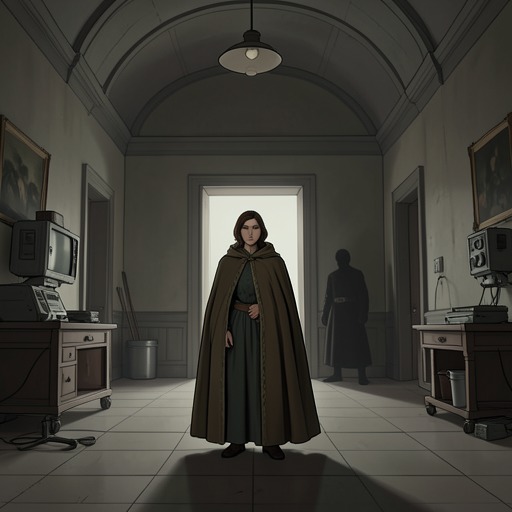
He married late. His young wife died after giving birth to Maud, their only child, and the bereavement made him more taciturn and, toward others, more severe. Maud understands that he loves her, though his tenderness is not conveyed through familiar expressions. His manner is so reserved that she rarely dares address him unless he speaks first. When he appears unexpectedly beside her, his imposing presence and silence make him seem almost like a recurring apparition in her thoughts.
Trust in Silas and the Family Scandal
Austin’s attitude toward Silas is shaped by a family scandal and by his determination to defend his brother. Silas had been suspected in a case that damaged his reputation; Monica Knollys explains that local gentlemen disliked his politics and resented his response to their treatment of his wife. Austin, however, never suspected Silas. He regarded the accusation as a politically motivated slander, made more plausible by Silas’s poverty and imprudence, and remained convinced of his brother’s innocence.
As Austin’s health failed, he asked Maud whether she would make a sacrifice to clear the family name. He considered Silas’s eventual survival and position as representative of the family, and Maud’s response showed her willingness to help. Austin’s request gives his later legal arrangements a purpose beyond inheritance: he means to make confidence in Silas public and to leave the family’s judgment of his brother on record.
Death and the Will
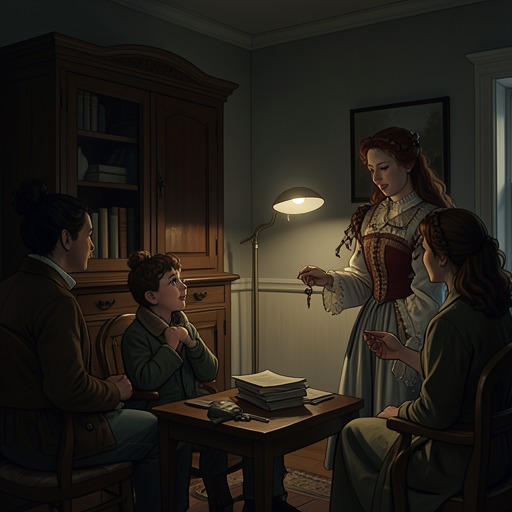
Austin knows that a serious aneurysm near his heart may prove fatal, but fears telling Maud directly. Instead, he hints at his approaching death through an allegory of a journey. His death is sudden, although the condition had been detected earlier by Doctor Bryerly. Maud initially cannot accept that he has died and insists that a doctor be summoned. In retrospect, she understands that the allegory concealed both the reality he could not bring himself to state plainly and words of consolation that remain with her.
The will places Austin’s estates, interests, possessions, and other property in the hands of four trustees, including Lord Ilbury and Hans Emmanuel Bryerly, for Maud’s benefit. It provides Silas with a legacy of £15,000, gives each of Silas’s two children £3,500, and grants him the use of Bartram-Haugh and adjoining lands for life at an annual rent of five shillings, subject to conditions against waste. Monica Knollys receives £1,000, and Doctor Bryerly £3,000 in recognition of his work as trustee.
The consequential provision appoints Silas Maud’s sole guardian, with full parental authority until she reaches twenty-one, and requires her to live under his care at Bartram-Haugh. The trustees are to pay him £2,000 annually for her maintenance, education, and expenses. Doctor Bryerly points out the arrangement’s sharpest danger: if Maud dies before coming of age, the entire property passes to Silas, while he has custody of her in the meantime. The will thus separates legal management of the estate from Maud’s practical control over her own life, placing both her residence and personal authority in her uncle’s hands.
The Will as a Public Vindication
Austin’s private letters to the trustees explain why he chose so unusual a guardianship. He calls Silas an oppressed and unhappy brother and says that appointing him guardian will show the world, or at least later generations of the family, that the brother who knew him best trusted him. Austin calls the arrangement an ordeal of purification: if Maud dies under age, Silas inherits what Austin owns; meanwhile, Silas alone has custody of her person. The other trustee letters share this defence.
For Austin, the will is therefore both a legal instrument and a public statement about Silas’s character. Its language of trust seeks to answer the scandal by making Silas’s conduct toward Maud a test of the confidence placed in him. Yet that design binds a vulnerable minor’s welfare to the very person whose reputation it is meant to restore. Maud later reads the letters and feels that, by hesitating to accept the arrangement, she has frustrated her father’s purpose and broken faith with him. Her distress shows how powerfully Austin’s moral intention continues to govern her understanding of the guardianship, even after his death.
Afterlife in the Story
Austin’s influence persists through the contrast between his trust and what Maud experiences at Bartram-Haugh. The grand house is marked by disuse and restrictions: high locked hatches interrupt the corridors, and rooms remain shut under Silas’s orders. In one chamber Maud remembers that Charles Charke killed himself. Later, when confined in a bedroom, she finds iron bars fixed across the windows and the frames screwed shut; the room has been converted into a prison. The resemblance between a place entrusted to Silas as Maud’s home and a house capable of restricting her movement lends the will’s guardianship provision a bleak consequence that Austin’s confidence did not anticipate.
Silas presents himself as a man striving to follow the Bible’s injunction against judgment, invoking the principle while defending his treatment of others. But when Doctor Bryerly challenges his handling of the estate, he argues that Silas is exercising a power he does not lawfully possess and thereby impoverishing Maud’s inheritance. Monica likewise reports that Silas has claimed money from Austin’s legacy for Dudley’s debts; Maud resists condemning him, insisting that he may believe he is entitled to cut timber at Bartram-Haugh. These disputes expose the gap between the protective and rehabilitative purpose Austin assigns to the trust and the contested exercise of authority after his death.
Austin remains significant less as a continuing actor than as the moral and legal origin of the plot’s predicament. His affection for Maud is real, but his attempt to vindicate Silas makes her safety part of an experiment in family honour. The will survives him as a structure of competing meanings: a brother’s declaration of confidence, a trustee’s charge, an inheritance with conditional consequences, and the source of Maud’s enforced dependence on Silas.