Bartram-Haugh
Uncle SilasBartram-Haugh is the Ruthyn family’s great house in Derbyshire, but under Silas Ruthyn it becomes more than a residence: it is the place where Austin Ruthyn’s will concentrates control over Maud, and where the domestic space of guardianship turns into confinement. Its grand but neglected architecture, locked passages, and concealed window mechanism give the house a double character—as inherited property and as an instrument of secrecy and coercion.
Estate, Inheritance, and Guardianship
Austin Ruthyn’s will grants Silas the use of the mansion-house and adjoining lands for his natural life, at an annual rent of five shillings and subject to restrictions on waste. The wider estate is held in trust for Maud, while Silas receives a bequest of £15,000 and each of his two children £3,500. The will thus distinguishes Silas’s lifetime occupancy from Maud’s beneficial interest in the property, even as its provisions make her dependent on him in practice.
The will also appoints Silas Maud’s sole guardian, giving him parental authority until she reaches twenty-one and requiring her to live under his care at Bartram-Haugh. The trustees are to pay him £2,000 each year for her maintenance, education, and expenses. Austin explains the arrangement as an ordeal intended to vindicate his brother against the scandal that had marked him: he says that Silas’s custody of Maud and the possibility that Silas would inherit the property if she died under age should demonstrate the confidence of the brother who knew him best. The design binds Maud’s safety, Silas’s reputation, and his financial interest together.
Silas refuses to give up the guardianship when the acting trustee seeks to change the arrangement. He presents his refusal as a conscientious duty: renouncing an office solemnly assigned by the will, he argues, would be improper, while withdrawing at the trustee’s request would amount to public self-condemnation. Bartram-Haugh is therefore not merely the residence named in the will; it is the physical setting in which a contested legal arrangement becomes daily authority over Maud’s person and movements.
Approach and Architectural Character
Maud and Mary Quince travel through the Derbyshire mountains, only to learn that they still have forty miles to go. On arrival, they encounter a great iron gate set between tall, fluted white-stone piers, their old family arms weathered until they seem almost indistinct. The gate and piers frame the estate as a threshold into a separate world, and the moonlit approach makes the house appear at once imposing and strangely remote.
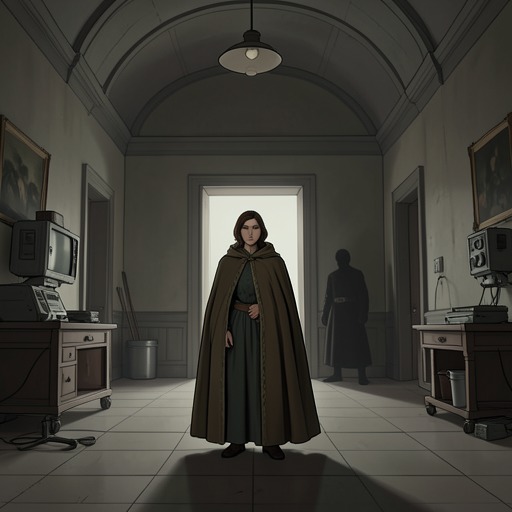
The mansion itself retains its elaborate exterior—pillars, carved decoration, a balustraded summit—but the grounds show neglect. Two storm-felled trees lie in the courtyard, while weeds and grass have spread through the approach. The narrator notes that Austin had prevented the house from falling into actual ruin: its roof, windows, masonry, and carpentry remained in repair. Yet the scale of the building and the poverty visible within it produce a different kind of desolation. Much of the house is uninhabited; dusty galleries and long corridors lead into dark, little-used spaces that make its apparent grandeur feel abandoned rather than secure.
The interior’s layout makes exploration difficult. Rooms along one side of the great gallery have their shutters closed and doors locked; Milly does not open the windows because Silas has ordered that things remain undisturbed. High gates divide the corridors and galleries, with some locked across passages to stop movement through the house. These barriers render the mansion’s size consequential: its many rooms do not offer freedom to explore or retreat but are partitioned by restrictions imposed from within.
Household Secrets and Restricted Space
The house carries the memory of an earlier death. Maud is told that Mr. Charke killed himself in one of its rooms, perhaps the very room where panelling has been removed from the wall. The uncertainty over the precise room does not erase the association; instead, it makes the building’s surfaces and closed spaces seem to hold an unresolved history. Later evidence about Charke’s death gives that history a different meaning.
Silas’s household also reflects the financial pressures behind its outward appearance. Dudley complains that his father has no money to give him, that the trustees will not provide funds until they have an opinion, and that Silas knows of his debts and legal bills. He threatens to sell his father’s books and jewels. Elsewhere, felled oaks marked with red chalk and Roman numerals suggest that timber from the estate has been cut and may have been sold. Maud regards the loss of the old trees as the disappearance of a family inheritance whose history cannot quickly be restored. Doctor Bryerly argues that Silas is exercising a power he does not lawfully possess and thereby impoverishing the estate to Maud’s detriment; Silas responds by forbidding Bryerly to enter the house or grounds during his lifetime.
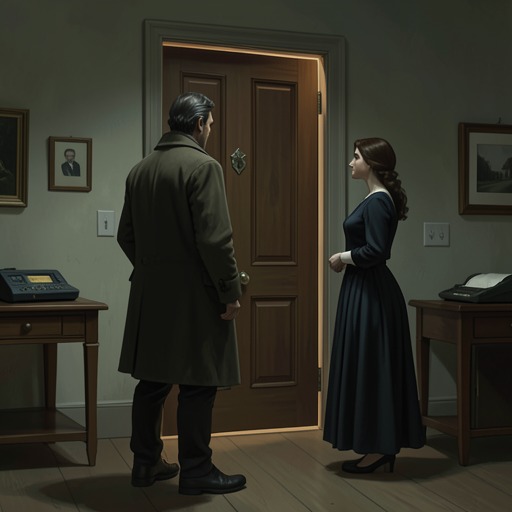
The house’s authority becomes especially stark when Maud is returned there without the ordinary household being aware of her arrival. She discovers that the door of her room is locked and that the windows are secured with iron bars and screwed shut. These precautions apply only to the windows available to her, making the room a prison rather than a general household safeguard. The remembered image of Bartram-Haugh’s lofty walls as an impassable barrier condenses the change: the estate that the will designated as Maud’s place of residence has become the boundary enclosing her.
The Concealed Window and the Resolution of a Mystery
A later revelation connects the house’s architecture to both Maud’s confinement and the old mystery of Mr. Charke’s death. During the night in Maud’s room, a man descends from the roof on a rope. He works at the side of the window, and a section containing the bars swings open with him; Maud recognizes the intruder as Dudley Ruthyn. The episode establishes that the apparent security of the room is deceptive: its window can be opened from outside through a hidden construction.
After Lady Knollys describes how Dudley entered Maud’s room, Doctor Bryerly examines the windows of the room where Mr. Charke had slept on the night of his murder. He discovers powerful steel hinges sunk into the window-frame and concealed in its timber. An iron pin on the outside secures the window; once removed, the window can swing open. The room where Maud had been placed has the same device. This discovery explains how someone could enter despite the room’s apparently secured state and resolves the question of how Charke’s room could have been accessed.
The architectural revelation also changes the meaning of the house’s locked and barred spaces. Bartram-Haugh’s defenses are not simply barriers protecting its occupants: hidden fittings allow secret entry even as doors and windows restrict those held inside. The same domestic fabric that helps conceal an earlier crime can facilitate a later intrusion, making the mansion’s apparent boundaries unreliable.
From Family Seat to Prison and Crime Scene
The estate’s inner court becomes the final repository of a concealed crime. After Dickon Hawkes is arrested and convicted on an older charge, he discloses the circumstances of the Frenchwoman’s death. Her body is found where he indicates, buried in the inner court of Bartram-Haugh, and after a legal inquiry is interred in the churchyard at Feltram. The disclosure confirms that the mansion’s secrets extend beyond Maud’s confinement and that its private grounds have been used to hide a body.
Maud reflects that the plan surrounding her return had been designed to keep her fate secret. Only a small group would have known what happened to her; Monica Knollys had been led to believe that Maud had gone to France, preparing her for Maud’s silence. If Maud had been killed, the body might have remained undiscovered for a long time, and suspicion might never have returned to Bartram-Haugh. Her imagined grave is the same inner court where the Frenchwoman’s remains are eventually found. The parallel makes the estate’s geography central to the threat: its secluded spaces offer concealment, while the eventual discovery turns them into evidence.
Bartram-Haugh’s importance lies in the way its architecture gives material form to the novel’s conflict over inheritance and authority. The will places Maud under Silas’s care there; the neglected scale of the house and the household’s financial pressures complicate its status as a home; locks and barriers restrict movement; and a concealed hinge overturns the security suggested by the rooms’ appearance. By the time the inner court yields the hidden body, the mansion has become not simply a family seat but a place where legal power, domestic control, and concealed violence occupy the same ground.