Derbyshire
Uncle SilasDerbyshire is the county setting for the Ruthyn family’s country estates and a decisive landscape in Maud’s story. It first appears as a name Maud has to explain to Madame de la Rougierre; it soon becomes the destination imposed by Austin Ruthyn’s will, the setting of Maud’s arrival at Bartram-Haugh, and the home of Monica Knollys. Across these places, the county’s ancestral properties are not merely scenery: their ownership, upkeep, and use are bound to guardianship, family reputation, and debt.
A county made personal
When Madame asks whether Maud’s older relative is wealthy, Maud can offer only that she has a place in Derbyshire. Madame asks whether Derbyshire is an English county, prompting Maud to repeat that she has already named it and then recite the county’s principal towns and rivers from her geography. The exchange gives Derbyshire an early, matter-of-fact introduction, while hinting at how little Maud knows of the wider family and the places associated with it.
Later, Maud confirms that her uncle Silas lives in Derbyshire. Lady Knollys explains that Silas, as the younger brother, had little more than a thousand a year, and that his gambling losses led Austin to pay large sums for him. The county thus becomes linked not only to inherited property but also to a family history of financial dependence and squandered means. Silas’s reputation and present circumstances are set against the wealth of Austin’s estate, making the geography inseparable from the unequal fortunes of the brothers.
Inheritance and guardianship
Austin’s will places the county at the center of Maud’s legal and personal future. He leaves the bulk of his property to four trustees, in trust for Maud, while bequeathing Silas £15,000 and £3,500 to each of Silas’s two children. He also grants Silas the use of Bartram-Haugh and neighboring Derbyshire lands for his natural life, for an annual rent of five shillings and subject to restrictions on waste. The arrangement distinguishes Maud’s beneficial inheritance from Silas’s life interest in the estate and land.
A separate provision makes Silas Maud’s sole guardian, with full parental authority until she reaches twenty-one. She must live under his care at Bartram-Haugh, and the trustees are to pay him £2,000 a year during the guardianship for her maintenance, education, and expenses. The will’s private explanation describes this arrangement as an ordeal intended to vindicate Silas against slander: if Maud dies before coming of age, the entire property will pass to him. The provision therefore binds Maud’s physical custody and her inheritance to Silas’s reputation and financial interest. Doctor Bryerly warns that the combination is extraordinary and troubling; the legal structure turns Derbyshire into the place where a test of trust is to be enacted.
Bartram-Haugh: grandeur and neglect
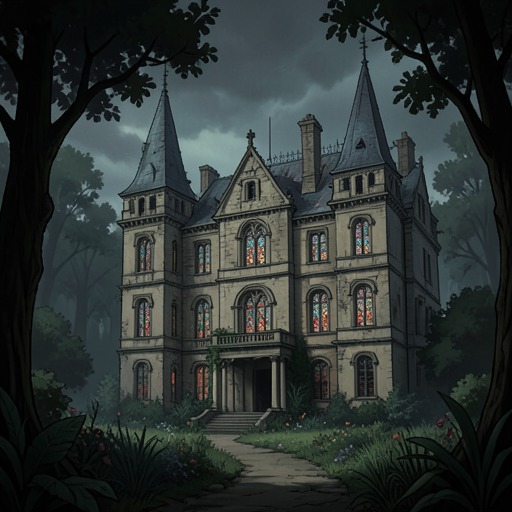
Maud’s arrival presents Derbyshire through the approach to Bartram-Haugh. The carriage passes a long park wall and enters through a broad, fantastic iron gate flanked by tall, weathered stone piers bearing the Ruthyn arms. Beyond it, a wide avenue runs between ranks of forest trees toward the house. Under moonlight, the elaborate white-stone frontage, fluted pillars, carved doorway, and balustraded roof appear impressive, but the building is stained and moss-grown. Two storm-felled trees lie in the courtyard, and weeds and grass interrupt the formal space.
The contrast between architectural magnificence and visible neglect continues inside. Austin had prevented actual structural decay by maintaining the roof, windows, masonry, and carpentry, but poverty and disuse remain evident: much of the immense house is uninhabited, and long corridors and galleries recede through dust and silence. The scale of the building makes it easy to imagine losing one’s way. Derbyshire’s principal family residence thus embodies a divided condition: the house remains grand and intact, yet its unused spaces and neglected grounds register the strain on the family’s resources.
Other homes and contested resources
Derbyshire also contains the contrasting home of Monica Knollys. On the journey to visit her, Maud and Milly cross the county’s moors and enter a wooded hollow, where Monica’s gabled house appears sheltered among old timber. Maud associates the residence with generations of family life, hospitality, and remembrance. Set against Bartram-Haugh’s imposing but neglected scale, Monica’s house offers a different domestic image: continuity made welcoming rather than forbidding. The contrast matters because access to Monica is a source of companionship for Maud, even as Silas later restricts her freedom to seek outside support.
The county’s land is also a material asset under pressure. Maud passes rows of barkless oak trunks, some squared by hatchets and marked in red chalk with letters and Roman numerals. She understands that the timber may have been sold and mourns the loss of trees that had adorned Bartram-Haugh for centuries, although she is not certain that Silas’s action is unlawful. In a separate confrontation, Doctor Bryerly argues that Silas is exercising a power he does not lawfully possess and thereby impoverishing the estate to his own benefit. The dispute reveals the difference between legal authority, present control, and the preservation of inherited property.
Financial need becomes explicit when Dudley complains that Silas has no money to give him, that bills and lawyers are pressing, and that the trustees will not release funds without an opinion on the matter. He threatens to sell Silas’s books and jewels. Later, Silas refuses Maud’s offer of financial help, saying that accepting it could expose him to the suspicion that he had unduly influenced her; he says an execution may reach the house within three weeks. Dudley, in turn, offers to take Maud out of Bartram and place her with Monica or wherever she chooses if she gives him a written promise of £20,000. These episodes make Derbyshire’s estates a setting where family affection, legal claims, debt, and access to money repeatedly collide.
Narrative significance
Derbyshire gathers the novel’s central tensions into a recognizable region of ancestral houses and country land. Bartram-Haugh is at once Silas’s residence, the property he may use for life, and the place where Maud must live under his authority; the surrounding estate is also vulnerable to financial pressure and dispute. Monica’s more inviting home provides a counter-image and a possible refuge, but it does not erase Maud’s dependence on the will’s arrangements.
The county’s changing aspect—from a geography lesson and a distant family address to a moonlit approach, an immense house, a welcoming gabled residence, and marked timber awaiting removal—gives material form to the story’s movement from inheritance toward confinement and conflict. Derbyshire is not simply where the family lives: it is the landscape on which the will’s promise of trust is tested, and where property’s apparent grandeur coexists with debt, restricted freedom, and uncertainty over who has the right to use or preserve it.