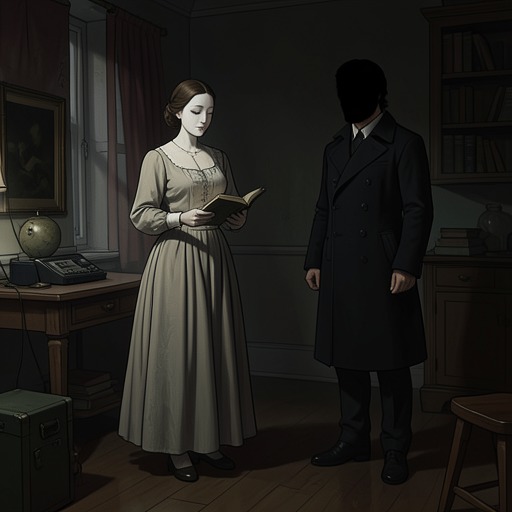
Doctor Jolks
Uncle SilasDoctor Jolks is the physician whose clinical authority repeatedly intersects with the danger and uncertainty at Bartram-Haugh. Pompous in manner but capable of practical care, he treats Silas Ruthyn’s coma, helps arrange aid for Meg Hawkes, and offers Maud a rational explanation for her terror of a ghost; after Maud has escaped, his testimony establishes the official finding that Silas died from an accidentally administered overdose of laudanum.
Identity and Manner
Doctor Jolks is introduced as a small-town practitioner with a ceremonious, self-important manner. His formal bow and murmured introduction make an impression on Maud, who finds him suave and pompous and wishes for a more bustling doctor who might get through the business faster. The contrast between his elaborate manner and the urgency of the household’s medical crisis frames him as both a comic social presence and an important source of information.
His speeches reinforce that impression. When he explains Silas’s condition, he emphasizes the severity of the coma, his own intervention, and the patient’s poor habits in a succession of confident medical pronouncements. His manner can seem theatrical, yet the account conveys a genuine crisis: Silas has been dangerously unresponsive, and Jolks says that he resorted to bleeding him freely. The doctor’s assurance that the treatment worked as hoped does not make Silas well; it marks only his passage out of immediate peril.
Treatment of Silas Ruthyn
Jolks tells Maud that Silas has suffered an obstinate coma and has been in a highly critical state. He declares that Silas would have died without an extreme remedy, and credits the bleeding with a favorable effect. At the same time, he describes Silas’s habits as destructive and warns that medical efforts cannot end satisfactorily if the patient will not cooperate. The diagnosis thus presents Silas’s illness not as an isolated episode but as part of a pattern of self-damage.
The crisis briefly appears to resolve. The following morning, Jolks reports Silas out of danger but very weak, and Maud and Milly see him. His recovery is therefore qualified from the outset: the danger has receded, but his weakness and habits remain. Later, after Maud’s flight, the doctor’s role shifts from treating Silas during life to certifying the circumstances of his death.
Care for Meg Hawkes
Jolks also attends to Meg Hawkes, whom he identifies as being on his dispensary list. When Maud and Milly encounter him near Windmill Wood, he is going to see the sick girl. His brief reference to his notebook makes the visit part of his ordinary professional rounds, in contrast to the more dramatic medical emergencies inside Bartram-Haugh.
The circumstances he finds are grave: he considers Meg very ill and fears that she is utterly neglected. He says she should be taken to hospital if she were strong enough, but recognizes that she is not. Maud offers to pay for a nurse and for whatever comforts might help. Jolks accepts the practical proposal, undertakes to send a nurse from Feltram with supplies, and calls Dickon Hawkes to the yard gate, apparently to inform him of the arrangement. His part in this episode is modest but consequential: Maud’s concern becomes concrete assistance through the doctor’s local connections and medical judgment.
Maud’s Terror and the Ghost
After a night of intense fear, during which Maud weeps, starts and screams, and is given sal-volatile, Jolks visits her as well as Silas. He pronounces her hysterical, questions her closely about her hours and diet, and asks what she ate the previous day. His intervention is both medical and interpretive: instead of accepting the ghost as supernatural, he confidently dismisses that explanation and prescribes a regimen that excludes tea, adds chocolate and porter, and requires earlier hours.
Jolks promises that if Maud follows his directions she will never see a ghost again. His certainty gives her something reassuring to hold onto, and a few days later she feels much better. His contemptuous rejection of the ghost theory helps her develop doubts about whether the apparition was real, though it does not erase her fear: she remains unable to speak or think about the room where it appeared. The episode shows the limits as well as the immediate usefulness of his explanation. He offers a practical routine and a calmer account of the experience, but Maud’s continuing aversion outlasts the treatment.
The Visit That Was Not What It Seemed
During Maud’s later confinement, Madame de la Rougierre tells her that Doctor Jolks has arrived to see Silas. Maud hears a woman’s voice and challenges this account, but Madame insists that only the doctor is there and affects to watch him get out of his carriage. The scene gives Jolks a brief, indirect presence: his expected medical visit supplies the cover for Madame’s explanation, while the discrepancy Maud hears makes the household’s information difficult to trust. Nothing in the episode establishes that Jolks participates in Madame’s deception; its importance lies in the use of his familiar role as a physician to make her account sound plausible.
Silas’s Death and the Inquest
More than two years after her escape, Maud learns what happened at Bartram-Haugh. Old Wyat found Silas dead on the sofa, with his scent-bottle spilled on the table, and sent the old butler for Doctor Jolks. Jolks said Silas had died from too much laudanum. The detail of the overturned bottle connects the death to a substance already associated with Silas’s troubled condition, while the doctor’s diagnosis supplies the first medical account Maud receives after leaving the household.
At the inquest, Jolks is the chief witness. The finding is that Silas died from an excessive dose of laudanum accidentally administered by himself. His testimony thereby helps establish the official conclusion, distinguishing the death’s legal explanation from the wider suspicions and crimes surrounding Bartram-Haugh. The account also leaves a tension intact: Jolks’s evidence defines how the death was judged, but Maud’s retrospective narrative sets that finding beside Silas’s dangerous habits and the sinister history of the house.
Narrative Role
Jolks is a recurring figure of medical explanation within a story saturated with uncertainty. He names Silas’s coma, attends to Meg’s illness, and treats Maud’s ghostly terror as hysteria; in each case he tries to translate distress into bodily condition and practical response. His confidence can reassure, particularly when Maud is frightened, yet the narrative does not make medical assurance a universal resolution: her fear persists, and Silas’s recovery from coma is temporary in the larger course of his life.
His final importance is evidentiary rather than curative. As chief witness at Silas’s inquest, he gives official weight to the accidental-overdose verdict. Across these episodes, Doctor Jolks stands at the boundary between private suffering and public explanation: he treats what he can, offers interpretations that shape how others understand illness and fear, and ultimately helps turn a death within the secrecy of Bartram-Haugh into a formally recorded cause.