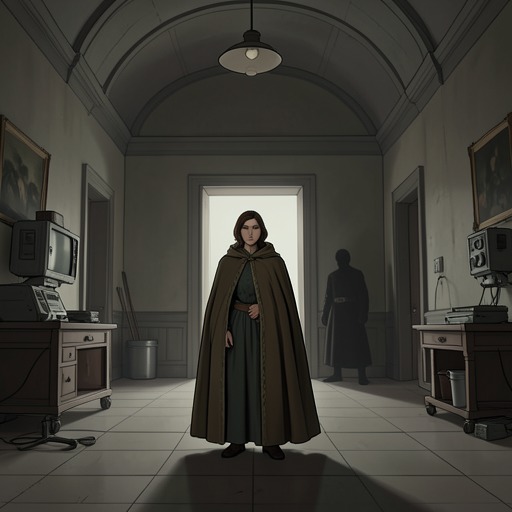
Madame de la Rougierre
Uncle SilasMadame de la Rougierre is Maud Ruthyn’s governess, an apparent instructor whose access to the young heiress becomes a means of surveillance and intimidation. Her repeated appearances—from her arrival at Knowl, to her night-time search of Austin Ruthyn’s desk, to her return at Bartram-Haugh—make her one of the most persistent human threats in Maud’s life. Her eventual death and the later discovery of her body confirm that the danger surrounding Maud has culminated in a concealed crime.
Identity and Introduction
Madame de la Rougierre enters the story when Maud’s father, Austin Ruthyn, tells her that he has appointed a governess who is highly recommended and qualified. Maud’s response is immediate foreboding: she already dislikes and distrusts the woman, and fears her before the appointment has even taken shape in daily life. The gap between the reassuring recommendation and Maud’s instinctive alarm establishes the tension that follows her through the novel.
Her identity is not as straightforward as her title suggests. Years later, Monica Knollys recalls seeing a woman selling stones and trinkets in a shop, including a pearl cross, and recognizing her as Mademoiselle Blassemare, a person Monica had previously pointed out to Maud at Elverston. The revelation is that Mademoiselle Blassemare and Madame de la Rougierre are the same person. The assumed name and concealed past make her a figure of deliberate disguise rather than merely an unsettling governess.
At Knowl: Information and Intrusion
Madame’s interest in Maud is bound up with the terms of Austin’s will. She urges Maud to reveal what the document contains and when it was written, presenting the information as something that would benefit Maud. The questions turn a relationship that should be based on teaching and care into an attempt to obtain privileged knowledge from a child whose inheritance and future guardianship are at stake.
The will’s provisions explain the stakes of that curiosity. Austin leaves his estates and possessions to four trustees, while appointing his brother Silas Ruthyn as Maud’s sole guardian until she reaches twenty-one. Maud is to live under Silas’s care at Bartram-Haugh, and the trustees are to pay him £2,000 each year for her maintenance, education, and expenses. Austin describes the guardianship as an ordeal intended to vindicate Silas against slander: if Maud dies before coming of age, the property passes to Silas. Madame’s probing therefore concerns a document that gives Silas authority over Maud’s person while tying his financial interest to her survival and inheritance.
Monica Knollys recognizes the danger in Maud’s position and warns her that Madame is likely to be a deep, daring, and unscrupulous enemy. The warning reframes Madame’s apparent domestic role: she is not simply a harsh teacher but a person whose presence may threaten Maud’s safety. Monica’s insistence that Maud stop behaving like a child and guard herself makes explicit the vulnerability created by the governess’s access.
That access becomes especially stark in the night-time search of Austin’s desk. Madame enters Maud’s room still dressed in the Chinese silk she had worn during the day, without shoes, and carrying a candle. She goes to Austin’s desk, tries a key, and blows through its wards. The scene turns the governess’s interest in the will into a physical attempt to open a private repository of papers. Austin later confronts her with the accusation that she was seen entering the room with a key and reading his letters and documents. He demands the key and any false keys she possesses, threatening to search her belongings and prosecute her if she refuses.
Threat and Recognition
Madame’s danger is not limited to secrecy or manipulation. During an attack on Maud, she holds Maud’s arm and urges her to come along, while a tall man restrains Maud and tries to suppress her cries. Maud breaks away from Madame, struggles, and screams. Madame’s presence alongside the man makes her an active participant in an attempt to control Maud, rather than a bystander to someone else’s violence.
The consequences of that fear persist in Maud’s perception. Having previously mistaken accidental arrangements of light and shadow for apparitions, Maud tries to approach another apparent figure in the same rational spirit. This time, however, she becomes certain that the face she sees is Madame’s. Later, in a chamber at Bartram-Haugh, she opens a door and finds Madame’s large figure before her. The repetition of the face as both apparition and unexpected living presence binds supernatural uncertainty to the concrete history of Madame’s pursuit: whether Maud is confronting a shadow or a person, the image that terrorizes her is the same.
Return to Bartram-Haugh
Madame resurfaces at Bartram-Haugh after Maud has been brought there under the terms of Austin’s will. She explains that Silas wrote to the superior of a religious house seeking a governess to accompany a young lady on a journey, and that she was sent for the position. Her explanation gives her return an institutional pretext, but it does not resolve the history Maud carries with her.
When Maud reports what she knows, Madame denies the account, swearing solemnly and pleading with clasped hands and tears that Maud withdraw it. Maud, in turn, insists to Silas that her story is true. The confrontation stages the conflict between an accusation grounded in Maud’s experience and Madame’s dramatic performance of innocence. Afterward, Maud encounters Madame as if nothing has happened, hearing her talk and seeing the results of her shopping while feeling as though she were moving through a dream. The outward continuation of ordinary household life does not erase the accusation; it leaves Maud to live alongside the person she says has endangered her.
Madame is also present when Maud’s confinement and removal are being managed. On the journey that brings Maud back to Bartram-Haugh, Madame is dressed for travel and veiled, while Silas receives Maud with an austere, rejecting manner. Maud’s realization that she has arrived at Bartram-Haugh is accompanied by the question of how the journey was accomplished. Madame’s place in this return connects her earlier role as governess to the larger machinery keeping Maud under Silas’s control.
Death and Narrative Significance
The account of the final plot reveals that Madame herself has been deceived about the plan. She believes Maud is to be taken that night to a remote, safe place and expects generous compensation for her services and later evidence. She is not trusted with the full truth, which is known to only three people. The information casts Madame as an accomplice who is useful to the scheme but not admitted to its innermost secret; her involvement does not mean she understands the whole design.
Nearly a year after the events at Bartram-Haugh, Dickon Hawkes is arrested and convicted for an older crime committed in Lancashire. In a last attempt to save himself, he discloses the circumstances surrounding the Frenchwoman’s previously unsuspected death. Her body is found buried in the inner court of Bartram-Haugh, where Dickon says it is, and is later interred in the churchyard at Feltram after a legal inquiry. The discovery confirms Madame’s death and transforms the mystery around her disappearance into a matter of criminal evidence.
Madame’s narrative function rests on the repeated collapse of trust in the roles and appearances surrounding Maud. A recommended governess becomes an interrogator about the will; a household instructor is discovered searching a desk; a returned companion denies the history Maud recounts; and a woman involved in Maud’s removal is ultimately revealed as a murder victim buried within the estate. Her story links the legal vulnerability created by the guardianship provisions to the physical isolation of Bartram-Haugh, while the delayed discovery of her body shows how thoroughly the household’s apparent order has concealed violence.