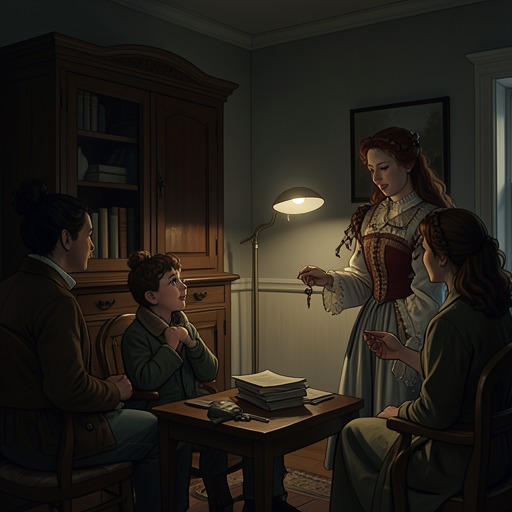
Maud Ruthyn
Uncle SilasMaud Ruthyn is the first-person narrator and central character of Uncle Silas, whose inheritance makes her both a young woman coming of age and the object of a consequential guardianship. Her father’s will sends her to live under Silas Ruthyn’s authority at Bartram-Haugh until she is twenty-one. The arrangement is presented as a test of trust and a vindication of Silas’s name, but its practical effect is to place Maud’s person and daily life in another’s hands. Her retrospective account traces how that formal protection becomes a source of peril—and how she eventually survives it.
Identity and Background
At the opening, Maud is a little more than seventeen, slight and rather tall, with golden hair and dark grey eyes. Her face is described as sensitive and melancholy; she is sitting at the tea-table in a reverie when the narration identifies her as the girl being observed. That image establishes the book’s intimate method: Maud is at once the young person inside the scene and the older narrator who can look back on her former self.
Maud is the daughter of Austin Ruthyn and the niece of Silas Ruthyn. Her father’s long seclusion and the mystery surrounding her uncle shape the family world she inherits. Before meeting Silas in person, she has known him as a vision and a problem; the first encounter makes that distant figure bodily real, but not reassuringly familiar. His pale appearance and hollow, striking eyes leave her wondering whether he is more than a shadow to her, a doubt sharpened by the spectral impression he makes on her after their first meeting.
Inheritance and Guardianship
Austin Ruthyn’s will places his property in the hands of four trustees: Lord Ilbury, Mr. Penrose Creswell, Sir William Aylmer, and Doctor Bryerly. A separate direction appoints Silas as Maud’s sole guardian, giving him parental authority until she reaches twenty-one and requiring her to reside at Bartram-Haugh. The trustees are to pay him £2,000 each year for her maintenance, education, and expenses. The division matters: Maud is the heir, but for the duration of her minority she does not directly command either her residence or the resources intended for her care.
Austin explains the provision as an ordeal intended to silence what he calls a slander against Silas. In a letter, he describes his brother as oppressed and unhappy, insists that the accusation arose from political malice, and says that the inheritance would pass to Silas if Maud died under age. He presents the guardianship as evidence that a brother who knew Silas best trusted him implicitly. The will therefore binds Maud’s safety to a public and familial claim about Silas’s character: she is not only placed in his care but made the living proof of her father’s confidence.
The risks are not abstract. Maud’s cousin Monica Knollys points out that if Maud dies before twenty-one, the property will go to Silas, who meanwhile has custody of her person. Her warning exposes the material stakes embedded in the language of trust. Maud nevertheless decides to go, saying that her father has been with her and ordered her to Bartram-Haugh. Her choice is shaped by filial loyalty and bereavement, while the authority she accepts has been fixed by a will she cannot revise.
From Knowl to Bartram-Haugh
Maud’s departure from Knowl is marked by a striking contrast between the secure familiarity of her childhood home and the uncertainty of what lies ahead. On her last morning there, the house is stripped of its usual life: many doors are locked, the servants have left, and a charwoman is washing the bare drawing-room floor. After an emotional parting with Monica, Maud leaves with Mary Quince. The journey is not merely a change of address; it is the point at which the terms of Austin’s will become the conditions of her everyday existence.
At Bartram-Haugh, Maud encounters Millicent Ruthyn, Silas’s daughter, and the uncle she has imagined for years. The first sight of Silas overwhelms the comic impressions stirred by her cousin’s eccentricities. Maud is awed by the difference between the legendary figure and the man before her, then continues to see him in her mind as a pale, spectral presence. Her account makes that uncertainty part of the reader’s experience: the question is not settled by appearance alone, and Maud’s limited knowledge becomes a source of suspense.
The danger surrounding the household is signaled before Maud can fully judge it for herself. Monica warns her that Madame de la Rougierre may be her enemy and urges her to be on her guard, describing the woman as dangerous and unscrupulous. The warning places Maud in a difficult position: she is young, has little experience of the world beyond Knowl, and is moving into a household where the people around her may not share her interests.
Judgment, Authority, and Conflict
Maud’s own temperament is presented as both a vulnerability and a capacity. During a crisis involving Silas, she contrasts herself with Millicent: Millicent, she thinks, feels her father’s danger more deeply through affection and habit, while Maud is more nervous and impetuous, with feelings that can both stimulate and overwhelm her. This self-assessment does not make her passive. It shows her trying to understand how her emotional intensity affects decisions made under pressure.
Her dependence on Silas is reinforced through the authority he exercises over communication and movement. When Maud mentions that Lady Knollys has criticized some of his actions, Silas’s expression becomes menacing. He then writes to Lady Knollys refusing her request to host Maud and Millicent, and declares that he will prevent her from again undermining his authority over his ward and daughter. The letter makes clear that Silas treats access to Maud not as a matter for her own judgment, but as a contest over who may influence her.
The conflict also reaches the management of Maud’s inheritance. Doctor Bryerly challenges Silas over his handling of the estate, saying that Silas is exercising a power he does not lawfully possess and thereby impoverishing the estate to Maud’s detriment. The dispute distinguishes guardianship from ownership: Maud’s legal and financial interests exist even as her uncle controls her daily circumstances. Her presence in these conflicts places her at the intersection of family loyalty, legal authority, and the practical question of who protects the heiress.
Maud recognizes that appearances and testimony can be manipulated. After Dudley Ruthyn makes a proposition she considers insulting, she worries that silence may allow him to misrepresent what occurred and shift blame onto her. Her concern is not simply about the encounter itself; it is about who will control its account. As narrator, she preserves the distinction between what she experienced and what others might claim happened.
Confinement, Escape, and Afterlife
At Bartram-Haugh, control becomes physical as well as familial. Maud learns that the gates are locked and that dogs are being used to prevent her from leaving. In another moment of alarm, she insists that a figure she saw was Dudley, who she believes never left in the ship as she had been led to think. She asks Mary Quince to look again and confirm what is there. The episode places Maud between observation and uncertainty: she is frightened, but she insists on the evidence of her own sight rather than accepting the account imposed on her.
When Silas announces that she will join his daughter at a pension in France, the journey is laid out in controlled stages: a night in London, travel to Dover, and passage by mail-packet. He also dictates what Maud must write to Monica and Lady Knollys, requiring him to read one letter before it is sent and prescribing an explanation for the silence that is to follow. The proposed departure is thus not simply a transfer for education; it is accompanied by close management of what Maud may communicate and what others may know of her whereabouts.
Maud’s resistance depends in part on people beyond the formal guardianship. Meg Hawkes secretly warns her not to eat or drink what is provided, offering a piece of bread and directing her to clean spring water. The warning reflects a network of overheard conversation and observation: Meg has pieced together what she has heard from her father and Dudley, though she admits she does not know everything. Maud’s escape is likewise aided by Tom Brice and Meg. As she slips from her room, Dudley is moving Madame de la Rougierre’s heavy box, which contains Maud’s jewel-case. Maud gets out to the gallery; later she and her helpers reach the steep road by the ash trees and stile, where a pursuing figure appears behind them. Escape is a change of circumstance achieved through alertness and assistance, not a restoration of the safety promised by the original guardianship.
The older Maud’s closing account confirms that the girl at Knowl has survived and entered a different life. She identifies herself as Lady Ilbury, married to a husband she describes as beloved and noble-hearted, and says that the once shy, useless girl is now a mother trying to be a good one. The last pledge has lived. This ending gives her retrospective narration a double movement: it remembers the helplessness and uncertainty of youth while speaking from a future in which marriage and motherhood have become part of her identity.
Narrative Role and Significance
Because Maud narrates her own history, the reader receives events through her changing understanding rather than through an all-knowing account. The younger Maud encounters puzzling faces, warnings, letters, and restrictions without being able to see their full significance; the older narrator can arrange those moments into a story of trust tested and authority abused. Her uncertainty is not incidental to the plot. It controls what can be known at each stage, making the distinction between appearance, evidence, and other people’s claims central to the reading experience.
Maud’s legal position intensifies that narrative limitation. She is an heiress whose property is managed by trustees, a minor whose residence is determined by her guardian, and a daughter expected to honor her father’s confidence in Silas. These roles do not neatly coincide. The will names care as its purpose, but the custody it grants gives Silas extensive power over Maud’s environment, contacts, and movement. Her story therefore examines how familial trust can be converted into institutional control, and how a young woman’s capacity to interpret and report events becomes one of the means by which she resists it.