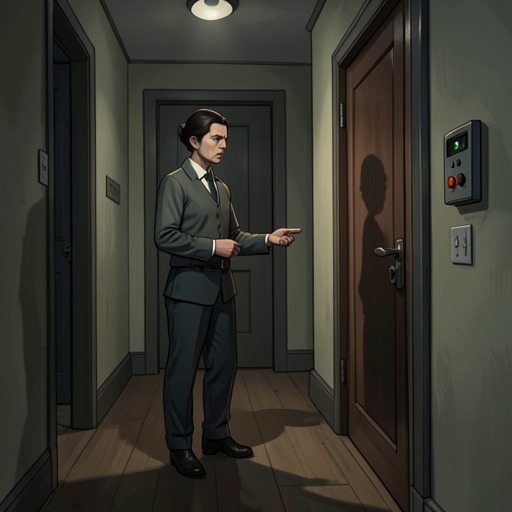
Maud's appeal to Lady Knollys
Uncle SilasMaud’s appeal to Lady Knollys is a secret letter written from Bartram-Haugh when Maud believes she can no longer trust the people around her. Its catalogue of threats turns private fear into evidence: Dudley Ruthyn has returned in secret, Madame de la Rougierre is again at the house, and Maud understands the estate’s walls, locked gates, dogs, and watchful household as instruments of confinement. The attempt to get the letter to Lady Knollys at Elverston brings that hidden crisis into the open, but its interception allows Silas to confront Maud before the plea can secure her escape.
The letter’s purpose and circumstances
Having locked her door, Maud writes to Lady Knollys in the knowledge that an escape through Feltram may fail and that much will then depend on the appeal. She asks her cousin to help her and take her away from Bartram-Haugh, describing herself as at her wits’ end and unable to decide whom to trust. The letter is not a general complaint: it is an urgent effort to reach the one relative Maud hopes might intervene.
The danger she reports is specific. Dudley has returned and is hidden somewhere on the grounds, although the household has told Maud that he sailed away on the Seamew and had his name published among its passengers. Madame de la Rougierre has appeared again, and Silas insists that she remain Maud’s close companion. By putting these concealed circumstances into writing, Maud records the discrepancy between what she is told and what she believes is happening around her.
Bartram-Haugh described as a prison
Maud’s account makes the estate’s physical boundaries part of the appeal. She calls its walls a prison, says the gates are locked against her, and reports that dogs are kept for pursuit. She also fears that her gaolers’ eyes are always upon her. These details convey not only the difficulty of leaving but the pressure of living under surveillance, where movement and communication both seem controlled.
That sense of enclosure has already been prepared by the house’s spaces. Bartram-Haugh’s long corridors contain high hatches that interrupt passage, while rooms are shut and left undisturbed by Silas’s order. The inner quadrangle, which Maud recognizes from a room she had earlier associated with Charke’s death, returns later as a disquieting point of resemblance: during the supposed journey to France, she sees a hotel court that looks just like Bartram-Haugh’s interior. The appeal’s image of the house as a prison therefore belongs to a larger pattern in which familiar domestic architecture becomes a means of disorientation and restraint.
Delivery and interception
Maud entrusts the letter to Tom Brice for delivery to Lady Knollys at Elverston and gives him a pound with it. She explicitly asks him not to carry it unless he will deliver it to its intended recipient, and to keep silent about her request. Tom hesitates because he fears Silas controls the household’s post and may open and read letters; a message carried by hand, he worries, could reveal who transported it.
The letter does not remain secret. Silas later strikes Maud’s open appeal onto the table and accuses her of bribing a servant to carry slander to Lady Knollys. The scene converts the written plea into proof of Maud’s resistance in Silas’s eyes, while showing that her effort to bypass household channels has been discovered. During her later escape, Tom tells Maud that Dickon found the letter in his pocket. The message has thus passed through several hands, and its interception helps explain why Maud’s effort to reach her cousin does not itself bring immediate rescue.
Meaning and narrative function
The appeal gathers several strands of the danger at Bartram-Haugh into one document: Maud’s wardship under Silas, Dudley’s concealed presence, Madame’s renewed access to her, and the difficulty of communicating beyond the estate. The letter makes those separate pressures legible as a single crisis, not by resolving what the household intends, but by recording what Maud knows and fears at the moment she seeks help.
Its fate also sharpens the contrast between writing as testimony and writing as a vulnerable object. Maud addresses a trusted relative, but the letter travels through servants and grounds where Silas’s influence reaches; it can be withheld, discovered, and used against the person who wrote it. As a result, the appeal marks both Maud’s attempt to act for herself and the limits imposed on that action. Its eventual disclosure confirms how difficult it is for her to create a private channel of help inside a household that controls her movement and scrutinizes her communications.