Monica Knollys
Uncle SilasMonica Knollys is Maud Ruthyn’s cousin and a determined, practical counterweight to the isolation imposed by Silas Ruthyn. She warns Maud that Madame de la Rougierre may be an enemy, challenges Silas’s control of his ward, and remains ready to offer Maud a home at Elverston. Though Silas repeatedly blocks their meetings, Monica’s care survives in visits, letters, and the refuge Maud reaches at the novel’s end.
Identity and First Meeting
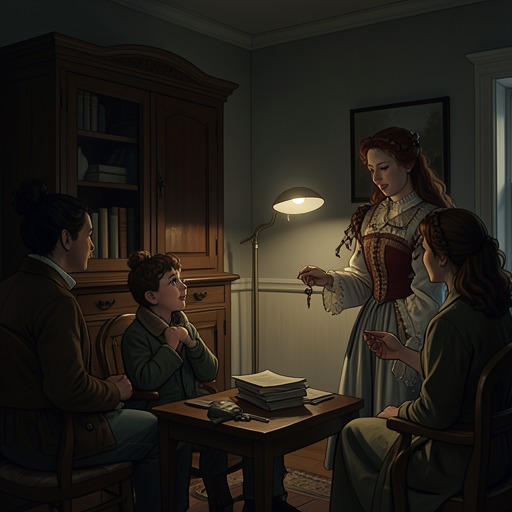
Monica arrives at Knowl with her nephew, Captain Oakley, and immediately greets Maud as a young cousin she has not seen since Maud was a small child. Her warmth is physical and unceremonious: she kisses Maud on both cheeks, brings her to the lamp to look at her properly, and compares her features with those of Maud’s mother and father. The encounter establishes a familiarity that is at once familial and newly formed; Monica remembers the family’s past, while Maud is meeting her as an adult for the first time.
Monica’s affectionate informality is paired with a sharp capacity to notice what others would prefer to conceal. When Madame de la Rougierre pretends to be asleep beneath a coverlet, Monica draws it back and recognizes the woman’s face. Her reaction changes at once from good humour to suspicion and dismay. The discovery makes Monica an early witness to the governess’s deception and shows that her sociability does not make her credulous.
Warning Maud and Leaving Knowl
Monica’s first visit ends in conflict with Austin Ruthyn. She tells Maud that she and her father have quarrelled, that she believes his decision to retain Madame is dangerous, and that she cannot stay after he refuses permission for Maud to visit her. Before leaving, she speaks to Maud as someone who must become more alert to danger: Monica believes Madame is deep, daring, and unscrupulous, and urges Maud to behave as though the woman might be capable of treachery without openly displaying distrust.
The warning is not simply a declaration of fear. Monica gives Maud a practical means of preserving their connection, asking her to write whenever she wants to hear from her and promising to come if she can be of real use. She says she is now at ease about Maud only because Maud has been warned and is on guard. Her departure therefore leaves Maud without immediate protection at Knowl, but also establishes a relationship based on continuing advice and the possibility of intervention.
Conflict with Silas and the Guardianship
After Austin’s death, Monica’s concern takes on sharper stakes. His will appoints Silas Maud’s sole guardian until she is twenty-one, gives him parental authority over her, requires her to live at Bartram-Haugh, and directs the trustees to pay him £2,000 each year for her maintenance, education, and expenses. Austin presents this arrangement as an ordeal intended to vindicate his brother against slander; Monica is among those who recognize how much power it gives Silas over Maud’s person and circumstances.
When Monica comes to Bartram-Haugh, she tries to set aside the old antagonism between herself and Silas. She says she has not come to quarrel and asks for a truce while she is there, reasoning that at their age another quarrel might make reconciliation impossible. Her approach combines conciliation with a clear purpose: she wants to see Maud and remains troubled by the guardianship. She also knows of Doctor Bryerly’s warning and urges Maud to take it seriously, saying that any visit to her at Elverston should be made with the intention of staying there.
The temporary truce does not give Monica free access to Maud. When Lady Mary invites Maud and Millicent Ruthyn to the Grange to meet Monica, Lord Ilbury supports the request, but Silas refuses it in a letter addressed to Monica. He accuses her of hostility and of having spoken against him to Maud, and says he will take measures to prevent her from undermining his influence and authority over his ward and daughter. The refusal turns his private grievance into a practical barrier between the cousins.
Correspondence and Continuing Protection
Blocked from seeing Maud, Monica maintains contact by letter. During Maud’s confinement at Bartram-Haugh, Monica sends a long, affectionate letter despite living scarcely seven miles away. It is full of gossip, hopeful imaginings, and concern for Millicent as well as warmth toward Maud. The distance is therefore not merely geographical: Silas’s authority makes a nearby cousin difficult to reach, while correspondence becomes one of the few remaining channels of companionship.
When Maud secretly appeals to Monica for help, she describes Dudley Ruthyn’s return, Madame’s presence, locked gates, watchful attendants, and her fear that she cannot escape. Monica’s response, sent after Maud is deceived into believing she is travelling to Elverston, is hopeful: she anticipates seeing Maud soon and says Silas has written candidly about his situation. According to Monica, he wishes her eventually to undertake Maud’s care. She worries that accepting too eagerly might revive his opposition, and understands that he expects her to come to Bartram-Haugh and stay a night. The letter reveals an apparent change in Silas’s stated intentions, but it does not become a rescue: he has arranged Maud’s journey under false pretences, and Maud is secretly returned to Bartram-Haugh instead.
Refuge at Elverston and Narrative Role
Monica’s name also marks the destination that Maud hopes to reach. Silas tells an associate that Maud is probably halfway to Elverston, having been persuaded to take a drive and call there; he assumes she has followed that suggestion. The difference between this account and Maud’s actual return to Bartram-Haugh underscores how completely her movements are being controlled, even as Elverston remains the place associated with a possible escape.
At last Maud reaches Elverston. She remembers little of getting into the house, but sees Monica in the oak-parlour, runs to her with her arms extended, and collapses into her cousin’s embrace. Monica’s role thus comes to fruition not through authority over Maud’s circumstances, but through enduring welcome: repeated attempts to advise and protect Maud culminate in the refuge she had offered. Her relationship with Silas remains marked by old estrangement and failed truces, while her relationship with Maud is sustained by kinship, candid warning, and practical care. Monica gives the novel’s threatened heiress a bond outside Bartram-Haugh’s closed circle and a destination beyond its control.
Faith and the Limits of Knowledge
Monica is associated with the family’s arguments over religion, but the evidence does not make her a religious authority. Austin speaks of Swedenborg as perceiving beyond death and claiming that Maud’s mother is not in the afterlife, and tells Maud that the place he describes can be reached only through death. After Austin’s death, Maud fears the influence of the Swedenborgians and wonders about Doctor Bryerly’s mysterious authority over her father. Monica’s more firmly established role is interpersonal: she offers loyalty and protection amid religious claims and suspicions that Maud cannot resolve for herself.
The novel also leaves Monica’s reach distinct from control over the outcome. She can warn Maud about Madame, seek access through Silas, correspond from nearby, and offer to assume Maud’s care; she cannot prevent the guardianship from being imposed or stop Silas from obstructing her visits. That limit gives her eventual welcome its force. Monica is not a solution to every danger, but the relationship she preserves allows Maud to emerge from enforced isolation into the company of someone who has repeatedly tried to help.