Supernatural ambiguity
Uncle SilasSupernatural ambiguity is the sustained uncertainty between supernatural presence and natural misperception in Maud Ruthyn’s experience. In these episodes, a figure, face, or voice seems to cross into the room, but the evidence remains bound to darkness, reflection, disturbed attention, and the narrator’s own acknowledged capacity for fear. The result is not simply a series of ghostly effects: the uncertainty makes perception itself precarious, while allowing the threat of living people to acquire the force of the supernatural.
Perception and the Uncertain Apparition
During a midnight vigil, Maud reads from a small thick Bible beside a mirror. A folded printed paper and scraps bearing Dudley Ruthyn’s name have caught her attention; with her back toward the bed, she senses movement but recalls no sound. Looking into the glass, she sees Silas Ruthyn rise in a long white morning gown and cross the room in noiseless steps. His bandaged forehead and stiff arm sharpen the uncanny impression as he takes the Bible and whispers a biblical reference to the serpent’s deception. He then moves to the far window and sits facing her. The scene offers a concrete, sustained figure rather than a fleeting shadow, but its presentation is limited to Maud’s perception in the middle of the night; the passage does not independently confirm what she sees or explain Silas’s purpose.
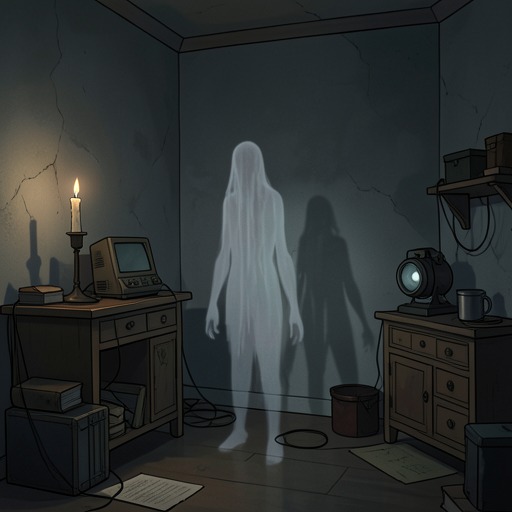
The uncertainty becomes explicit in a later vigil with Milly. Looking toward the door, Maud thinks she sees a partial human face and fingers, the door concealing most of the figure. In the imperfect light, the face resembles a livid mask with chalky eyes. She has often mistaken accidental arrangements of light and shadow for alarming figures, and initially expects this one to dissolve into harmless objects. Instead, she becomes certain that the face is Madame de la Rougierre’s. Maud cries out and shakes the sleeping Milly, but by the time Milly can look, the apparition—or illusion—has disappeared. The scene preserves both possibilities in its own description: Maud’s prior experience supplies a natural explanation, while the certainty of recognition and the figure’s disappearance deny her the reassurance of verification.
Voices, Memory, and Recognition
A different kind of uncertainty attaches to a voice heard near the hearth. Maud has been looking at a print of a girl fleeing wolves, its woods recalling Windmill Wood, and has written an inscription associated with compassion for Silas’s fallen state. She thinks a stern whisper answers with a warning to flee Belisarius’s fangs. Mary Quince denies speaking and appears to think Maud’s mind is unsettled. Maud herself concludes that the voice must be a trick of the imagination, yet says she would recognize its clear, stern quality among a thousand voices. The moment therefore closes without an external witness to the sound: rational self-correction coexists with an enduring confidence in its distinct identity.
The next morning, Maud notices a change in Silas. He remains gentle, kind, and submissive in manner, yet she senses that he now regards her with a half-superstitious repulsion. When she is not looking, his eyes seem grimly fixed on her; when she turns toward him, he looks at the book before him and speaks as though reading aloud from it. Maud wonders whether a dream, voice, or vision has caused this altered relation. The narrative establishes her impression of a mutual, unexplained fear, not the cause of Silas’s behavior. What cannot be resolved as supernatural nonetheless changes the emotional balance between them.
The House as a Field of Uncertainty
The architecture at Bartram-Haugh makes perception difficult without proving that the uncanny is real. Exploring dismal rooms, Maud passes rusty, cobwebbed bird-cages and mildew-stained paneling, then looks across a weed-choked quadrangle through grimy panes as sleet falls outside. A door creaks accidentally; she expects Charke, or the skeleton she had spoken of lightly, to enter. Though her nerves remain fearful, she finds enough courage to continue into one more chamber. There she suddenly sees the bony figure of Madame de la Rougierre. The shock is likened to discovering a scorpion in one’s bed, an image that measures the intensity of Maud’s response rather than establishing the apparition’s nature. The decayed rooms and restricted sightlines make the house an active condition of uncertainty: every doorway can hide a person, a shape, or a mistaken impression.
Across these episodes, the narrative offers recurring checks on perception but no simple guarantee that they settle the matter. The mirror supplies the image of Silas; the obscuring door frames the face Maud recognizes as Madame; darkness makes an ordinary shadow plausible; Mary Quince’s denial gives the voice no second witness. Yet the apparitions do not feel interchangeable with harmless errors, because each enters a setting already charged by human distrust and danger. A fearful impression may be mistaken, but it still shapes what Maud expects and how she reads those around her.
Narrative Effect and Meaning
The uncertainty is created through close attention to Maud’s limits as a witness. She distinguishes what she actually heard from what she cannot recollect, acknowledges her history of mistaking shadows for figures, and tries to test appearances against the room. That self-questioning makes her account more, not less, unsettling: the reader receives both her efforts at rational correction and the persistence of experiences they do not conclusively explain. The narrative does not step outside her perception to identify an apparition as a ghost or reduce every episode to an illusion.
This ambiguity also makes the supernatural vocabulary available to interpret human conduct without turning that interpretation into a fact. Silas appears in a disturbing midnight tableau, and afterward Maud perceives unexplained fear and repulsion in his manner; Madame’s remembered face and later bony figure make her presence seem spectral, though the episode in the chamber presents a figure rather than an independently established ghost. In each case, fear attaches to recognizable people and real interpersonal danger, while the possibility of misperception remains open. The uncanny thus deepens the book’s central tension between appearance and reality: Maud must act within a threatening world while lacking the certainty that would separate what is seen, imagined, and deliberately concealed.