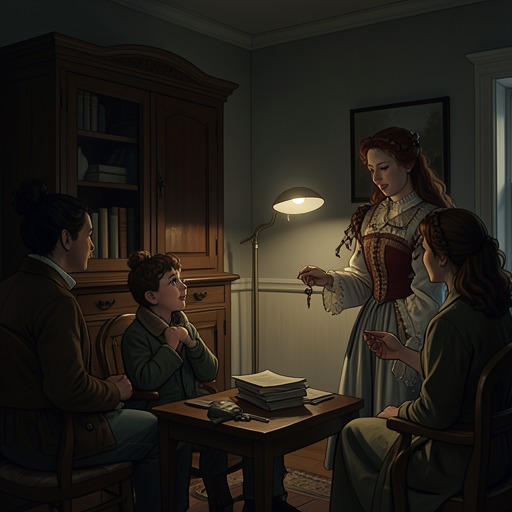
The key to the oak cabinet
Uncle SilasThe key to the oak cabinet is a small, oddly shaped object that Austin Ruthyn places under Maud Ruthyn’s care through a carefully limited instruction. Its practical function is clear—it opens the oak cabinet beside the door—but Austin’s secretive handling makes the key also a test of obedience and a guarded link between Maud, her father, and Doctor Bryerly.
Appearance and Custody
Austin takes a bunch of roughly half a dozen keys from his breast pocket and studies one of them, balancing it between finger and thumb as he hesitates. His deliberation gives the key an importance beyond an ordinary household tool: he considers how to proceed, worries that others may be frightened, and decides that Maud will not suspect what he is doing. He then raises the selected key for her to remember. Its shape is unlike the others, making it visually distinct as well as closely watched.
Austin explains the key’s immediate purpose by tapping it sharply against the oak cabinet. He identifies the cabinet by its position—next to the door on Maud’s left—and checks that she will remember it. The instructions establish both the key’s location and its restricted use, while the decisive contents or further significance of the cabinet remain undisclosed in this episode.
Instructions and Exception
Austin tells Maud that by day the key is kept in its usual place, but at night he puts it under his pillow. The routine places the object under his direct protection and emphasizes that access is controlled at all times. Maud is not simply told where the key is; she is made responsible for remembering it and for preserving the secrecy around it.
He commands Maud to tell nobody what he has said, under pain of his displeasure. He then gives one carefully defined exception: if he is absent and Doctor Bryerly comes to ask for the key, Maud is to understand that this is the person for whom the arrangement has been made. Austin reminds her that Bryerly is the thin gentleman in spectacles and a black wig who had spent three days at the house the previous month, anchoring the exception to a particular visitor rather than leaving it as an abstract contingency.
Later, Austin makes the instruction more explicit: Doctor Bryerly is to be shown both the key and what it opens, and no one else. The distinction matters. The secret is not an invitation for Maud to investigate or disclose the cabinet’s contents generally; it is a narrowly authorized future disclosure to a named person. Maud fears even a small disobedience, and asks how she could find the key if Austin himself is absent. His sudden, wintry smile leaves the practical question unresolved in the available scene, preserving the arrangement’s air of mystery.
Narrative Function and Uncertainty
The key is introduced through pauses, repeated reconsideration, and Austin’s attention moving from the object to Maud and back again. That staging makes the scene less a simple transfer of property than an act of guarded trust. Austin chooses the key, directs Maud’s memory, and restricts who may learn about it; Maud’s role is initially to obey and retain the instruction, not to act independently on the object.
The arrangement also gives the key a future-facing function. Austin anticipates his own absence and connects that possibility to Doctor Bryerly’s return, while withholding from Maud any broader explanation. The object therefore carries a promise of later revelation without itself revealing what lies inside the cabinet. Its significance at this point rests on the precise boundaries around access: Austin possesses it, Maud is charged to remember it, and Bryerly alone is authorized to be shown both key and cabinet.