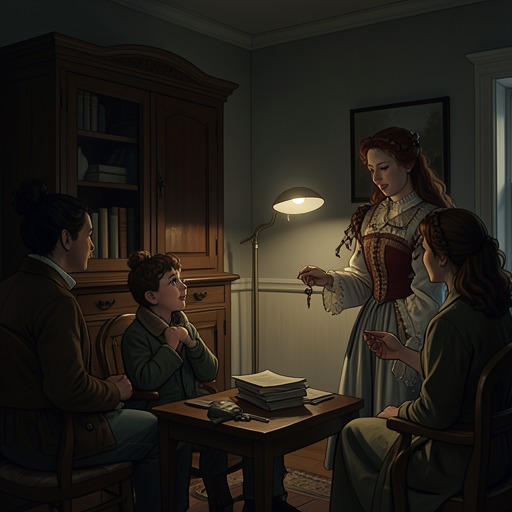
The oak cabinet
Uncle SilasThe oak cabinet is a carved piece of furniture in Austin Ruthyn’s library at Knowl, but its importance lies in the secrecy organized around it. Austin makes Maud remember its position and the unusual key that opens it, then specifies where the key is to be kept and who may ask for it in his absence. The cabinet’s contents are not disclosed in this episode; what the scene establishes is a rule of access, an exception, and the expectation that Maud will preserve both in memory. Later, the novel’s locked rooms and modified windows at Bartram-Haugh give that early lesson in domestic secrecy a darker architectural echo.
The Cabinet and Its Key
Austin leads Maud from the hall into his library, a long, narrow room with two tall windows concealed by dark curtains. The room is dimly lit by one candle. Near the door stands an old-fashioned press or cabinet of carved oak, and Austin stops in front of it. The scene makes the cabinet’s physical placement precise: it is beside the library door, on Maud’s left as she enters. This exactness matters because Austin is teaching her to recognize a particular object and retain its location, rather than merely mentioning a piece of furniture.
Austin draws Maud’s attention to an oddly shaped key, unlike the others she might know. He tells her to remember it, taps it sharply against the cabinet door, and explains that it opens the cabinet. The instruction then becomes a routine of concealment: during the day the key is kept on Austin’s person; at night it lies beneath his pillow. Maud answers that she understands and will remember. The key is therefore presented not as an ordinary household convenience but as a closely guarded instrument whose custody is part of Austin’s private arrangements.
The exchange also defines Maud’s role in relation to the object. Austin makes her responsible for remembering the cabinet and the key, yet does not at this point ask her to use the key or explain what the cabinet contains. Knowledge is divided: she is given the practical details of location and access, while the purpose of the arrangement remains unexplained. The cabinet’s significance rests on this gap between what Maud is taught to remember and what she is told.
An Exception and a Test of Trust
Austin sets out one explicit exception to the usual rule. If he is absent and Doctor Bryerly comes to ask for the key, Maud is to understand that this is a special case. Austin identifies the doctor by recalling his appearance and the three days he spent at Knowl the previous month. The exception links the cabinet not only to Austin’s private authority but also to a second person whom he expects Maud to recognize and whose request would matter under specified circumstances.
The instruction is framed as a test of attention and trust. Austin repeats the need to remember, emphasizes that Maud must not forget the cabinet, and checks that she has understood the contingency. His manner is unsettled: he talks partly to himself, pauses over how best to proceed, and wonders aloud whether she will understand. He also reflects that she is young and a girl, as though doubting her capacity to keep the information. Yet he entrusts her with a rule whose details he takes care to make unmistakable. The contrast between his uncertainty about Maud and his insistence that she remember gives the scene its tension.
The cabinet’s contents remain outside the evidence of this encounter. Its door, key, and carefully described place establish the possibility of protected knowledge without revealing what that knowledge is. As a result, the object works in the narrative through withheld information: the reader learns the conditions governing access before learning any reason for them. The particularity of Austin’s instructions makes the restraint itself conspicuous.
Domestic Architecture and Confinement
The cabinet episode takes place in a room whose curtains and single candle limit what can be seen, but the furniture is not described as supernatural or independently active. Its effect is practical and relational: a locked container, controlled by a key that Austin keeps close, materializes a boundary within the home. Maud is positioned as the future custodian of a secret’s access procedure, even though she is not told what lies beyond the door.
That arrangement finds a broader architectural counterpart when Maud later arrives at Bartram-Haugh. The mansion’s grandeur is already marked by neglect: its white façade is stained and moss-grown, weeds fill the grounds, and storm-felled trees lie in the courtyard. Inside, entire ranges of rooms have their shutters closed and their doors generally locked. High hatches cut across corridors and galleries; some are turned across the passage and locked, interrupting Maud and Milly’s exploration. The house’s restrictions are no longer concentrated in a single cabinet but distributed across routes, rooms, and thresholds.
The contrast becomes sharper when Maud and Milly discover a little-used chamber overlooking a dismal inner quadrangle. Maud recognizes it as the room in which Mr. Charke killed himself, noting that the panelling has been pulled away from the wall. The room’s neglected condition and the barred or interrupted routes elsewhere make the house’s hidden spaces carry a history that ordinary domestic order does not explain away. The cabinet at Knowl is a controlled point of access; at Bartram-Haugh, the same broad pattern of concealment expands into an environment that limits where Maud can go and what she can safely inspect.
The Cabinet Motif at Bartram-Haugh
When Maud is confined to a bedroom at Bartram-Haugh, the mechanisms of restriction become explicit. The room’s windows are crossed by iron bars secured into the oak frames, and the sashes have been screwed shut. Maud notices that the screws and marks in the wood appear new and that the work has been disguised. Here, oak is no longer only the material of a cabinet door: it is part of a window structure altered to prevent escape. The practical details turn the room into a prison and expose deliberate human intervention behind the appearance of an ordinary house.
Maud’s recognition of Bartram-Haugh’s inner court further binds the house’s architecture to secrecy and deception. On looking out from what she has been told is a hotel, she realizes that the enclosed courtyard resembles the mansion’s inner quadrangle. The resemblance reveals that she has been brought back to Bartram-Haugh, not to a safe alternative destination. A structure she had previously glimpsed as an obscure, neglected part of the house becomes a clue to her actual location.
The later escape scene confirms that the house’s boundaries can be manipulated by those who control them. Maud hears a grating sound above her, sees Dudley Ruthyn descend by rope, and watches him open a section of the window with its bars as one mass. The barred opening is thus not an absolute barrier: it is a carefully constructed obstacle that can be altered by someone with the means and knowledge to do so. Set beside Austin’s carefully guarded key, this episode sharpens the novel’s recurring distinction between a barrier’s visible form and the person who controls its operation.
Narrative Significance
The oak cabinet introduces a pattern in which domestic objects and spaces regulate knowledge. Austin’s directions are concrete—one key, one cabinet, one fixed position in the library, and one named exception—while their purpose is left unstated. This imbalance gives the scene a quiet suspense: Maud receives an exact procedure without an explanation of its stakes. The cabinet is significant as a material sign of restricted access, not because the scene discloses what it contains.
Across the later Bartram-Haugh episodes, that pattern broadens from the locked object to the house itself. Closed rooms and locked hatches interrupt exploration; an inner court becomes evidence of a concealed return; screwed and barred windows disclose confinement; and a removable barred section reveals how access can be controlled or secretly reversed. The cabinet’s early lesson—that knowing where a barrier is, and who may approach it, matters—anticipates the novel’s more consequential conflicts over privacy, movement, and control. Its importance is therefore both local and structural: it is a small, carefully guarded object in the first house, and an early expression of the architecture of secrecy that later surrounds Maud.