The portrait of Silas Ruthyn
Uncle SilasThe portrait of Silas Ruthyn is the image through which Maud Ruthyn first gives visible shape to the uncle she has never met. Hung in the oak-room at Knowl, it shows a handsome young man whose elegant appearance invites admiration, while the family’s silences make the painting a focus of forbidden curiosity. For Maud, it becomes more than a likeness: first an enigmatic sign of a concealed history, then a screen onto which she projects the possibility of Silas’s vindication. Its changing meaning prepares the novel’s central tension between a compelling appearance and the uncertain truth behind it.
Appearance and First Encounter
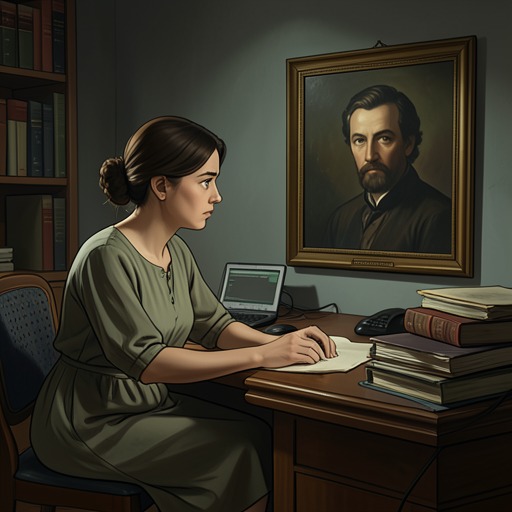
The painting is a full-length portrait of a dark, slender, elegant young man dressed in an obsolete fashion: white leather pantaloons, top-boots, a buff waistcoat, and a chocolate-coloured coat. An Italian greyhound stands beside him, while slender columns and rich drapery furnish the background. The setting and costume suggest luxury, but the face is not merely that of a fashionable figure. Its delicate features combine resolution and ability; the large shadowy eyes have a fire that resists any impression of weakness, and the long hair is brushed back from a face viewers praise as both handsome and clever.
Maud first asks whether the picture is of Uncle Silas. Mrs. Rusk confirms it, but qualifies the image’s hold on the present: it was painted forty years earlier, and forty years change a person. Her cynical good humour places time between the painted young man and the living relative Maud has never seen. The picture offers an arresting likeness, not a guarantee that the person it represents remains the same.
A Family Secret Made Visible
The portrait becomes a centre of speculation because Maud’s father has spoken little of Silas, and then with a pained, thoughtful manner. Rumour has left Maud unsure whether her uncle is unspeakably unfortunate or unspeakably vicious. When she presses Mrs. Rusk to explain her father’s sadness, the adults’ reserve only sharpens her interest. The household will let her ask questions but will not satisfy them; after an injunction is laid upon the housekeeper, neither Mrs. Rusk nor Mary Quince will discuss Silas freely.
That silence gathers around the picture itself. To Maud, the handsome face seems to smile with a provoking significance, as though the portrait possesses a knowledge withheld by the living household. She reflects that curiosity is difficult to resist precisely when knowledge is forbidden: the picture links the pleasure of exploration to the temptation of a family story. Its physical visibility contrasts with the obscurity of Silas’s history. Maud can study every feature, yet cannot initially establish what those features mean.
Monica Knollys and Maud’s Reinterpretation
When Monica Knollys visits, Maud brings up the full-length portrait and asks about Silas. Monica reacts with a sudden, odd look, then says she had just been thinking of him. She calls the face singular and briefly suggests putting the image back in its place. The exchange deepens the portrait’s uncanny quality: it is not simply a family likeness but an object that seems to summon unease and recollection in those who recognize it.
Monica’s account complicates Maud’s idealizing response. She describes Silas as an idol to Maud’s father, yet doubts that he has helped him much; she acknowledges his unusual abilities and misfortune, while cautioning that he is neither hero nor wonder. The next morning, Maud returns to the picture with these fragments of information. Her imagination supplies what Monica’s restrained account does not, and she reads the painted features as evidence of a roué and duellist, a passionate lover, a political dissenter, and a victim of slander. The portrait has not changed; the story Maud can read in it has.
The Image and the Will
Maud’s new interpretation turns the picture into a private emblem of possible redress. In the dark eye she imagines the intensity of Silas’s ill-starred passion; in the fine lip, the courage of a man willing to defend the Ruthyn honour by combat; in the nostril’s half-sarcastic line, defiance of the county’s landed oligarchy. She also reads patience and cold disdain in the face. From these details she constructs a figure at once prodigal, hero, and martyr, and feels indignation, pity, and hope. Her reading is emotionally powerful, but it remains an imaginative interpretation of a painted face, not independent proof of the history she hopes to uncover.
That distinction matters when Austin Ruthyn’s will is read. The legal document places the estates in trust for Maud, gives Silas a bequest of £15,000 and the use of Bartram-Haugh for life at a nominal annual rent of five shillings, and appoints him Maud’s sole guardian until she turns twenty-one. The trustees are also directed to pay him £2,000 each year for her maintenance, education, and expenses. The arrangement gives Silas authority over Maud’s person while her inheritance remains subject to the trust; if she dies before coming of age, the entire property goes to him. The portrait has encouraged Maud to anticipate a chance to help vindicate her uncle, while the will makes his reputation inseparable from her guardianship and the material stakes of her survival.
Trust, Appearance, and Narrative Significance
Austin’s explanation of the guardianship reveals how deliberately the family has made Silas’s character a matter of judgment. In letters to the trustees, Austin calls his brother oppressed and unhappy, rejects the slander against him as politically motivated, and presents the guardianship as an ordeal of purification: entrusting Maud to Silas is meant to demonstrate that the brother who knew him best has implicit confidence in him. The portrait’s heroic effect therefore echoes a real familial act of trust, but it cannot settle the question that the will dramatizes. A striking likeness, a brother’s defence, and the legal transfer of guardianship are different kinds of evidence, each with different consequences.
The painting’s narrative importance comes from this gap between what can be seen and what can be known. At first, the young face appears to offer Maud a way through the household’s silence; later, it gives visible form to her hope that Silas is a wronged man worthy of vindication. Yet the will turns that hope into a perilous obligation, binding her to the uncle she has imagined and making his conduct consequential for her freedom and inheritance. The portrait remains fixed in its youthful elegance while Maud’s interpretation shifts from curiosity to admiration and moral commitment. It is at once a family object, a focus for suppressed knowledge, and an image through which the novel tests whether appearance and inherited trust can withstand the evidence of action.