turquoise ring
Uncle SilasThe turquoise ring is a small keepsake Milly gives Maud after a quarrel, but its importance is larger than its modest appearance: Maud wears it from the moment she accepts Milly’s apology, and later remembers it as a permanent token of their repaired bond. Set against the costly jewels beside which it seems almost unworthy, the ring makes affection visible through an object whose value lies in the relationship it records.
Appearance and Provenance
The ring enters the narrative as an answer to a question about Maud’s unusual jewelry. Looking back, Maud explains that it appears valueless to an uninformed observer and an unworthy companion to the jewels that flash beside it. Its plainness is central to the contrast: the ring does not impress by material display, yet it is the keepsake she singles out as emotionally lasting.
Its provenance is personal and specific. Milly gives it to Maud during an appeal for forgiveness, along with a Banbury cake and some taffy. She presents it as less pretty than Maud’s other rings and asks that Maud wear it for her sake. The offering is not a purchase or a formal gift; it is part of Milly’s attempt to repair a relationship she fears she has damaged.
The Apology and the Test of Friendship
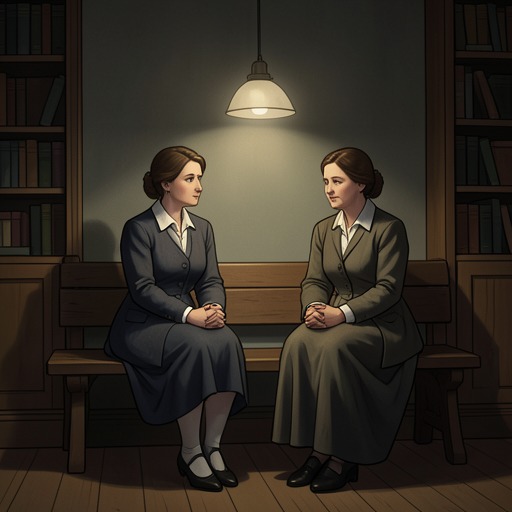
The gift follows a quarrel in which Maud calls after Milly and pursues her through the galleries, only to lose her. Later, Milly comes to Maud’s room in tears. She apologizes for having behaved cruelly, calls herself a brute, and fears Maud will never like her again. The ring gives her a concrete way to ask whether the apology has been accepted: she says she will look at breakfast to see whether Maud is wearing it, and will take its absence as a sign that she should trouble Maud no more.
Milly’s appeal is at once affectionate and alarming. She threatens to drown herself if Maud does not forgive her, then leaves quickly, barefoot and dressed only in a petticoat over her shoulders. Maud is left half-awake with the candle and the offerings beside her. Afraid of goblins, she does not follow Milly; instead, she kisses the ring and puts it on. The gesture answers Milly’s test before either of them can speak again, while Maud’s later reflection admits that she reproached herself for her own cool, provoking manner and judged herself more to blame than Milly.
Recognition and Reconciliation
At breakfast, the test is quietly fulfilled. Across the table, Milly sees the ring on Maud’s finger and reacts with a breathless exclamation, round eyes, and tears. She is sitting with Maud in the presence of Uncle Silas, whose silent, apathetic watch makes the large dining table an uncomfortable place for conversation. When Milly raises her voice, he winces, presses his thin white fingers to his ear, and turns away with a piteous smile. Against this restrained and uneasy setting, the small sign between the cousins carries the emotional exchange they cannot freely make aloud.
When they later find an opportunity, Milly embraces Maud with such force that she sways her from side to side, buries her face in Maud’s dress, and sobs that she had been lonely before Maud came. She promises never to call Maud by another name, but only by her own. Maud, crying and hugging her in return, tells Milly she may call her Mrs. Bustle or anything she likes. The reconciliation does not erase their teasing familiarity; it restores it on warmer terms. Maud concludes that they became better friends than before.
A Keepsake That Outlasts the Scene
Maud’s retrospective account gives the ring a duration the quarrel itself does not have: she says it has remained on her finger ever since and always will. That lasting wear transforms the little gift from a temporary token into a continuing record of the moment when she accepted Milly’s remorse and recognized her own share of the hurt. Its significance depends not on beauty or price, but on the action attached to it: Maud puts it on, Milly sees it, and their friendship is restored.
The ring also preserves an early sense of responsibility. Before the gift is exchanged, Maud has begun to feel responsible for Milly, and she later blames herself for provoking her. Its meaning therefore holds more than forgiveness in a narrow sense: it marks a bond shaped by loneliness, care, mutual vulnerability, and the willingness to repair a breach. The contrast between its apparent worthlessness and its permanent place among Maud’s jewels makes the object a compact emblem of the difference between display and personal value.