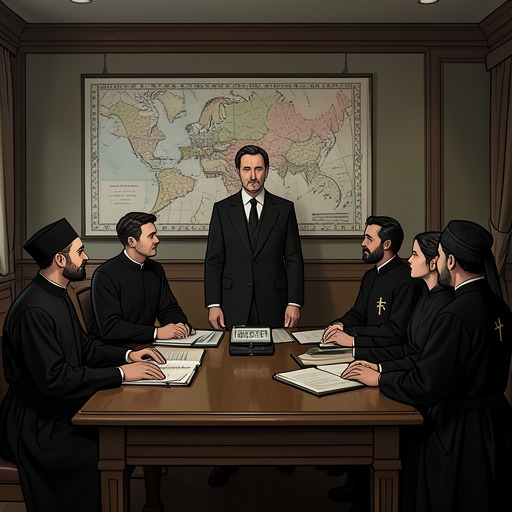
Act in Restraint of Appeals
Wolf HallThe Act in Restraint of Appeals is the measure that bars appeals to the Pope and brings the king’s marital case into English jurisdiction. It turns the claim that England is an empire, governed by its own king and laws, into a legal mechanism: Katherine’s appeal to Rome can no longer determine the case, while Archbishop Thomas Cranmer can decide it in English courts. Its force rests not only on the rule it states but on the struggle over which legal authority has the right to state and enforce rules in England.
Background and purpose
The measure emerges amid a conflict between royal authority and the Church’s jurisdiction. Earlier proceedings against Thomas Wolsey had invoked praemunire, a law against maintaining a foreign jurisdiction within the king’s realm. Its meaning, the narration observes, had become uncertain enough that it seemed to mean whatever the king said it meant. The law therefore supplies a precedent for the Crown’s challenge to the clergy, while exposing how established legal language can be redirected toward new political ends.
By early 1532, Parliament is considering measures to reduce the revenues sent to Rome and to make Henry’s supremacy over the Church more than a formula. A Commons petition challenges the authority and even the existence of the church courts. Thomas Cromwell works through its drafts with Rafe Sadler and Thomas Wriothesley, amending the text as opposition gathers. The Act in Restraint of Appeals belongs to this broader legislative campaign: the dispute is not simply about one marriage, but about whether an external religious court may exercise jurisdiction inside England.
The law’s effect on the king’s case
The Act’s immediate significance is its effect on Katherine’s suit. When Cromwell explains the proposed settlement to her, he presents the king’s position as a definition of authority already supported by precedent; Katherine counters that those precedents have only recently been invented. Their exchange reveals the measure’s contested foundation. The same act that Cromwell describes as clarifying an existing royal right appears to Katherine as part of a concerted effort to displace the Church’s authority.
Following the secret marriage of Henry and Anne Boleyn on 25 January 1533, Cromwell discusses the legislation with Cranmer. He explains that after Easter it will be against the law and the king’s prerogative to appeal to the Pope in any matter. The consequence for Katherine’s case is decisive: her suit is, in Cromwell’s phrase, dead and buried, and Cranmer will be able to judge the king’s cause in English courts. The new marriage and the law thus move together: the act provides a domestic legal forum for a dispute whose outcome bears directly on the standing of the king’s existing marriage.
Jurisdiction disputed
The debate is not resolved by the enactment of a rule, because its parties reject one another’s account of legitimate authority. At Ampthill, Katherine refuses to attend the proceedings at Dunstable, insisting that her case remains at Rome and that Pope Clement has not knowingly authorized Cranmer’s role. Cromwell urges her not to close off the possibility of reconciliation; she answers that the king is a schismatic and warns that excommunication would place him outside the Church. Their disagreement exposes the human and political stakes behind the legal division: for Katherine, the English proceeding cannot substitute for the authority she recognizes; for Cromwell, accepting the English forum may preserve a path back to the king’s favour.
The novel later sets the same conflict against a theory of secular government drawn from Marsiglio of Padua. Cromwell argues to Henry VIII that Christ did not establish papal rule over princes and that civil authority derives through a legislative body acting for the people. In this account, Parliament can legislate on matters of temporal jurisdiction, including the king’s authority within England. The argument gives the statute an intellectual frame, but it also makes clear that the assertion of national jurisdiction is a claim being advanced and defended, not a neutral settlement accepted by all parties.
Thomas More’s distinction, reported by Richard Riche, marks the boundary the statute cannot erase by itself. More accepts that Parliament may make a king in a temporal matter, but says that spiritual jurisdiction is beyond Parliament because it lies outside the realm. Cromwell sees the implication as a denial of Parliament’s capacity and, through it, of the king’s title; More’s reasoning instead preserves a separate jurisdiction beyond the statute’s reach. The contrast shows why control of appeals matters: the law reallocates the forum for judgment, while leaving the underlying disagreement about the source and limits of authority alive.
From declaration to enforcement
The statute’s language is connected to a broader act of political construction. While drafting, Cromwell writes that England is an empire governed by one supreme head and king. The declaration and the restriction on appeals reinforce one another: if England is an independent realm, a final appeal to Rome challenges that independence; if appeals are barred, the Crown can make its claim to domestic jurisdiction effective in practice.
Yet a statute’s words do not enforce themselves. Cromwell reflects that laws must be made to produce consequences in the world and must be enforceable across the kingdom. Elsewhere, he describes words as working like spells only when people believe in them. The Act is therefore significant both as a legal barrier to Roman appeals and as part of the effort to make royal authority legible and operative through English institutions. Its achievement is substantial but contested: it gives the king’s courts jurisdiction over the case, without reconciling the competing religious and legal principles that made the question so consequential.